
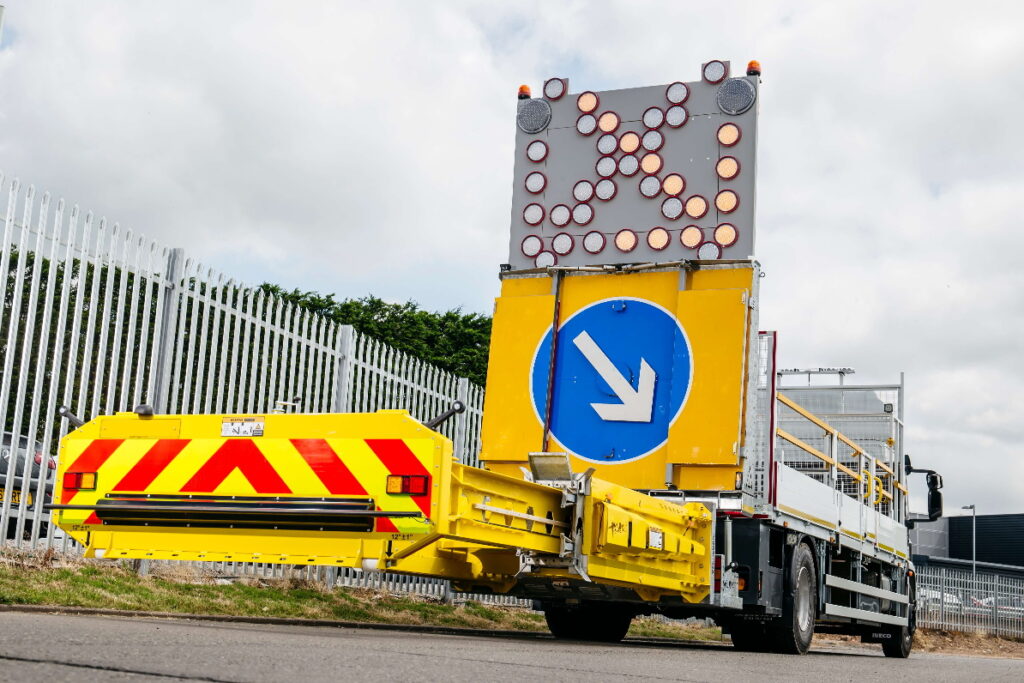
In a work zone, the contractor or employer responsible for the work zone operation legally owns the responsibility for correct truck mounted attenuator positioning. This accountability typically falls on the traffic control supervisor or site manager designated by the contractor, not the TMA driver alone. The sections below unpack what that means in practice, from operator qualifications to what goes wrong when positioning fails.
Who legally owns TMA positioning responsibility in a work zone?
Legal responsibility for correct TMA positioning rests with the contractor managing the work zone, specifically the qualified traffic control supervisor overseeing the operation. While the TMA operator physically positions the vehicle, the contractor’s site management carries the duty of care to ensure deployment follows the approved traffic management plan and applicable standards such as MASH 2016 or NCHRP-350 TL-3.
In practice, this responsibility is layered. The contractor is accountable for producing a compliant traffic management plan, assigning qualified personnel, and verifying that the TMA is positioned correctly before work begins. The traffic control supervisor on site is accountable for confirming that the plan is followed in real time. The TMA operator is accountable for executing the positioning accurately and flagging any site conditions that make the approved plan unsafe to follow.
When an incident occurs and positioning is found to be incorrect, investigators typically examine all three levels. A contractor who assigned an unqualified operator, approved a flawed plan, or failed to supervise the deployment can face significant legal and financial exposure regardless of who was physically behind the wheel.
What qualifications does a TMA operator need before positioning the vehicle?
A TMA operator must hold a valid commercial or appropriate vehicle license for the host truck, complete work zone traffic control training relevant to their jurisdiction, and receive site-specific briefing on the approved traffic management plan before positioning the vehicle. In many markets, this includes formal certification such as a Temporary Traffic Control (TTC) qualification or equivalent national standard.
Beyond licensing, operators need practical competency in several areas:
- Reading and interpreting traffic management plans accurately
- Understanding taper lengths, buffer zones, and shadow vehicle positioning
- Operating the TMA’s onboard systems, including arrow boards and warning lights
- Communicating with the traffic control supervisor during deployment and recovery
- Recognizing when site conditions deviate from the approved plan and escalating appropriately
Contractors should document operator qualifications before assigning them to TMA duties. An unqualified operator who positions a TMA incorrectly creates liability for both the individual and the organization.
How is the correct TMA position determined on site?
The correct TMA position is determined by the approved traffic management plan, which specifies the vehicle’s placement relative to the work area, lane configuration, posted speed, and required buffer distances. The site supervisor confirms that real-world conditions match the plan before the operator locks in position.
Several factors directly influence where the TMA must sit:
- Posted or operating speed: Higher speeds require longer upstream buffer zones between the TMA and the nearest worker or equipment
- Lane width and road geometry: Curves, narrowing lanes, or uneven surfaces affect safe vehicle placement
- Work activity type: Stationary operations require different positioning than moving operations where the TMA shadows a paving or line-marking machine
- Visibility conditions: Low light, fog, or horizontal curves may require the TMA to be positioned further upstream than the minimum standard
When site conditions differ from what the plan anticipated, the supervisor must either adjust the plan formally or halt work until a safe position can be confirmed. Operators should never improvise positioning without supervisor approval.
What happens when a TMA is positioned incorrectly?
Incorrect TMA positioning exposes road workers to unprotected impact risk, increases the severity of errant vehicle crashes, and creates legal liability for the contractor, supervisor, and operator involved. A TMA that sits too far into the travel lane, too close to workers, or at the wrong angle fails to perform its protective function when a vehicle strikes it.
The consequences fall into three categories:
- Safety consequences: Workers in the shadow zone lose the protective buffer the TMA is designed to provide. An impact at the wrong angle can redirect a vehicle into the work area rather than away from it.
- Regulatory consequences: Inspectors and enforcement bodies can issue stop-work orders, fines, or contract penalties when positioning does not comply with the approved plan or the applicable standard.
- Legal consequences: If a worker or road user is injured and positioning is found to be non-compliant, the contractor faces civil liability. Documentation of the positioning decision and who approved it becomes central to any investigation.
Correct positioning is not a formality. It is the mechanism by which a TMA actually delivers the protection it is certified to provide.
Does the TMA manufacturer’s guidance affect on-site positioning decisions?
Yes, manufacturer guidance directly affects on-site positioning because it defines the operational parameters within which the TMA performs as tested and certified. Deploying a TMA outside those parameters, such as on a grade steeper than the manufacturer specifies or at a speed higher than the system’s test level, means the device may not perform as its certification assumes.
Manufacturer documentation typically covers:
- Maximum and minimum operating speeds for the system
- Approved host vehicle weight ranges
- Grade and surface limitations
- Mounting and connection requirements that affect crash performance
- Arrow board and lighting activation requirements during deployment
Traffic management planners and site supervisors should review manufacturer documentation alongside the applicable standard when writing or approving a traffic management plan. If the plan calls for conditions outside the manufacturer’s guidance, the TMA model may not be the right choice for that application.
How Verdegro Supports Correct TMA Deployment
We design and manufacture truck mounted attenuator systems built to MASH 2016 and NCHRP-350 TL-3 standards, and we provide the technical documentation you need to make informed positioning and deployment decisions. Our range includes the TMA-US 100K, TTMA-US 100K, LTMA-US 70K, and BLADE TMA, each with clearly defined operational parameters.
When you work with us, you get more than hardware. We support your team with:
- Detailed technical specifications covering host vehicle requirements, grade limits, and approved operating speeds for each model
- Optional integrated systems including LED arrow boards, full-color VMS displays, and hydraulic LED-lift masts that support compliant, visible deployments
- Guidance on matching the right TMA model to your specific work zone conditions and applicable national standard
- Access to our Mobilityplanner platform for real-time GPS tracking and status monitoring of deployed units
If you are selecting a TMA for an upcoming project or need clarification on which model fits your site conditions and compliance requirements, contact our team and we will help you find the right solution.