
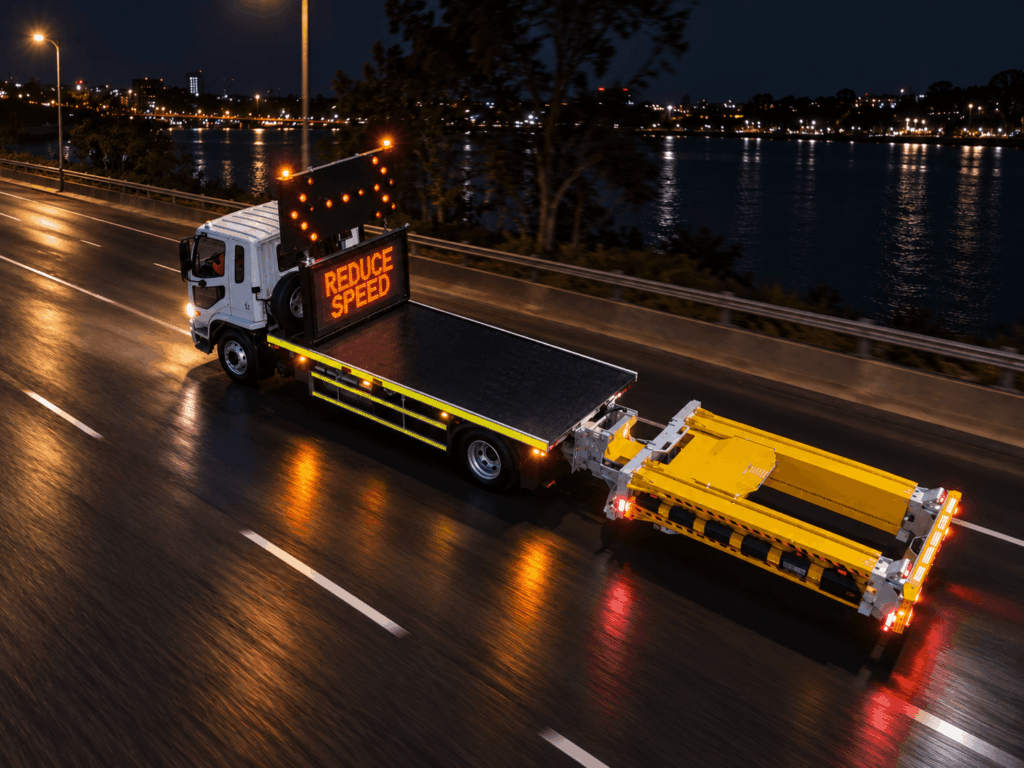
A mobile work zone needs a crash protection vehicle when workers are exposed to live traffic lanes and there is a meaningful risk of an errant vehicle entering the work area. In most cases, this means deploying a truck mounted attenuator, a purpose-built crash cushion fitted to the rear of a shadow vehicle that absorbs impact energy and protects workers behind it. The exact trigger depends on posted speed, lane configuration, work duration, and the applicable national or regional standard. The sections below answer the most common questions contractors and project managers face when deciding whether a truck attenuator is required.
What qualifies as a crash protection vehicle in a work zone?
A crash protection vehicle in a work zone is a truck or van fitted with a Truck Mounted Attenuator (TMA), a rear-mounted crash cushion designed to absorb the kinetic energy of an errant vehicle before it reaches workers. The vehicle positions itself between live traffic and the work crew, acting as a moveable barrier that travels with the operation or holds a fixed shadow position.
To qualify as a crash protection vehicle, the unit must meet two conditions. First, the host vehicle must fall within the weight class specified by the attenuator manufacturer and the applicable crash test standard. Second, the TMA itself must carry a valid crash test certification for the speed environment where it will be deployed. A vehicle with an uncertified cushion, or a cushion fitted to a truck outside its approved weight range, does not qualify as a crash protection vehicle under any recognized standard.
Beyond the attenuator, a qualifying shadow vehicle typically carries warning lights, an arrow board or Variable Message Sign, and in many jurisdictions must display retroreflective markings. The combination of the certified TMA and the correctly equipped host vehicle together constitute what standards and specifications call a shadow vehicle or protection vehicle.
At what traffic speed is a crash protection vehicle required?
A crash protection vehicle is generally required when the posted or operating speed on the road adjacent to the work zone reaches 50 mph (80 km/h) or above. Below that threshold, some standards permit alternative measures such as traffic control devices, barriers, or reduced-speed orders. Above it, the kinetic energy of an errant vehicle becomes high enough that a TMA is the recognized method of absorbing impact before workers are struck.
Speed thresholds vary by country and by the specific standard governing the project. In the United States, MASH 2016 defines Test Level 3 (TL-3) at 100 km/h (62 mph), which is the benchmark for highway work zone TMAs. In the United Kingdom, the TD49/07 optional 110K test addresses higher-speed motorway environments. Many European national standards align with EN 1317 and set their own speed-based trigger points, so always verify the requirement against the specification document for your contract.
It is also worth noting that posted speed alone is not always the deciding factor. Some standards require a TMA whenever workers are within a certain distance of a live lane, regardless of speed. Others trigger the requirement based on whether the work is stationary or moving. Speed is the most common threshold, but it works alongside other criteria covered in the next section.
Which types of work zone operations require a shadow vehicle?
Shadow vehicles with truck mounted attenuators are required for stationary, slow-moving, and mobile work zone operations where workers are exposed to traffic lanes without a positive barrier between them and live vehicles. The operation type determines both whether a TMA is required and how the vehicle is positioned.
- Stationary operations: Resurfacing, line marking, bridge inspection, drainage work, and other tasks where the crew holds a fixed position for an extended period. A shadow vehicle parks between traffic and the work crew and remains in place throughout the shift.
- Slow-moving operations: Milling, paving, and similar activities where equipment moves at very low speeds along the carriageway. The TMA vehicle moves with the operation, maintaining its protective position behind the crew at all times.
- Mobile operations: Litter collection, road marking, inspection runs, and other tasks where vehicles travel at or near traffic speed. Here the TMA vehicle follows directly behind, providing continuous protection as the convoy moves.
- Incident management: When emergency or maintenance crews respond to a live-lane incident on a high-speed road, a shadow vehicle is deployed to protect responders until the scene is cleared.
Short-duration tasks, those lasting less than a defined period, often 15 to 30 minutes depending on the standard, may qualify for a reduced protection setup, but this exemption disappears once the work extends beyond that window or the speed environment exceeds the relevant threshold.
What are the MASH and EN standards for crash protection vehicles?
The two primary standards governing crash protection vehicles are MASH 2016 (Manual for Assessing Safety Hardware, published by AASHTO and FHWA) and EN 1317 (the European standard for road restraint systems). Both define test levels, impact conditions, and performance criteria that a TMA must satisfy before it can be used in a qualifying work zone.
MASH 2016
MASH 2016 replaced the earlier NCHRP 350 standard and is now the accepted benchmark in the United States and many international markets. For TMAs, Test Level 3 (TL-3) is the relevant classification, covering impacts at 100 km/h (62 mph). Tests 3-50 through 3-53 are mandatory; test 3-54 is optional and addresses a perpendicular impact scenario. A TMA that carries MASH 2016 TL-3 acceptance has demonstrated it can absorb a high-speed impact without causing unacceptable occupant risk or excessive debris scatter.
EN 1317 and national standards
In Europe, EN 1317 provides the framework, but individual countries add their own supplementary requirements. The UK’s TD49/07 includes an optional 110K test for motorway-speed environments. Contractors working across multiple European markets need to verify which national annex or supplementary test applies to their specific project, as a TMA approved under one country’s specification may require additional certification in another.
The practical takeaway: always check that your TMA holds a current, valid acceptance letter or certificate for the specific standard named in your contract documents. An older NCHRP 350 certificate does not satisfy a MASH 2016 requirement, and vice versa.
Who is responsible for deciding if a TMA is needed on a project?
Responsibility for the TMA decision sits with the project designer or traffic management designer at the planning stage, and with the principal contractor during execution. In practice, both parties share accountability: the designer specifies the protection requirements in the traffic management plan, and the contractor must implement those requirements and flag any site conditions that change the risk picture.
On publicly funded road projects, the client authority, a national highway agency, municipal transport department, or similar body, typically sets the minimum standard through its specification documents. These documents define which crash test level applies, which standards are accepted, and whether the contractor has any discretion in choosing protection measures. The contractor cannot substitute a lower level of protection without formal approval from the client.
On privately funded or contractor-led projects, the designer of the traffic management scheme carries the primary duty to assess risk and specify appropriate protection. This assessment should consider posted speed, proximity of workers to live lanes, work duration, and any site-specific hazards. Where there is genuine uncertainty about whether a TMA is required, the safer and legally defensible position is to deploy one.
What happens if a work zone operates without required crash protection?
Operating a work zone without required crash protection exposes both the contractor and the client to legal liability, regulatory penalties, and, most seriously, preventable worker fatalities. When an errant vehicle strikes an unprotected work crew, the consequences are severe and the absence of a specified TMA becomes a central issue in any investigation or prosecution.
From a regulatory standpoint, most jurisdictions treat the failure to implement a required traffic management measure as a breach of occupational health and safety law. Fines, project shutdowns, and in serious cases criminal charges against responsible individuals are all possible outcomes. Insurers may also decline to cover claims arising from an incident where the specified protection was not in place, leaving the contractor to bear costs directly.
Beyond the legal exposure, the operational impact is significant. A serious incident triggers investigation, halts work, and can result in the suspension of the contractor’s ability to bid on future public contracts. The reputational damage from a preventable worker injury is difficult to recover from in a sector where trust and safety record are key procurement criteria.
The cost of deploying a certified TMA is small relative to these risks. If there is any ambiguity about whether protection is required, the right decision is to deploy it and document the reasoning.
How We Help You Choose and Deploy the Right TMA
At Verdegro, we design and manufacture truck mounted attenuators that cover a wide range of work zone environments, from compact van-based operations to full highway shadow vehicle setups. Here is what we offer:
- Armadillo TMA: Our newest truck attenuator, introduced in 2026 and fully certified to MASH 2016 TL-3. It deploys in under 20 seconds at 80 km/h, operates without sensors or electronic feedback systems, and fits trucks between 7,228 kg and 12,475 kg. Its single-cushion design keeps maintenance simple and minimizes downtime.
- VanGuard TMA: The world’s first TMA designed specifically for closed vans, available in rear-mounted, top-mounted, and swing-mounted variants. It withstands impacts up to 80 km/h (50 mph) and keeps rear door access available on the top and swing versions, useful when the van carries additional equipment.
- Mobitrack integration: Both systems can be fitted with our Mobitrack tracking module, which provides real-time GPS location, status data, and automatic integration with safety alert platforms including Waze, Google, and Flitsmeister, so approaching drivers receive a warning before they reach your work zone.
- Certifications: Our TMAs carry MASH 2016 TL-3 acceptance letters, CE marking, and EMC compliance. The Armadillo also holds the optional MASH test 3-54 certification and is approved under the UK TD49/07 110K test.
If you are planning a project and need guidance on which TMA fits your speed environment, truck weight class, and contract specification, contact our team and we will help you match the right system to your requirements.
Related Articles
- Why is Verdegro's impact protection system called VanGuard?
- Who typically buys truck mounted attenuators?
- What is an LED-lift accessory on a truck mounted attenuator?
- What speed rating do truck mounted attenuators have?
- Is NCHRP-350 still valid or has it been replaced by MASH for truck mounted attenuators?