
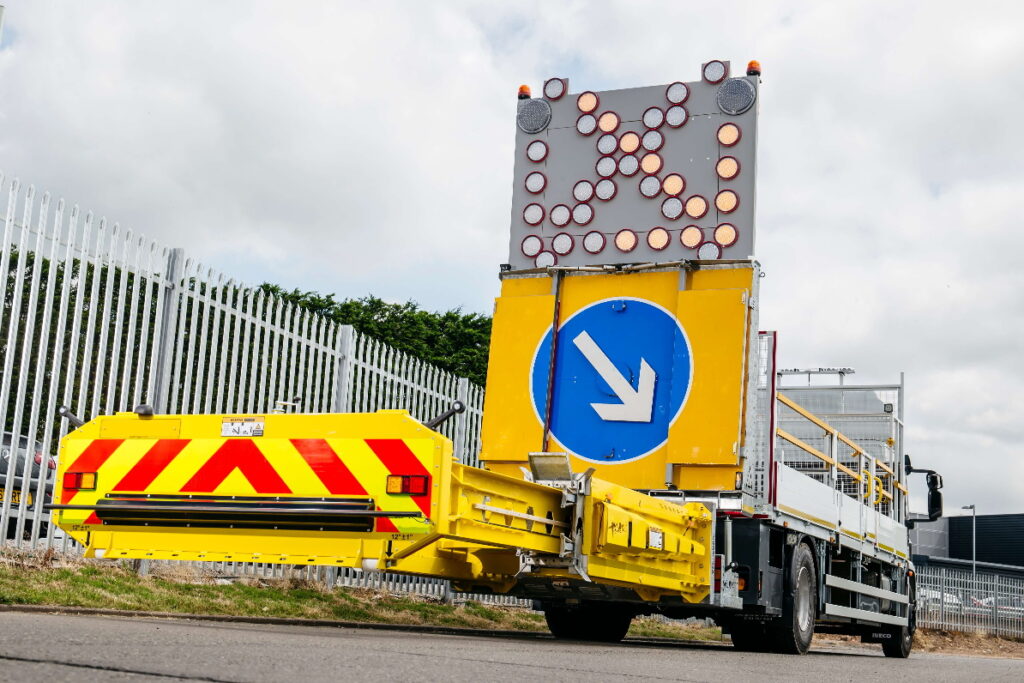
No, truck mounted attenuators are not all built the same way. They differ significantly in design, weight class, crash test rating, and intended deployment scenario. The right choice depends on your work zone type, vehicle configuration, and the safety standards required in your region or project specifications. Below, we break down the most important differences to help you make an informed decision.
What are the main types of truck mounted attenuators?
Truck mounted attenuators fall into several categories based on how they attach to a host vehicle and how they absorb impact energy. The most common types are standard TMAs, towable TMAs (TTMAs), and lightweight TMAs (LTMAs). Each type suits different vehicle weights, deployment speeds, and work zone configurations.
A standard TMA mounts directly to the rear of a work truck and is designed for high-speed highway environments. It absorbs collision energy through a controlled collapse mechanism, protecting both the road crew ahead and the occupants of the impacting vehicle.
A towable TMA (TTMA) is pulled behind a host vehicle rather than fixed to it. This setup separates the crash cushion from the truck itself, which can reduce damage to the host vehicle during an impact and simplifies replacement of the attenuator unit after a strike.
A lightweight TMA (LTMA) is engineered for smaller host vehicles, typically those in the 70,000 lb gross vehicle weight range. These systems allow contractors to deploy crash protection without needing a full-size heavy truck, making them practical for urban work zones or situations where vehicle size is restricted.
What safety standards do truck mounted attenuators have to meet?
Truck mounted attenuators must meet crash test standards that verify their performance under controlled impact conditions. In the United States, the two primary standards are NCHRP 350 and MASH 2016 (Manual for Assessing Safety Hardware). MASH 2016 is the current standard required for new product approvals by the FHWA, replacing the older NCHRP 350 criteria.
MASH 2016 uses updated vehicle weights and impact conditions that better reflect modern traffic. Products tested to MASH 2016 carry FHWA acceptance letters confirming they meet federal requirements. For work zones on federally funded roads in the US, specifying MASH-compliant equipment is not optional, it is a contractual requirement on most projects.
Outside the United States, equivalent standards exist in Europe and other regions, though the specific criteria vary. When procuring TMAs for international projects, always confirm which standard applies in the target country and verify that the product holds the relevant acceptance documentation.
How does TMA design affect crash performance?
TMA design directly determines how effectively the system absorbs and redirects crash energy during an impact. Key design factors include the energy absorption mechanism, the attachment method, and the weight class compatibility with the host vehicle. A poorly matched system can fail to perform within tested parameters, increasing injury risk for both the errant driver and road workers.
The energy absorption mechanism, whether hydraulic, foam cartridge, or a collapsible aluminum structure, governs how quickly the system decelerates an impacting vehicle. A system that decelerates too abruptly increases occupant injury risk; one that is too soft may not stop the vehicle before it reaches workers. Crash testing under MASH or NCHRP 350 verifies that the deceleration curve stays within acceptable limits.
Attachment design also matters. A TMA that is rigidly fixed to the truck transfers more impact force to the host vehicle than a system with a controlled release or towable configuration. For operations where the shadow truck is likely to sustain repeated impacts, a design that minimizes force transfer protects both the vehicle and its operator.
What’s the difference between a shadow vehicle TMA and a truck-mounted system?
The terms are often used interchangeably, but there is a practical distinction. A shadow vehicle is the host truck that positions itself between traffic and the work zone, providing a physical barrier. A truck mounted attenuator is the crash cushion device attached to the rear of that shadow vehicle. Together, they form the protection system, the shadow vehicle provides mass and positioning, while the TMA manages the crash energy.
When people refer to a “shadow vehicle TMA,” they typically mean the complete system: the truck plus the attenuator. A standalone truck without an approved TMA does not meet work zone safety requirements on most regulated road projects, because the truck alone cannot reliably control deceleration forces in a rear-end collision.
The distinction matters when specifying equipment. You need to confirm that the TMA model is tested and accepted for use with the specific weight class of your host vehicle. Using a TMA rated for a heavier truck on a lighter vehicle, or vice versa, takes the system outside its tested configuration and invalidates its crash performance certification.
Which truck mounted attenuator is right for a specific work zone?
The right TMA for a work zone depends on four factors: posted speed limit, host vehicle weight, required crash test standard, and additional equipment needs such as arrow boards or variable message signs. Matching all four to your project conditions ensures the system performs as tested and keeps your crew compliant.
- High-speed highway work zones typically require a TMA tested to Test Level 3 (TL-3), covering impact speeds up to 100 km/h (62 mph). MASH TL-3 compliance is standard for most federally funded US highway projects in 2026.
- Urban or lower-speed work zones may allow a lighter system, such as an LTMA, which suits smaller host vehicles operating on city streets or secondary roads.
- Long-duration projects benefit from towable TTMAs, which are easier to replace after an impact without taking the host truck out of service.
- Projects requiring integrated signage should consider TMAs with mounting options for LED arrow boards, full-color VMS displays, or hydraulic lift masts, all of which can be combined in a single unit.
Always check the project specification documents and the applicable state or national standard before selecting a TMA. The acceptance letter or test report for the product should confirm it was tested on a host vehicle within the weight range of the truck you plan to use.
How Verdegro Helps You Choose the Right TMA
We manufacture a range of truck mounted attenuator systems designed to cover the full spectrum of work zone requirements. Our TMA lineup includes options for different host vehicle weights and deployment scenarios:
- TMA-US 100K – a standard truck mounted attenuator tested and accepted to MASH 2016 TL-3, suitable for heavy host vehicles on high-speed highways
- TTMA-US 100K – a towable configuration that reduces force transfer to the host vehicle and simplifies post-impact replacement
- LTMA-US 70K – a lightweight system for smaller host vehicles, tested to NCHRP 350 TL-3, practical for urban and secondary road deployments
- BLADE TMA – a compact, versatile attenuator tested to international crash safety standards
All our systems are available with optional accessories including LED arrow boards, full-color VMS displays, and hydraulic LED lift masts, so you can configure a complete shadow vehicle setup from a single supplier. We hold multiple FHWA acceptance letters under MASH 2016, giving you the documentation you need for federally funded project compliance.
If you are not sure which system fits your vehicle configuration or project specification, contact us directly and we will help you identify the right solution for your work zone.
Related Articles
- How does vehicle type affect the choice of crash attenuator?
- Are truck mounted attenuators mandatory on highways?
- What should you look for when getting a truck mounted attenuator quote?
- Do you need a special license to tow a trailer truck mounted attenuator?
- Does a heavier truck mounted attenuator offer better protection?