
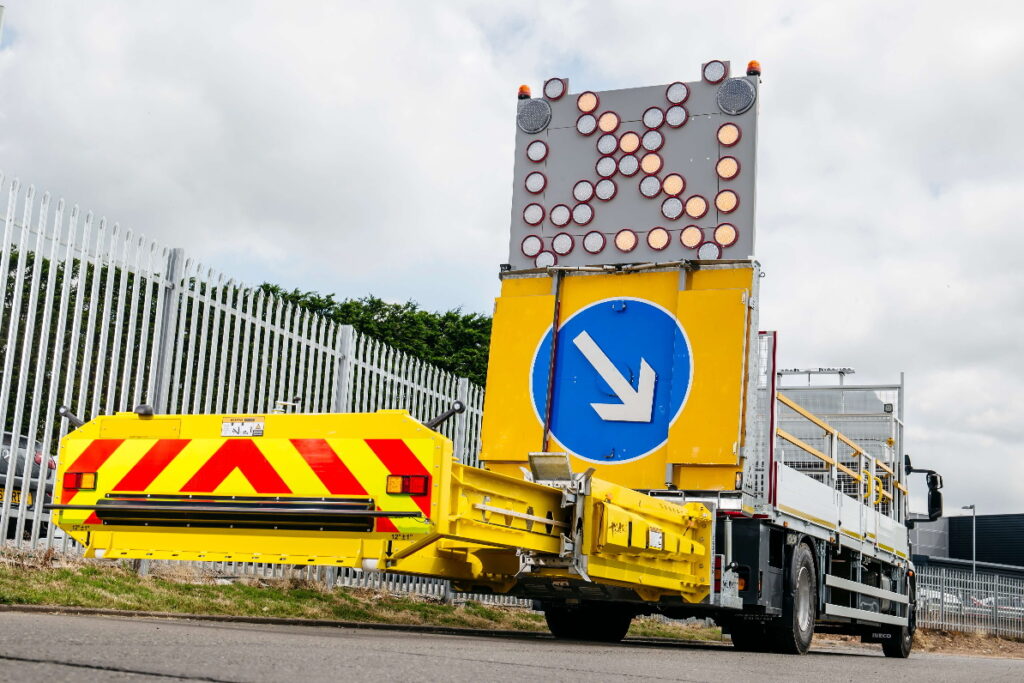
In most countries, truck-mounted attenuators are legally required on highways and high-speed roads whenever a work vehicle is positioned in or adjacent to live traffic lanes. The specific rules vary by country and road type, but the underlying principle is consistent: any slow-moving or stationary work truck exposed to fast-moving traffic must carry rear-mounted crash protection. Below, we answer the most common questions contractors and traffic managers ask about TMA requirements.
Where are truck-mounted attenuators legally required?
Truck-mounted attenuators are legally required in work zones on highways, motorways, and other high-speed roads where work vehicles are exposed to live traffic. In the United States, federal and state regulations mandate TMA use on roads with speed limits typically above 45 mph. Across Europe, national road authorities set their own rules, but attenuators are broadly required on motorways and dual carriageways.
In the US, the Manual on Uniform Traffic Control Devices (MUTCD) provides the federal framework, while individual state departments of transportation translate that into enforceable requirements for work zone setups. In practice, this means most highway construction and maintenance contracts specify TMA deployment as a non-negotiable condition. European countries follow their own national standards, many of which align with EN 1317 or equivalent crash-test benchmarks, and major infrastructure tenders routinely require certified attenuator systems as part of the work zone safety plan.
What standards do truck-mounted attenuators have to meet?
Truck-mounted attenuators must meet recognized crash-test standards that verify their ability to absorb impact energy and redirect errant vehicles safely. In the United States, the two primary standards are NCHRP-350 and the more current MASH 2016 (Manual for Assessing Safety Hardware). MASH 2016 is now the required standard for new product acceptance on federally funded projects. In Europe, EN 1317 governs road restraint system testing.
MASH 2016 raised the bar compared to its predecessor. It uses heavier test vehicles, updated crash scenarios, and stricter occupant risk criteria. The Federal Highway Administration (FHWA) issues acceptance letters to products that pass MASH testing, and these letters are often required documentation during project bidding. Any TMA without a current FHWA acceptance letter under MASH 2016 may not qualify for use on federally funded highway projects in the US.
Key criteria that standards evaluate include:
- Impact energy absorption at defined test speeds
- Vehicle trajectory after impact (to prevent secondary collisions)
- Occupant risk factors, including deceleration forces
- Structural integrity of the attenuator after impact
What happens if a work zone operates without a TMA?
Operating a work zone without a required truck-mounted attenuator exposes the project owner, contractor, and workers to serious legal, financial, and safety consequences. Regulators can issue stop-work orders, impose fines, and disqualify the contractor from future publicly funded projects. More importantly, the absence of a TMA dramatically increases the risk of fatal or serious injury when a vehicle strikes a work truck.
From a liability standpoint, if an incident occurs in a work zone where a TMA was mandated but not deployed, the responsible party faces significant legal exposure. Courts and insurers will look at whether the applicable safety standard was followed. Beyond the legal risk, the human cost is real: rear-end collisions into unprotected work trucks are among the most severe accident types in road construction environments.
Are there different TMA requirements for different road types?
Yes, TMA requirements differ based on road type, posted speed limit, and traffic volume. High-speed roads such as motorways and interstate highways carry the strictest requirements, typically mandating Test Level 3 (TL-3) certified attenuators rated for impacts at 100 km/h (62 mph). Lower-speed urban roads or local construction sites may permit lighter-duty systems or, in some cases, alternative protective measures.
The distinction matters when selecting equipment. A TMA approved for TL-3 testing is designed to handle high-energy impacts typical of motorway work. Using an under-rated system on a high-speed road, even if it carries some form of certification, may not satisfy the project’s legal requirements. Always verify the required test level against the specific road classification and contract specifications before deploying any attenuator system.
Who is responsible for ensuring TMA compliance on a project?
Responsibility for TMA compliance typically sits with the principal contractor on the project, though it is shared across several parties. The contractor is responsible for deploying the correct equipment, maintaining it in serviceable condition, and ensuring operators are trained. The project owner or client, whether a government agency or private developer, is responsible for specifying the correct standards in the contract documents.
In practice, compliance flows through the project chain:
- Client or road authority specifies the required TMA standard in tender documents
- Principal contractor procures compliant equipment and includes TMA deployment in the traffic management plan
- Subcontractors and operators follow the plan and ensure the TMA is correctly mounted and operational before entering the work zone
- Site supervisors conduct daily checks to confirm the attenuator is undamaged and properly attached
If a subcontractor operates without a required TMA, the principal contractor remains liable for the non-compliance. This is why leading contractors build TMA verification into their pre-start checklists and require documentation of product certifications before any work zone goes live.
How Verdegro Helps with TMA Compliance
We manufacture a range of truck-mounted attenuator systems designed to meet the compliance requirements that matter on your projects. Our TMA lineup includes the TMA-US 100K, TTMA-US 100K, LTMA-US 70K, and BLADE TMA, all tested and certified to recognized crash safety standards including NCHRP-350 TL-3 and MASH 2016. We hold multiple FHWA acceptance letters under MASH 2016, so you can deploy our systems on federally funded highway projects with confidence.
Here is what our TMA systems offer you:
- MASH 2016 and NCHRP-350 TL-3 certification for use on high-speed roads and federally funded projects
- FHWA acceptance letters available as documentation for project bidding and compliance verification
- Optional accessories including LED arrow boards, full-color VMS displays, and hydraulic LED-lift masts to build a complete work zone setup
- Systems designed for road construction contractors and traffic management operators working across international markets
Whether you are preparing a tender submission, replacing aging equipment, or setting up a new work zone operation, we can help you find the right system for your road type and project requirements. Contact us to discuss your compliance needs and get technical documentation for your project.