
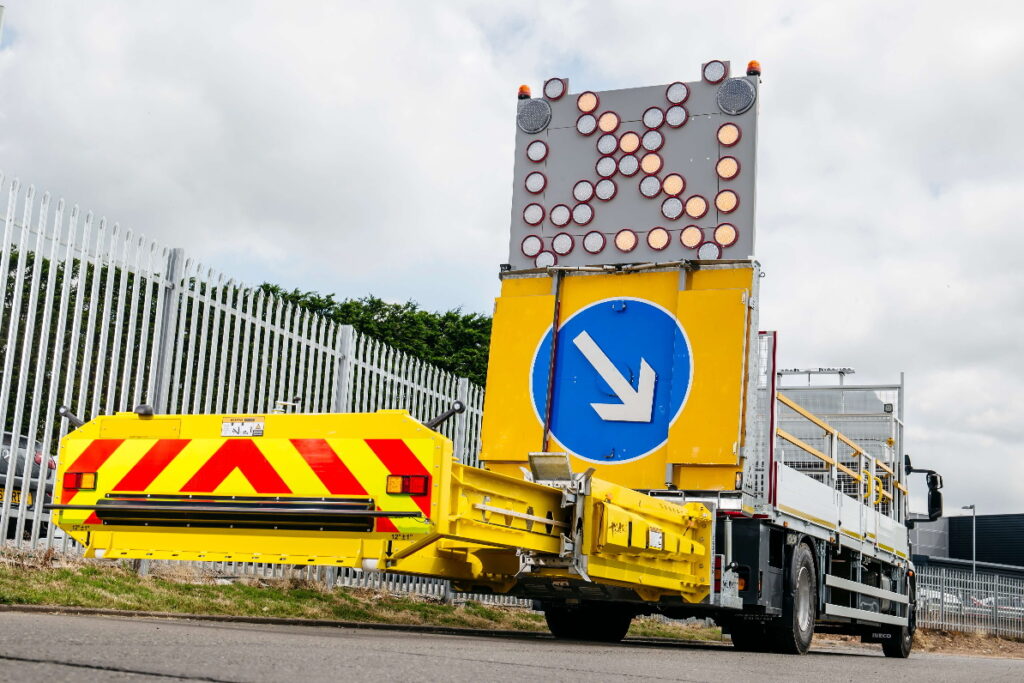
Before a truck mounted attenuator reaches a work zone, it must pass a series of controlled, high-speed crash tests conducted according to an approved safety standard. These tests verify that the system absorbs impact energy in a predictable way, protects the occupants of the impacting vehicle, and minimizes risk to workers ahead. The sections below walk through each part of that approval process.
What standards govern truck mounted attenuator approval?
Truck mounted attenuators are tested and approved under crash test standards developed to evaluate roadside safety hardware. In the United States, the two most widely referenced standards are NCHRP Report 350 and its successor, MASH 2016 (Manual for Assessing Safety Hardware). MASH 2016 is the current standard and sets stricter requirements for vehicle dimensions, test conditions, and occupant risk criteria than its predecessor.
MASH defines test levels that correspond to different impact speeds and vehicle weights. For truck mounted attenuators used on high-speed roads, Test Level 3 (TL-3) is the relevant designation, requiring the attenuator to perform safely when struck by a vehicle traveling at 100 km/h (62 mph). Meeting TL-3 under MASH 2016 demonstrates that the system performs under conditions representative of real highway traffic.
Outside the United States, other countries reference their own standards or align with MASH requirements when procuring internationally certified equipment. In practice, MASH acceptance has become a recognized benchmark in global procurement, particularly for government and contractor clients who require documented proof of compliance.
How does crash testing a TMA actually work?
Crash testing a truck mounted attenuator involves driving a precisely specified test vehicle into the rear of the attenuator at a defined speed and angle, under controlled conditions at an approved test facility. The test vehicle weight, speed, and trajectory are all set according to the applicable standard, and every variable is documented before the test begins.
For MASH TL-3 testing, the test vehicle is typically a passenger car or light truck traveling at 100 km/h. The attenuator is mounted to a host vehicle, which remains stationary during the test. High-speed cameras record the event from multiple angles, and sensors inside the test vehicle measure the forces experienced by crash test dummies positioned in the front seats.
The test is not a single event. Standards like MASH require multiple tests at different impact configurations, including centered impacts and offset impacts where the striking vehicle does not hit the attenuator squarely. This range of scenarios ensures the system performs safely across the variety of real-world collisions that can occur in an active work zone.
What happens to a TMA during and after a crash test?
During a crash test, the truck mounted attenuator deforms in a controlled way to absorb the kinetic energy of the impacting vehicle, slowing it down progressively rather than stopping it abruptly. This controlled deformation is intentional. A system that collapses predictably reduces the peak deceleration force transmitted to the vehicle occupants.
After the impact, engineers and test personnel assess the results against several criteria defined by the standard:
- Occupant risk values: The forces measured by the crash test dummies must fall within acceptable limits for head injury, chest compression, and other injury metrics.
- Vehicle trajectory: The impacting vehicle must not rebound or redirect in a way that creates secondary hazards for other road users.
- Debris: Fragments from the attenuator must not penetrate the occupant compartment or scatter dangerously across the road.
- Host vehicle movement: The truck carrying the attenuator must not move forward into the work zone in a way that endangers workers.
If the system passes all criteria, the test results are submitted for review. If it fails any criterion, the design must be modified and retested before approval can be granted.
What is an FHWA acceptance letter and why does it matter?
An FHWA acceptance letter is an official document issued by the U.S. Federal Highway Administration confirming that a safety device has met the requirements of an approved crash test standard and is eligible for use on federally funded roadway projects. Without this letter, a truck mounted attenuator cannot be specified or deployed on projects that receive federal funding in the United States.
The letter references the specific standard under which the device was tested, such as MASH 2016, and identifies the exact product configuration that was evaluated. This matters because an acceptance letter applies to a specific design, not a general product family. Any change to the system may require a new evaluation.
For buyers and specifiers, the FHWA acceptance letter functions as independent verification. Rather than relying solely on a manufacturer’s claims, you can confirm that a recognized federal authority has reviewed the test data and accepted the results. This provides a clear, auditable basis for procurement decisions, particularly in government and public works contexts.
Does a TMA need to be retested when it’s modified or repaired?
Yes, modifications to a truck mounted attenuator can void its existing acceptance, and significant changes typically require new testing or engineering evaluation before the modified system can be considered compliant. The FHWA acceptance letter applies to the exact configuration that was crash tested, so altering that configuration changes the basis on which approval was granted.
The practical implications depend on the nature of the change:
- Like-for-like repairs using original manufacturer parts generally preserve compliance, provided the repair restores the system to its tested condition.
- Structural modifications, such as changes to the crash cushion geometry, mounting frame, or energy-absorbing components, require manufacturer review and potentially new testing.
- Adding accessories not included in the original test configuration may affect compliance, particularly if they alter the system’s mass, aerodynamics, or impact behavior.
When in doubt, contacting the manufacturer before making any modification is the safest approach. Deploying a modified system without verifying its compliance status creates liability exposure and may put workers and road users at risk.
How Verdegro Supports TMA Compliance and Deployment
We manufacture a range of truck mounted attenuators that have been tested and accepted under both NCHRP 350 TL-3 and MASH 2016, the most current standard in use today. Our product line includes the TMA-US 100K, TTMA-US 100K, LTMA-US 70K, and BLADE TMA, each designed to meet the specific weight and speed requirements of high-speed work zone protection.
When you work with us, you get more than a certified product. Here is what we provide alongside our TMA systems:
- FHWA acceptance documentation for each applicable model, so you have the paperwork needed for federally funded projects
- Guidance on configuration to ensure the system you deploy matches the tested and accepted specification
- Optional accessories including LED arrow boards, full-color VMS displays, and hydraulic LED-lift masts, integrated in a way that maintains compliance
- Support on repair and modification questions to help you preserve the compliance status of systems already in your fleet
If you are specifying truck mounted attenuators for an upcoming project or need to verify the compliance status of existing equipment, contact us directly and we will help you find the right solution.
Related Articles
- What happens if a vehicle crashes into a truck mounted attenuator?
- How do truck mounted attenuator models differ in crash performance?
- Do all truck mounted attenuators come with arrow boards included?
- What should a driver do after hitting a truck mounted attenuator?
- What is the VanGuard truck mounted attenuator and when is it used?