
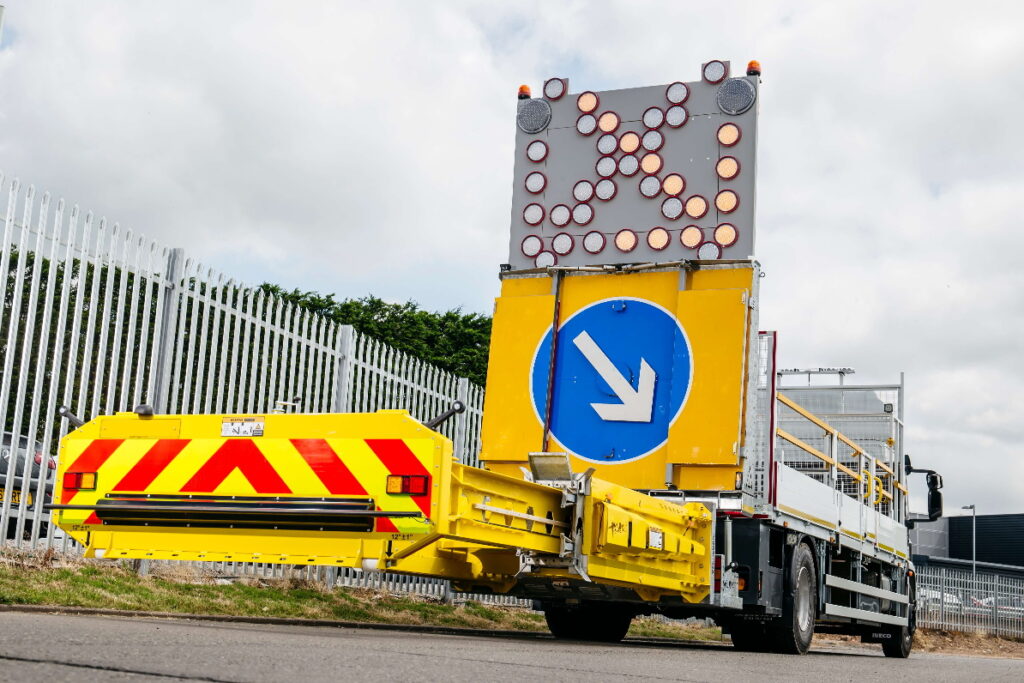
A truck-mounted attenuator needs to be replaced when it has absorbed a significant impact, shows structural deformation, fails inspection criteria, or can no longer perform its energy-absorbing function reliably. Even minor impacts can compromise the internal cartridges or frame geometry in ways that are not always visible from the outside. The sections below walk through the specific warning signs you should check before every deployment.
How many impacts can a truck-mounted attenuator absorb before replacement?
Most truck-mounted attenuators are designed to absorb a limited number of impacts before replacement is required, and that number depends on the severity of each strike. A single high-energy impact at or near the system’s rated test level, such as a MASH 2016 TL-3 condition, will typically take the unit out of service immediately. Lower-speed impacts may allow continued use after inspection and repair, but cumulative loading shortens the remaining service life with each event.
The manufacturer’s documentation for your specific TMA will define the replacement threshold. Some systems use a single-hit replacement policy for any impact above a defined speed, while others allow a set number of minor impacts before mandatory retirement. You should never assume a TMA is still serviceable after a collision without consulting the manufacturer’s guidance. The energy-absorbing cartridges inside the unit compress and deform on impact, and once they have done their job, they cannot return to their original state. Deploying a spent attenuator exposes road workers and drivers to the full force of the next strike.
What visible damage signals a TMA is no longer safe to deploy?
Visible damage that signals a truck-mounted attenuator is unsafe to deploy includes bent or buckled frame members, crushed or displaced energy-absorbing cartridges, cracked welds, deformed mounting brackets, and any misalignment of the rear impact face. If the unit no longer sits level or square on the host vehicle, that alone is enough to ground it.
During your post-impact or pre-deployment inspection, work through the following checklist:
- Frame integrity: Look for bends, cracks, or permanent deformation in the main structural members
- Cartridge condition: Check whether the energy-absorbing elements show compression, fracture, or displacement from their housing
- Mounting hardware: Inspect the hitch, mounting plate, and all fasteners for shear damage or loosened connections
- Alignment: Verify the unit sits symmetrically and the impact face is perpendicular to the direction of travel
- Hydraulic components: If your TMA includes a hydraulic lift or tilt mechanism, check for fluid leaks, damaged cylinders, and proper range of motion
- Lighting and signage: Confirm that any integrated arrow board or LED components still function correctly and are securely attached
Any single failure in this list is grounds for taking the unit out of service until it has been assessed and cleared by a qualified technician.
How do age and corrosion affect truck-mounted attenuator performance?
Age and corrosion reduce a truck-mounted attenuator’s performance by weakening the structural components that must transmit and absorb crash energy. Steel frames, mounting brackets, and fasteners exposed to road salt, moisture, and UV radiation deteriorate over time, and a corroded frame may fail at a much lower impact force than its original rated capacity.
Corrosion is particularly problematic in hidden areas: inside hollow frame sections, at weld joints, and around the mounting interface between the attenuator and the host vehicle. Surface rust that looks cosmetic can mask deeper pitting that compromises load-bearing capacity. A TMA that looks functional from a distance may be structurally compromised at the connection points that matter most during a real impact.
Age also affects non-metallic components. Rubber buffers, foam cartridges, and polymer housings harden and lose flexibility over years of temperature cycling, reducing their ability to absorb energy progressively. Most manufacturers specify a maximum service life in years, independent of impact history. If your unit has exceeded that period, replacement is warranted even if it has never been struck.
What documentation should flag a TMA for replacement during inspection?
Documentation that should flag a truck-mounted attenuator for replacement includes any recorded impact event, a failed inspection report, a repair history showing repeated structural issues, or a unit age that exceeds the manufacturer’s stated service life. Inspection records are your primary tool for tracking cumulative wear and making defensible replacement decisions.
Specifically, look for these red flags in the paperwork:
- An incident report noting an impact at or above the system’s rated speed threshold
- Previous inspection records showing deferred repairs that were never completed
- A maintenance log showing the unit has been repaired more than the manufacturer’s allowable number of times
- Certification records indicating the unit was tested to an older standard, such as NCHRP-350, and has not been updated to meet current MASH 2016 requirements
- Missing or illegible serial number and certification plates, which make it impossible to verify compliance
Keeping accurate records is not just good practice; in many jurisdictions it is a contractual or regulatory requirement. If the documentation trail is incomplete, treating the unit as suspect and scheduling a full physical inspection before the next deployment is the responsible course of action.
Can a truck-mounted attenuator be repaired instead of replaced?
A truck-mounted attenuator can sometimes be repaired rather than replaced, but only when the damage is limited to components that are specifically designed to be replaced and when the repair is carried out using manufacturer-approved parts and procedures. Repairs that restore the unit to its certified performance specification are acceptable; field repairs that deviate from the original design are not.
Replaceable components typically include energy-absorbing cartridges, end caps, and certain fasteners. Structural frame repairs, by contrast, are rarely permissible under the original certification. Welding a cracked main beam, for example, changes the load path in ways that were not part of the original crash test program, and a repaired frame cannot be assumed to perform identically to the tested configuration.
Before authorizing any repair, confirm with the manufacturer that the proposed work keeps the unit within its certified specification. If the damage is too extensive, or if replacement parts are no longer available, full unit replacement is the only option that preserves the safety assurance the certification provides. Deploying a TMA that has been repaired outside approved parameters exposes your crew and the traveling public to unquantified risk.
How Verdegro Supports Your TMA Replacement Decisions
We manufacture a range of truck-mounted attenuator systems built and tested to current international crash safety standards, including MASH 2016 and NCHRP-350 TL-3. Our product line covers different weight classes and deployment scenarios:
- TMA-US 100K and TTMA-US 100K for standard and tandem host vehicle configurations
- LTMA-US 70K for lighter host vehicles where payload is a constraint
- BLADE TMA for operations requiring a lower-profile crash protection solution
All our systems are available with integrated accessories including LED arrow boards, full-color VMS displays, and hydraulic LED-lift masts, so you can consolidate your work zone protection equipment on a single certified platform. We also hold multiple FHWA acceptance letters under MASH 2016, giving you the documentation you need to meet compliance requirements on government and contractor projects.
When you are assessing whether your current attenuator should be repaired or replaced, we can help you evaluate your options based on the unit’s impact history, age, and inspection findings. Contact us to discuss your specific situation and find the right replacement solution for your fleet.
Related Articles
- Can one impact protection vehicle be used for different types of roadwork?
- When do you need a full-size impact protection vehicle?
- Is NCHRP-350 still valid or has it been replaced by MASH for truck mounted attenuators?
- Does a heavier truck mounted attenuator offer better protection?
- How much does a truck mounted attenuator cost?