
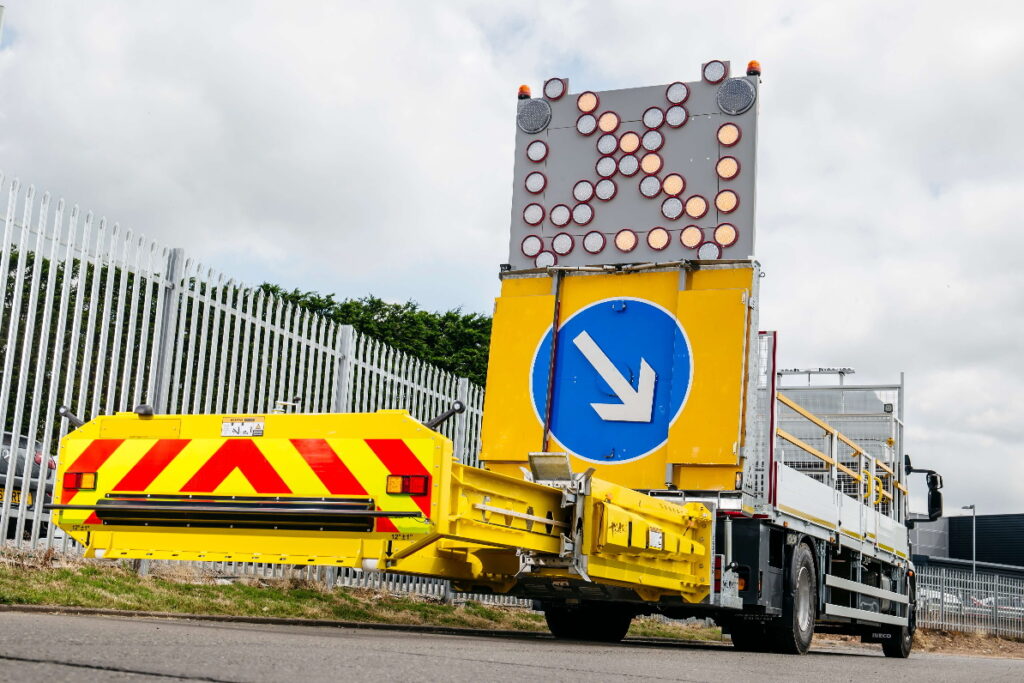
A truck-mounted attenuator (TMA) is a crash cushion system bolted to the rear of a work truck that absorbs the energy of an errant vehicle before it reaches road workers. It acts as a sacrificial buffer, protecting both the people working in the zone and the driver of the striking vehicle. The sections below answer the most common questions professionals ask before specifying or deploying a TMA.
How does a truck-mounted attenuator protect workers in a work zone?
A truck-mounted attenuator protects workers by absorbing and redirecting the kinetic energy of an errant vehicle through a controlled crush mechanism at the rear of the host truck. When a vehicle strikes the attenuator, the TMA deforms progressively, slowing the impacting vehicle and preventing it from penetrating the work zone where crews are active.
The host truck itself is called the shadow vehicle or attenuator truck. It positions itself between live traffic and the work crew, creating a physical barrier that moves with the operation. The TMA mounted to its rear handles the impact load so the truck cab, the driver, and the workers ahead are shielded from the worst of the collision forces.
Modern attenuator systems are engineered to manage two outcomes simultaneously: minimizing injury to the occupants of the striking vehicle by reducing deceleration forces, and preventing the impacting vehicle from redirecting into adjacent lanes or into the work zone itself. This dual function is what separates a certified TMA from a simple physical barrier.
What types of vehicles can be fitted with a truck-mounted attenuator?
Truck-mounted attenuators can be fitted to a wide range of work vehicles, provided the host vehicle meets the minimum weight requirements specified in the TMA’s certification. The most common host vehicles are flatbed trucks, utility trucks, and highway maintenance vehicles, typically in the medium- to heavy-truck category.
The weight of the host vehicle matters because it directly affects how the system performs during an impact. A TMA rated for a heavier host truck will behave differently if installed on a lighter vehicle, which is why manufacturers publish specific gross vehicle weight (GVW) requirements for each model. Installing a TMA on an undersized vehicle can compromise the system’s tested performance and may void its certification.
Some attenuator systems are designed specifically for towable or trailer-mounted configurations, which offer more flexibility when a dedicated shadow truck is not available. These systems are towed behind a separate vehicle and are common in longer-duration road works where a stationary protective setup is needed at the taper or merge point.
What is the difference between a TMA and a crash cushion?
The key distinction is mobility. A truck-mounted attenuator is a mobile crash protection device attached to a moving work vehicle, while a crash cushion is a fixed or semi-permanent barrier installed in front of a rigid hazard such as a concrete barrier end, bridge pier, or gore area. Both absorb impact energy, but they serve different deployment scenarios.
A fixed crash cushion system is anchored to the ground and designed to protect road users from striking a stationary object. It stays in place for the duration of a project or permanently. A TMA travels with the work zone, moving forward as the crew progresses, which makes it suitable for operations like lane marking, pothole patching, and mowing where the hazard point is constantly shifting.
From a certification standpoint, both device types are tested under the same standards framework, but the specific test conditions differ. TMAs are tested with the host vehicle present as part of the system, reflecting real-world deployment. Crash cushions are tested as standalone installations. This means the two products are not interchangeable, even when they look similar in construction.
When is a truck-mounted attenuator legally required on a job site?
A truck-mounted attenuator is legally required whenever a shadow vehicle is used to protect workers in an active traffic lane or adjacent to live traffic, as defined by national and regional traffic control standards. In the United States, the Manual on Uniform Traffic Control Devices (MUTCD) and state-specific work zone regulations govern when a TMA must be deployed. In Europe, equivalent national standards apply.
In practice, TMAs are required or strongly recommended in the following situations:
- Mobile operations where crews work within or immediately adjacent to a live travel lane
- Any work zone where a shadow vehicle is positioned upstream of the crew to intercept errant traffic
- High-speed roadways, typically those with posted speeds above 45 mph (70 km/h), where the risk of a high-energy impact is elevated
- Projects where the contract or tender specifies compliance with MASH 2016 or NCHRP 350 TL-3 standards
Requirements vary by jurisdiction, road classification, and the nature of the work. Government contracts and highway agency specifications will typically name the exact standard and test level the attenuator must meet. Always verify local regulations and contract documents before selecting a system.
How is a truck-mounted attenuator rated and tested for safety compliance?
Truck-mounted attenuators are rated and tested according to standardized crash-test protocols that simulate real-world impact scenarios. In the United States, the two primary standards are NCHRP 350 and the newer MASH 2016 (Manual for Assessing Safety Hardware). MASH 2016 is the current standard, and the Federal Highway Administration (FHWA) now requires MASH-compliant devices on federally funded projects.
Testing involves crashing vehicles of specified weights and speeds into the attenuator under controlled conditions. The tests evaluate three main outcomes:
- Structural adequacy: Does the TMA contain and redirect the impacting vehicle without allowing dangerous penetration?
- Occupant risk: Do the deceleration forces experienced by the vehicle occupants remain within survivable limits?
- Vehicle trajectory: Does the impacting vehicle exit the collision in a predictable, safe direction?
Test levels (TL) indicate the speed and vehicle weight used in testing. TL-3 is the most common requirement for highway work zones, covering impacts up to 100 km/h (62 mph). A TMA that passes TL-3 testing under MASH 2016 receives an FHWA acceptance letter, which serves as the formal documentation that the device meets federal requirements.
When evaluating any attenuator, always request the FHWA acceptance letter and confirm which standard it was tested under. A device tested to the older NCHRP 350 standard may not be accepted on projects that now require MASH 2016 compliance.
How Verdegro Helps with Truck-Mounted Attenuators
We manufacture a range of truck-mounted attenuators designed for road construction contractors and traffic management operators who need certified, field-ready crash protection. Our TMA lineup is tested and approved to both NCHRP 350 TL-3 and MASH 2016, and we hold multiple FHWA acceptance letters confirming compliance with the most current standard.
Our attenuator range includes:
- TMA-US 100K for standard heavy host vehicles
- TTMA-US 100K for towable configurations
- LTMA-US 70K for lighter host vehicle classes
- BLADE TMA for operations requiring a compact, high-performance profile
Each system is available with optional accessories including LED arrow boards, full-color VMS displays, and hydraulic LED-lift masts, so you can build a complete shadow vehicle setup from a single supplier. Our Mobilityplanner platform also gives you real-time GPS tracking and status updates for every deployed unit, helping you manage your fleet from a single dashboard.
If you are specifying a TMA for an upcoming project or want to confirm which system fits your host vehicle and contract requirements, contact our team directly. We will help you match the right attenuator to your operational needs and provide the compliance documentation your project requires.