
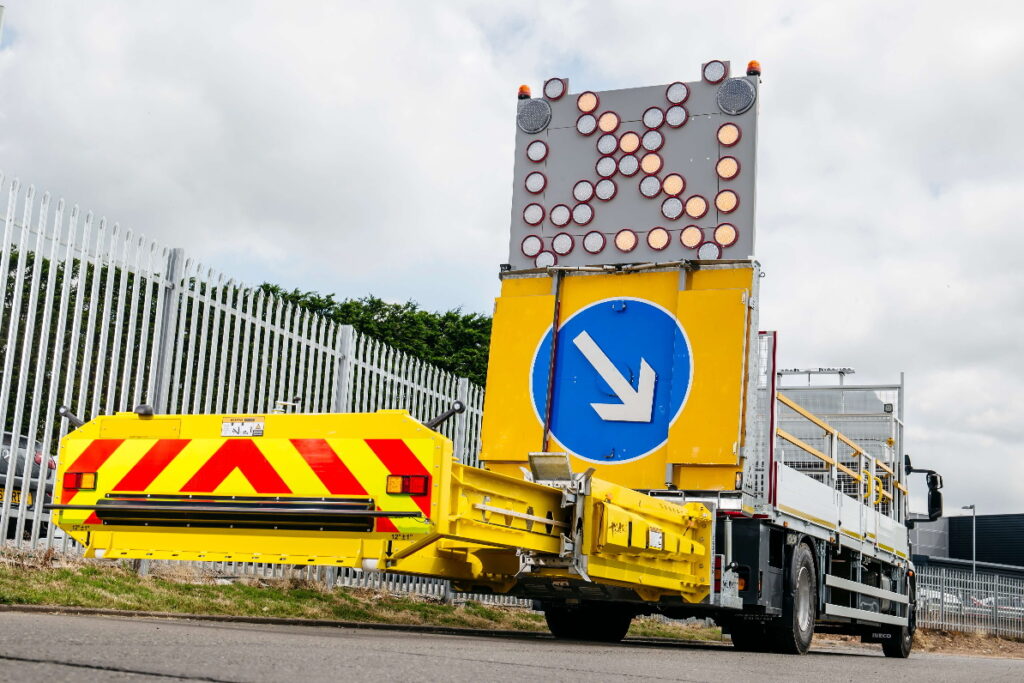
A truck-mounted attenuator (TMA) is a crash cushion device bolted to the rear of a work truck that absorbs the energy of an errant vehicle striking the back of the truck. It redirects or decelerates the impacting vehicle to reduce the severity of the collision, protecting both the vehicle’s occupants and the road workers ahead. Below, we answer the most common questions about how TMAs work, what types exist, and when you need one.
How does a truck-mounted attenuator protect workers?
A truck-mounted attenuator protects workers by acting as a physical buffer between oncoming traffic and the work zone. When a distracted or impaired driver strikes the rear of the host truck, the TMA absorbs and redirects the crash energy rather than allowing the full force to transfer into the truck or the crew working ahead. This dramatically reduces the risk of fatal injuries to workers on foot.
The attenuator achieves this through a controlled deformation process. The device’s internal structure, typically a series of aluminum or steel cartridges, foam elements, or hydraulic components, collapses in a calculated sequence. This sequential collapse slows the impacting vehicle over a longer distance and time, reducing the peak deceleration force experienced by its occupants while also limiting how far the host truck is pushed forward into the work area.
Most TMAs also include a shadow function: the host truck parks or moves slowly at the rear of the work zone, keeping workers shielded from live traffic at all times. The attenuator is the last line of defense if a vehicle breaches the traffic control setup.
What are the main types of truck-mounted attenuators?
Truck-mounted attenuators fall into two broad categories based on how the host truck responds to an impact: redirective systems and non-redirective systems. Redirective TMAs use a gating mechanism that allows the impacting vehicle to be redirected away from the truck’s path, while non-redirective models absorb the impact more directly and are typically used on narrower trucks or in lower-speed environments.
Within those categories, TMAs are also classified by the weight class of the host vehicle they are certified for. Common weight thresholds are 70,000 lb (approximately 32,000 kg) and 100,000 lb (approximately 45,000 kg) host trucks. Choosing the right unit for your truck’s gross vehicle weight is not optional: it is a compliance requirement under crash testing standards.
A further distinction is trailer-mounted attenuators (TTMAs), which are towed rather than directly bolted to a truck. TTMAs offer flexibility when you need to reposition the attenuator without moving the entire host vehicle, and they are popular in longer-duration work zones where the shadow truck operates independently of other site vehicles.
What is MASH 16 and why does it matter for TMAs?
MASH 16 (Manual for Assessing Safety Hardware, 2016 edition) is the current U.S. crash-testing standard that defines the test conditions, vehicle types, and performance criteria that roadside safety devices must meet before they can be used on federally funded highways. For truck-mounted attenuators, MASH 16 acceptance means the device has been crash-tested under the most up-to-date protocols and meets the occupant risk thresholds set by the Federal Highway Administration (FHWA).
MASH 16 replaced the older NCHRP 350 standard, and the two are not interchangeable on federally funded projects. Devices approved only under NCHRP 350 may no longer satisfy procurement requirements for new installations on those projects. This matters for procurement decisions: if you are bidding on a federally funded road contract, specifying a TMA that holds a current FHWA acceptance letter under MASH 2016 keeps you compliant and avoids costly substitutions mid-project.
Beyond federal compliance, MASH 16 acceptance signals a higher level of engineering rigor. The standard uses updated crash-test vehicles that better reflect the current fleet on U.S. roads, so a MASH 16-certified TMA has been validated against more realistic impact scenarios than older-generation devices.
When is a truck-mounted attenuator required on a job site?
A truck-mounted attenuator is required whenever a work truck is positioned in or adjacent to live traffic lanes and workers are operating in the area behind or around that truck. Regulatory requirements vary by jurisdiction, but in practice, any shadow truck operating on a highway or high-speed arterial road should carry a TMA as standard practice.
In the United States, the Manual on Uniform Traffic Control Devices (MUTCD) and individual state Department of Transportation specifications typically mandate TMAs for work zones on roads with speed limits above a defined threshold, commonly 45 mph or higher. Many state DOTs now require MASH 16-compliant devices on all new contracts regardless of speed limit.
Beyond legal requirements, consider the operational context. If your crew is performing lane striping, pavement patching, or utility work with vehicles moving slowly through active traffic, a TMA is the most direct way to give workers a protected zone. The cost of equipping a shadow truck with an attenuator is modest compared to the liability and human cost of an unprotected rear-end strike.
What’s the difference between a TMA and a crash cushion?
A truck-mounted attenuator is a mobile device attached to a moving or parked work truck, designed to travel with the work zone. A crash cushion is a fixed or semi-permanent barrier installed at a specific hazard point, such as the end of a concrete barrier or the nose of a gore area. The core difference is mobility: TMAs move with the job, crash cushions stay in place.
Both devices absorb impact energy and reduce injury severity, and both must meet crash-testing standards. However, their applications do not overlap directly:
- TMAs are used when the hazard moves, rolling or stationary shadow trucks in active work zones
- Crash cushions are used when the hazard is fixed, protecting a permanent roadside obstacle from errant vehicles
Another practical difference is reset time. After a significant impact, a fixed crash cushion often requires full replacement of damaged cartridges before it is serviceable again. Many modern TMAs are designed for faster field reset, allowing the host truck to return to operation more quickly after a minor strike. This crash protection capability is a key factor when evaluating total cost of ownership for fleet operators who run multiple shadow trucks across long-duration projects.
How Verdegro Helps with Truck-Mounted Attenuators
We manufacture a complete range of truck-mounted attenuators built and tested to the standards that matter for your projects. Our TMA lineup includes:
- TMA-US 100K – a redirective attenuator certified for host trucks up to 100,000 lb under MASH 2016
- TTMA-US 100K – a trailer-mounted version offering flexible deployment for longer work zones
- LTMA-US 70K – a lighter-duty option for host trucks up to 70,000 lb, tested to MASH 2016
- BLADE TMA – a compact, low-profile attenuator for tighter operational requirements
All of our TMAs hold FHWA acceptance letters under MASH 2016, so you can specify them with confidence on federally funded projects. We also offer optional accessories including LED arrow boards, full-color VMS displays, and hydraulic LED-lift masts, allowing you to equip a single shadow truck with everything it needs for both crash protection and traffic guidance.
Beyond the hardware, our MobilityPlanner platform gives you real-time GPS tracking, status updates, and remote monitoring across your entire fleet of deployed units, so you always know where your equipment is and how it is performing.
If you want to find the right TMA for your host vehicle weight class and project requirements, contact our team and we will help you identify the correct certified solution.
Related Articles
- How can impact protection be integrated into an existing maintenance fleet?
- What is the difference between impact protection for vans and trucks?
- What makes one truck mounted attenuator model better suited to your project?
- What is the VanGuard truck mounted attenuator and when is it used?
- How do you choose the right truck mounted attenuator weight class?