
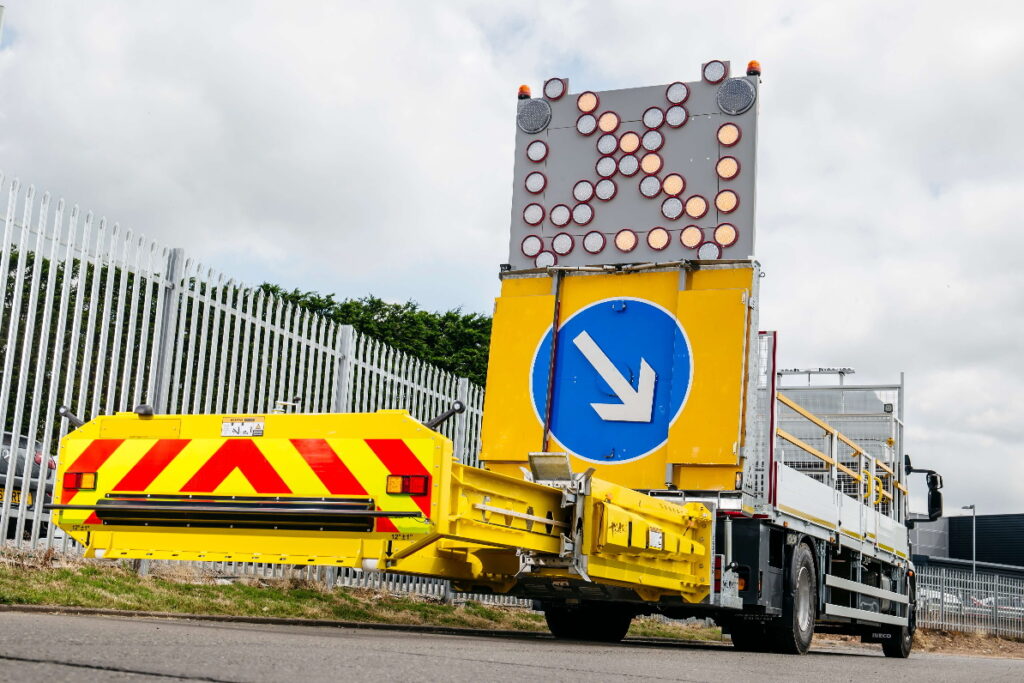
A truck-mounted attenuator (TMA) and an arrow board serve completely different purposes in a work zone. A TMA is a crash cushion device mounted to the rear of a truck that absorbs impact energy when a vehicle collides with it, protecting workers behind it. An arrow board is a signaling device that directs traffic around or through a work zone using illuminated arrow or chevron patterns. One protects people; the other guides drivers.
Both devices are standard equipment in active work zones, but they address separate safety needs. Understanding when and how to deploy each one helps you build a work zone setup that protects your crew and keeps traffic moving safely. The sections below answer the most common questions about how these two pieces of equipment compare and work together.
When should a work zone use a TMA instead of an arrow board?
A work zone should use a TMA whenever workers are exposed to live traffic and there is a real risk of an errant vehicle entering the work area. A TMA is not a substitute for an arrow board and does not replace it. The decision to deploy a TMA is driven by worker exposure, traffic speed, and the duration of the work activity.
On high-speed roads such as highways and motorways, a TMA positioned behind the shadow vehicle provides a physical barrier between fast-moving traffic and your crew. If a driver fails to react to warning signs or becomes distracted, the TMA absorbs the collision energy before it reaches the workers. Arrow boards, by contrast, do not provide any physical protection. They are guidance tools, not crash protection systems.
As a general rule, if your crew is working in or adjacent to a travel lane on a road with speeds above 45 mph (70 km/h), a TMA is a standard requirement in most jurisdictions. Arrow boards are required in virtually all work zones regardless of speed, because directing traffic is always necessary when lanes are modified or closed.
How does a truck-mounted attenuator protect workers?
A truck-mounted attenuator protects workers by absorbing and redirecting the kinetic energy of an impacting vehicle before that energy reaches the people working behind it. The TMA is engineered to crush in a controlled way on impact, slowing the striking vehicle and reducing the force transferred to the host truck and the work zone crew.
The host vehicle, often called the shadow vehicle or attenuator truck, is positioned between live traffic and the work crew. When a vehicle strikes the TMA at the rear, the attenuator’s crash cushion structure deforms progressively, dissipating energy over a longer distance and time period than a rigid barrier would. This controlled deformation is what makes the difference between a survivable impact and a fatal one.
Modern truck-mounted attenuators are tested against internationally recognized crash standards to verify that they perform as designed under real-world impact conditions. The host truck is also anchored by its own mass and braking systems, which work together with the TMA to manage the impact forces. After a significant strike, the TMA unit is typically replaced or inspected before being returned to service.
What does an arrow board actually do in a work zone?
An arrow board displays illuminated directional signals, typically an arrow or a series of chevrons, to guide drivers away from a closed or restricted lane and toward the correct path through a work zone. It gives drivers early, clear visual information so they can merge safely before reaching the actual work area.
Arrow boards are mounted on trailers or on the rear of vehicles and positioned at the upstream end of the work zone taper. The patterns they display, such as a single flashing arrow, a sequential chevron, or a caution mode, communicate different instructions depending on the lane configuration. A sequential arrow tells drivers to merge in a specific direction; a diamond or caution pattern warns of a general hazard ahead without directing a specific merge.
The effectiveness of an arrow board depends heavily on its placement, visibility, and the pattern selected for the traffic condition. Boards with high-brightness LED panels remain visible in direct sunlight and adverse weather, which is important for roads with high approach speeds where drivers need maximum reaction time.
Can a work zone use both a TMA and an arrow board together?
Yes, and in most active work zones on high-speed roads, using both a TMA and an arrow board together is standard practice. They perform complementary functions: the arrow board directs traffic away from the work zone, and the TMA protects workers if a driver fails to respond to that direction.
In a typical setup, the TMA truck is the shadow vehicle positioned at the rear of the work zone, facing oncoming traffic. An arrow board is mounted on the same truck or on a separate trailer positioned slightly upstream. This combination means drivers receive clear directional guidance well before they reach the work area, while the crew behind the shadow vehicle is protected by the crash cushion in case of a breakthrough impact.
Many TMA systems are designed to accommodate arrow boards and additional signaling equipment as integrated accessories. This means a single vehicle can serve both the crash protection and traffic guidance functions simultaneously, which reduces the number of vehicles needed in the work zone and simplifies the setup.
What compliance standards apply to TMAs and arrow boards?
Truck-mounted attenuators in the United States must meet the Manual for Assessing Safety Hardware (MASH) standards, with MASH 2016 being the most current version required for new installations on federally funded projects. Arrow boards must comply with the Manual on Uniform Traffic Control Devices (MUTCD), which defines size, brightness, and pattern requirements based on road type and speed.
MASH testing evaluates how a TMA performs when struck by vehicles of defined weights and speeds, measuring outcomes for the occupants of both the striking vehicle and the work zone. A TMA that holds an FHWA acceptance letter under MASH has been tested and accepted by the Federal Highway Administration for use on public roads in the United States. This acceptance is a practical requirement for contractors working on state and federal highway projects.
For arrow boards, MUTCD compliance covers the number of lamps or LEDs, the minimum display size for different road classifications, and the approved display patterns. Jurisdictions outside the United States apply their own national standards, so it is important to verify local requirements before deploying equipment on international projects.
How Verdegro Supports Your Work Zone Setup
We manufacture a range of truck-mounted attenuators built and tested to meet the most current international crash safety standards, including MASH 2016 and NCHRP-350 TL-3. Our TMA lineup includes the TMA-US 100K, TTMA-US 100K, LTMA-US 70K, and BLADE TMA, giving you options across different host vehicle weight classes and deployment scenarios.
Each system is designed with the practical needs of road construction contractors and traffic management operators in mind. Here is what our TMA systems offer:
- FHWA acceptance under MASH 2016, the most current standard, so you meet compliance requirements on federally funded projects
- Optional integrated arrow boards with LED panels, so your shadow vehicle handles both crash protection and traffic guidance in one unit
- Optional full-color VMS displays and hydraulic LED-lift masts for expanded signaling capability on complex work zones
- GPS tracking and remote monitoring through our Mobilityplanner platform, giving you real-time visibility of your deployed equipment
- Durable construction designed for repeated deployment in demanding road environments
Whether you are equipping a single maintenance crew or managing a large fleet of work zone vehicles, we can help you find the right combination of crash protection and traffic control equipment. Contact us to discuss your project requirements and find out which TMA configuration fits your operation.
Related Articles
- What is NCHRP-350 and how does it apply to truck mounted attenuators?
- What is the VanGuard truck mounted attenuator and when is it used?
- Is NCHRP-350 still valid or has it been replaced by MASH for truck mounted attenuators?
- How do you choose the right truck mounted attenuator weight class?
- Why do trucks have truck mounted attenuators attached?