
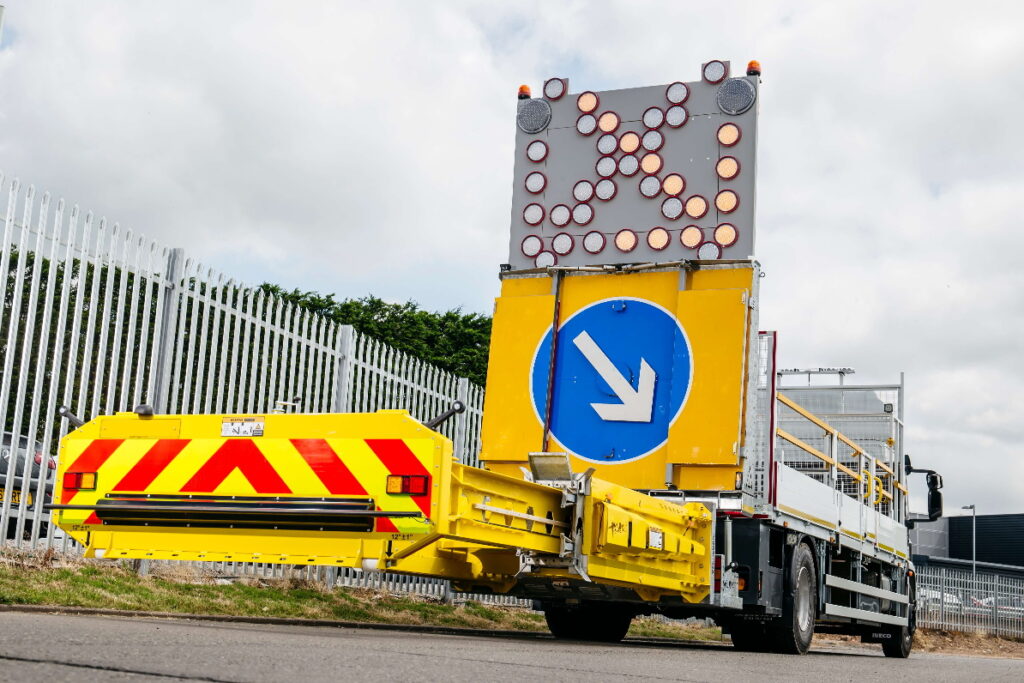
Yes, you can customize a truck mounted attenuator with additional warning lights. Most TMA systems support optional lighting configurations, including LED arrow boards, strobe lights, and variable message displays, which you can add to improve visibility and communicate hazards more effectively to approaching drivers.
The right lighting setup depends on the type of work zone, local traffic regulations, and the electrical capacity of your host vehicle. Whether you are running a highway lane closure or managing an urban maintenance operation, additional warning lights help you meet visibility requirements and protect your crew.
Below, we answer the most common questions about TMA lighting customization so you can make informed decisions before specifying or modifying your equipment.
What types of warning lights can be added to a truck mounted attenuator?
The most common warning lights added to truck mounted attenuators include LED arrow boards, strobe or beacon lights, and full-color Variable Message Signs (VMS). Arrow boards direct traffic away from the work zone, strobes increase rear visibility in low-light or poor-weather conditions, and VMS panels communicate specific messages or speed limits to approaching drivers.
Beyond these core options, some operators also integrate hydraulic LED-lift masts, which raise lighting equipment to a height where it remains visible over other vehicles and equipment. This is particularly useful on multilane highways where sight lines are restricted.
Here is an overview of common warning light types and their primary function:
- LED arrow boards: Guide traffic around or through the work zone with directional arrows or chevron patterns
- Strobe and beacon lights: Provide high-visibility flashing alerts, especially effective at night or in fog
- Variable Message Signs (VMS): Display text-based messages such as speed limits, warnings, or lane closure information
- Hydraulic LED-lift masts: Elevate lighting to improve visibility above surrounding traffic
- Perimeter lighting: Illuminate the work zone itself to protect workers on foot
The combination you choose should reflect both the complexity of your work zone and the traffic volumes you are managing.
How does warning light customization affect TMA compliance standards?
Adding warning lights to a truck mounted attenuator does not automatically affect its crash test certification, but improper modifications can compromise compliance if they alter the structural integrity of the attenuator or its mounting system. Any lighting additions must be installed in a way that does not interfere with how the TMA absorbs and redirects impact energy.
In the United States, TMA systems are tested and certified under standards such as NCHRP 350 TL-3 and MASH 2016. These certifications apply to the crash cushion assembly as tested. If modifications change the mass, geometry, or structural behavior of the unit, the original certification may no longer apply.
To stay compliant, follow these principles when adding warning lights:
- Use manufacturer-approved mounting points and brackets
- Avoid drilling into or welding onto load-bearing structural components
- Confirm that added weight does not exceed the host vehicle’s rated capacity
- Check whether your jurisdiction requires re-inspection or re-certification after modifications
- Document all changes in case you need to demonstrate compliance during an audit or incident investigation
When in doubt, contact the TMA manufacturer before making any structural or electrical changes to the unit.
Can warning lights be integrated with a TMA’s existing electrical system?
Yes, warning lights can typically be integrated with a TMA’s existing electrical system, provided the host vehicle’s power supply and wiring capacity can support the additional load. Most modern TMA platforms are designed with electrical connectivity in mind, and many manufacturers offer pre-wired configurations that simplify the addition of arrow boards, strobes, or VMS panels.
Before integrating new lighting, assess the following:
- Power draw: Calculate the combined wattage of all lighting components and confirm the vehicle’s alternator and battery system can handle it
- Control interface: Determine whether the new lights will be operated independently or through a centralized control panel in the cab
- Wiring protection: Ensure all cabling is routed and protected against road debris, vibration, and weather exposure
- Fusing and circuit protection: Add appropriate fuses or circuit breakers for each new circuit to prevent electrical faults
Many operators choose to use a dedicated secondary power source, such as a generator or auxiliary battery pack, when running high-draw equipment like full-color VMS displays. This reduces strain on the vehicle’s primary electrical system and improves reliability during extended deployments.
What work zone conditions require additional TMA lighting?
Work zones with reduced visibility, high traffic speeds, or complex lane configurations are the conditions that most commonly require additional TMA lighting beyond the standard setup. Night operations, tunnels, adverse weather, and multi-phase closures all create situations where standard rear-facing lights are insufficient to give drivers adequate warning time.
Consider adding supplemental lighting when your work zone involves any of the following:
- Night or low-light operations: Standard reflective markings lose effectiveness in darkness; active lighting compensates for this
- High-speed roads (above 70 km/h or 45 mph): Drivers need earlier visual cues to react safely, making elevated or high-intensity lighting important
- Curved or restricted sight lines: Locations where drivers cannot see the work zone until they are close require more prominent visual alerts
- Adverse weather conditions: Rain, fog, and snow significantly reduce visibility, making strobes and high-output LEDs more effective than passive reflectors
- Multi-lane closures or complex traffic patterns: Arrow boards and VMS panels help communicate which lanes are open and what actions drivers should take
Local traffic management regulations may also specify minimum lighting requirements for certain road classifications or work types. Always review the applicable standards for your region before deploying.
Should you customize a TMA yourself or work with the manufacturer?
You should work with the manufacturer whenever possible when customizing a truck mounted attenuator with additional warning lights. Manufacturer-approved configurations preserve the unit’s crash test certification, ensure electrical compatibility, and reduce the risk of voiding your warranty. Self-modification is possible for straightforward additions, but carries real risk if it affects structural components or the unit’s certified performance.
Working directly with the manufacturer gives you access to tested mounting solutions, compatible components, and documentation that supports your compliance obligations. It also means you have a clear line of accountability if questions arise after deployment.
Self-customization may be appropriate when:
- The modification is purely cosmetic or involves non-structural external accessories
- You are using manufacturer-approved aftermarket components with documented compatibility
- The changes do not affect the TMA’s mounting system, impact zone, or electrical architecture
In all other cases, particularly when adding electrical systems, structural brackets, or heavy components, engage the manufacturer before proceeding.
How Verdegro Helps with TMA Warning Light Customization
We design our truck mounted attenuators with optional lighting integrations built into the product specification, so you do not have to choose between customization and compliance. Our TMA range, including the TMA-US 100K, TTMA-US 100K, LTMA-US 70K, and BLADE TMA, is tested to NCHRP 350 TL-3 and MASH 2016 standards and available with factory-fitted accessories that preserve certification.
When you work with us, you can configure your TMA with:
- LED arrow boards for clear lane guidance in standard and complex work zones
- Full-color VMS displays for text-based messaging and dynamic traffic communication
- Hydraulic LED-lift masts for elevated visibility above surrounding vehicles and equipment
- Integrated electrical systems designed to handle the power demands of multiple lighting components simultaneously
All configurations are documented, and our team can advise you on the right setup for your specific work zone conditions, host vehicle, and regional compliance requirements. We also offer the Mobilityplanner platform, which gives you real-time status updates and remote control capabilities across your deployed equipment.
If you are specifying a new TMA or looking to upgrade an existing unit with additional warning lights, contact us to discuss your requirements and find the right configuration for your operation.
Related Articles
- How can contractors make roadwork safety vehicles more versatile?
- Can one impact protection vehicle be used for different types of roadwork?
- Can the same crash protection solution be used on every roadwork vehicle?
- What should a driver do after hitting a truck mounted attenuator?
- How do you choose the right truck mounted attenuator for your fleet?