
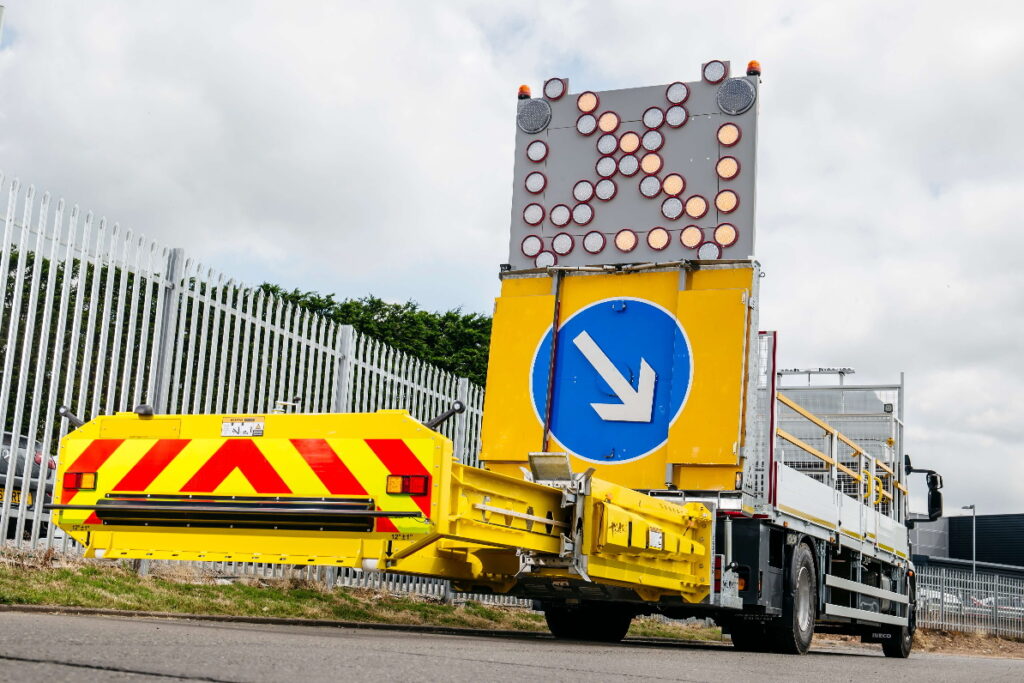
Choose your truck mounted attenuator weight class by matching the TMA’s minimum host vehicle weight requirement to the truck you plan to mount it on. Most TMAs fall into two main categories: 70,000 lb (70K) systems for lighter host vehicles and 100,000 lb (100K) systems designed for heavier trucks. The right choice depends on your host vehicle’s gross vehicle weight rating (GVWR), the applicable crash test standard in your jurisdiction, and the specific demands of your work zone environment.
Getting this match right is not just a compliance checkbox. It directly determines whether the attenuator performs as tested during a real impact. The sections below walk through the key questions you need to answer before making a selection.
What are the different weight classes for truck mounted attenuators?
Truck mounted attenuators are generally classified by the minimum host vehicle weight they require to function as crash-tested. The two most common weight classes are 70K systems, which require a host vehicle of at least 70,000 lb GVWR, and 100K systems, which require a host vehicle of at least 100,000 lb GVWR. Some manufacturers also produce trailer-mounted variants that follow similar weight thresholds.
These weight classes exist because the host vehicle itself acts as a critical part of the energy absorption system. When a vehicle strikes a TMA, the attenuator compresses and transfers impact forces into the host truck. If the truck is too light, it will be pushed forward too aggressively, increasing the risk of injury to workers ahead of the shadow vehicle and reducing the effectiveness of the crash cushion.
The weight class is not simply a label, it reflects the conditions under which the TMA was physically crash-tested. A 100K-rated system was tested with a host vehicle in that weight range, and its performance data only applies when mounted on a comparable truck.
How does vehicle weight affect TMA performance in a crash?
Vehicle weight directly controls how much the host truck moves during an impact. A heavier host vehicle absorbs more momentum from the striking vehicle, which reduces the distance the truck travels forward and limits the forces transmitted to workers in the work zone ahead. A lighter truck will travel farther forward on impact, increasing the risk to personnel and potentially causing secondary collisions.
Crash testing standards specify the host vehicle weight as part of the test conditions. When a TMA is tested at 100,000 lb, the deceleration forces, occupant risk values, and trajectory data all reflect that specific vehicle mass. Mounting the same TMA on a truck that weighs significantly less changes the physics of the impact and invalidates the tested performance assumptions.
This is why regulators and testing bodies treat host vehicle weight as a hard requirement rather than a guideline. Operating a TMA below its rated host vehicle weight can expose you to liability and put workers at genuine risk.
What regulations govern TMA weight class requirements?
In the United States, TMA weight class requirements are governed by crash test standards administered through the Federal Highway Administration (FHWA). The two most relevant standards are NCHRP Report 350 and the more current MASH 2016 (Manual for Assessing Safety Hardware). Each standard defines test conditions, including host vehicle weight, impact speed, and impact angle, that a TMA must survive to receive acceptance.
MASH 2016 is now the required standard for new TMA installations on federally funded projects in the US. Systems tested only under NCHRP-350 may still be in use but are no longer accepted for new installations on federal-aid projects. Internationally, equivalent standards apply depending on the country, but MASH acceptance letters from the FHWA are widely recognized as a benchmark for compliance.
State and local transportation departments may add their own requirements on top of federal minimums, so always verify the applicable standard for your specific project location before purchasing or deploying a TMA.
Which TMA weight class is right for highway work zones?
For highway work zones, a 100K-rated TMA is generally the appropriate choice. High-speed highway environments involve higher impact energies, and the heavier host vehicle requirement means the system is engineered to handle more severe collisions. Most highway shadow vehicles are large trucks or dump trucks that meet or exceed the 100,000 lb GVWR threshold, making the 100K class a natural fit.
On lower-speed roads, urban arterials, or maintenance operations where the available host vehicle is lighter, a 70K-rated system may be appropriate. These systems are still crash-tested and compliant but are designed for conditions where impact speeds and vehicle masses are lower.
The decision ultimately comes down to three factors:
- Posted speed limit of the work zone and surrounding road
- GVWR of your host vehicle and whether it meets the TMA’s minimum requirement
- Applicable standard required by your project contract or jurisdiction
When in doubt on a highway project, the 100K class provides a higher safety margin and broader regulatory acceptance.
Can a lighter truck be used with a heavy-duty TMA?
No. You cannot safely or compliantly use a host vehicle that falls below the TMA’s minimum weight requirement. The TMA’s crash test certification is only valid when the system is mounted on a vehicle that meets or exceeds the specified minimum GVWR. Using an underweight host vehicle means the attenuator has not been tested under those conditions, and its real-world performance cannot be guaranteed.
Beyond the safety concern, using a non-compliant host vehicle can void the TMA’s regulatory acceptance, expose your organization to liability in the event of an incident, and put you in violation of project specifications or contract requirements.
If your available truck does not meet the weight threshold for the TMA you need, the solution is either to source a heavier host vehicle or to select a TMA model with a lower minimum weight requirement that has been tested and approved for your vehicle class.
What other factors influence TMA selection beyond weight class?
Weight class is the starting point, but several other factors shape the right TMA selection for your specific operation.
- Crash test standard compliance: Confirm whether the system holds MASH 2016 acceptance or NCHRP-350 approval, and verify which standard your project requires.
- Mounting compatibility: The TMA must be compatible with your truck’s hitch receiver, rear frame, or fifth-wheel configuration. Verify mounting specifications before purchasing.
- Visibility equipment: Many work zones require arrow boards, variable message signs, or LED lighting integrated with the shadow vehicle. Some TMA systems support these accessories directly.
- Operational environment: Consider whether you need a trailer-mounted variant (TTMA) for flexibility, or a low-profile design for urban environments with height restrictions.
- Deployment frequency: If your crew deploys and retrieves the TMA daily, ease of attachment, hydraulic operation, and durability under repeated use become important practical considerations.
- Transport and storage: Some systems fold or retract for road travel, which affects logistics when moving between job sites.
Balancing these factors alongside weight class gives you a complete picture of which system actually fits your operation, not just on paper but in the field.
How Verdegro Helps You Choose the Right TMA
We manufacture a range of truck mounted attenuators designed to cover the weight classes and compliance requirements that matter most to road construction contractors and traffic management operators.
Our TMA lineup includes:
- TMA-US 100K – tested and accepted under both NCHRP-350 TL-3 and MASH 2016, for host vehicles meeting the 100K threshold
- TTMA-US 100K – a trailer-mounted variant offering deployment flexibility at the same weight class and compliance level
- LTMA-US 70K – a lighter-duty option tested for host vehicles in the 70K class, suited for lower-speed environments
- BLADE TMA – a compact, purpose-built system for operations where profile and practicality are priorities
All our systems hold FHWA acceptance letters under MASH 2016, the most current standard, so you can deploy with confidence on federally funded projects. We also offer optional integrated accessories, including LED arrow boards, full-color VMS displays, and hydraulic LED-lift masts, so your shadow vehicle can carry everything it needs in a single, compliant setup.
If you want to discuss which weight class and TMA model fits your host vehicle and project requirements, contact our team and we will help you find the right match.