
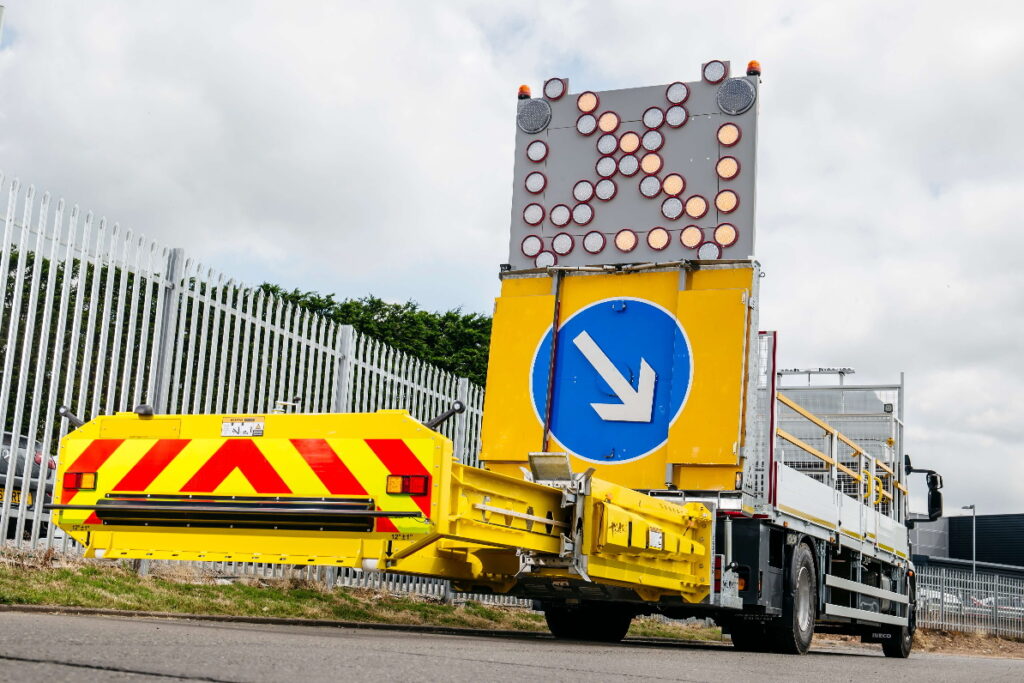
The main difference between a 70K and 100K truck mounted attenuator is the weight of the host vehicle each system is rated for. A 70K TMA is designed for trucks weighing up to 70,000 lbs (approximately 31,750 kg), while a 100K TMA is rated for host vehicles up to 100,000 lbs (approximately 45,360 kg). This distinction directly affects which crash test standard applies, how much impact energy the system can absorb, and which deployments each unit is approved for. The sections below break down what these ratings mean in practice and how to choose the right system for your work zone.
What do the 70K and 100K ratings actually mean?
The 70K and 100K ratings refer to the maximum allowable gross vehicle weight (GVW) of the truck that carries the attenuator. A 70K TMA is certified for use on host vehicles up to 70,000 lbs, and a 100K TMA is certified for host vehicles up to 100,000 lbs. These weight thresholds are not arbitrary, they are defined by the crash test protocols used to validate each system’s performance.
When a TMA is crash tested, the test is conducted with a host vehicle at a specific weight. The resulting certification is only valid when the attenuator is mounted to a truck within that approved weight range. Mounting a 70K-rated system to a heavier truck does not automatically improve protection, it actually voids the certification and may compromise crash performance in ways that are difficult to predict in the field.
The weight rating also signals how much kinetic energy the attenuator is designed to manage during an impact. Heavier host vehicles provide greater resistance mass, which changes how the crash cushion behaves on contact. A 100K system is engineered to work with that additional mass, while a 70K system is optimized for a lighter platform.
How does host vehicle weight affect crash performance?
Host vehicle weight is one of the most important variables in TMA crash performance because the truck itself acts as a resistance mass during an impact. When an errant vehicle strikes the attenuator, the crash cushion absorbs and redirects energy, but the host truck’s inertia determines how effectively that energy is managed. A heavier truck moves less on impact, which allows the attenuator to perform closer to its tested parameters.
If a TMA is mounted to a truck that is significantly lighter than the rated weight, the host vehicle may be pushed forward more than anticipated during a crash. This can reduce the attenuator’s ability to redirect the impacting vehicle safely and may increase the risk of injury to both the errant driver and workers in the work zone. Conversely, using a 70K-rated system on a truck that exceeds 70,000 lbs introduces structural stresses the attenuator was not designed to handle.
This is why matching the TMA rating to your actual truck weight is not just a compliance requirement, it is a direct safety consideration with real consequences in the event of a collision.
Which MASH test levels apply to each weight class?
Both 70K and 100K truck mounted attenuators can be tested under MASH (Manual for Assessing Safety Hardware) 2016, the current standard in the United States. However, the specific test conditions differ based on the host vehicle weight class, and not all attenuators in each category carry the same test level certification.
Under MASH 2016, TMA testing at Test Level 3 (TL-3) involves an impacting vehicle traveling at 100 km/h (62 mph). The host vehicle weight used during testing must fall within the rated range of the system. A 70K-rated TMA is tested with a lighter host truck, while a 100K system uses a heavier one. Both must meet the same occupant risk criteria and vehicle trajectory requirements to receive MASH acceptance.
It is worth noting that MASH 2016 superseded the earlier NCHRP 350 standard. Many older TMAs were tested only to NCHRP 350, which used different impact conditions. If your project or jurisdiction requires MASH 2016 compliance, which is increasingly common for federally funded work in the US, you need to confirm that the specific TMA model you are deploying holds a current FHWA acceptance letter under that standard, not just NCHRP 350 approval.
When should a contractor choose a 100K over a 70K TMA?
You should choose a 100K TMA when your host vehicle weighs more than 70,000 lbs gross vehicle weight, or when your project specifications explicitly require a 100K-rated system. This commonly applies to larger work zone trucks, tandem-axle vehicles, or trucks carrying additional equipment or materials alongside the attenuator.
Beyond vehicle weight, several other factors point toward a 100K system:
- High-speed highway deployments where the additional mass of a heavier truck provides more stable crash performance at impact speeds up to 100 km/h
- Long-duration projects where the host truck may be loaded differently from day to day and consistently exceeds 70,000 lbs
- Contractual or agency requirements that specify 100K-rated equipment, particularly on federally funded infrastructure projects
- Fleet standardization where a contractor operates predominantly heavy trucks and wants a single TMA specification across their equipment
If your truck regularly operates at or near the 70K threshold, a 100K system also gives you a practical buffer. Running a 70K-rated TMA on a truck that occasionally tips over the weight limit, due to fuel load, equipment, or ballast, puts you outside the certified operating range.
What are the practical deployment differences between the two?
In day-to-day deployment, the most noticeable difference between a 70K and 100K TMA is the type of truck each system mounts to. A 70K system is typically paired with medium-duty work trucks, while a 100K system is built for heavier, often multi-axle vehicles. This affects transport logistics, site access, and how the unit integrates with your existing fleet.
From a physical standpoint, 100K systems are generally more robust in their mounting hardware and structural components to accommodate the greater forces involved during a crash with a heavier host vehicle. This can translate to slightly more complex installation procedures and a higher unit weight, which matters when you are managing equipment across multiple active work zones.
Both weight classes can be equipped with accessories such as LED arrow boards, variable message signs, and hydraulic lift masts, so the functional capabilities at the work zone level are largely equivalent. The decision comes down to your truck, your certification requirements, and your project specifications rather than operational features.
How Verdegro Helps You Choose the Right TMA
We manufacture a range of truck mounted attenuator systems covering both weight classes, all tested and approved to current crash safety standards including MASH 2016 and NCHRP 350 TL-3. Our lineup includes:
- TMA-US 100K and TTMA-US 100K for heavy host vehicles up to 100,000 lbs
- LTMA-US 70K for medium-duty trucks within the 70K weight class
- BLADE TMA, a compact and versatile option for specific deployment scenarios
All our systems hold FHWA acceptance letters under MASH 2016, so you can deploy with confidence on federally funded projects. Optional accessories including LED arrow boards, full-color VMS displays, and hydraulic LED lift masts are available across the range, giving you a complete work zone protection solution from a single supplier.
If you are unsure which weight class fits your fleet or project requirements, we can help you match the right system to your specific trucks and compliance needs. Contact us and we will work through the options with you.
Related Articles
- What is the difference between impact protection for vans and trucks?
- Do truck mounted attenuator prices vary by weight class or standard?
- What should a driver do after hitting a truck mounted attenuator?
- What does truck mounted attenuator mean?
- What speed can you safely crash into a truck mounted attenuator at?