
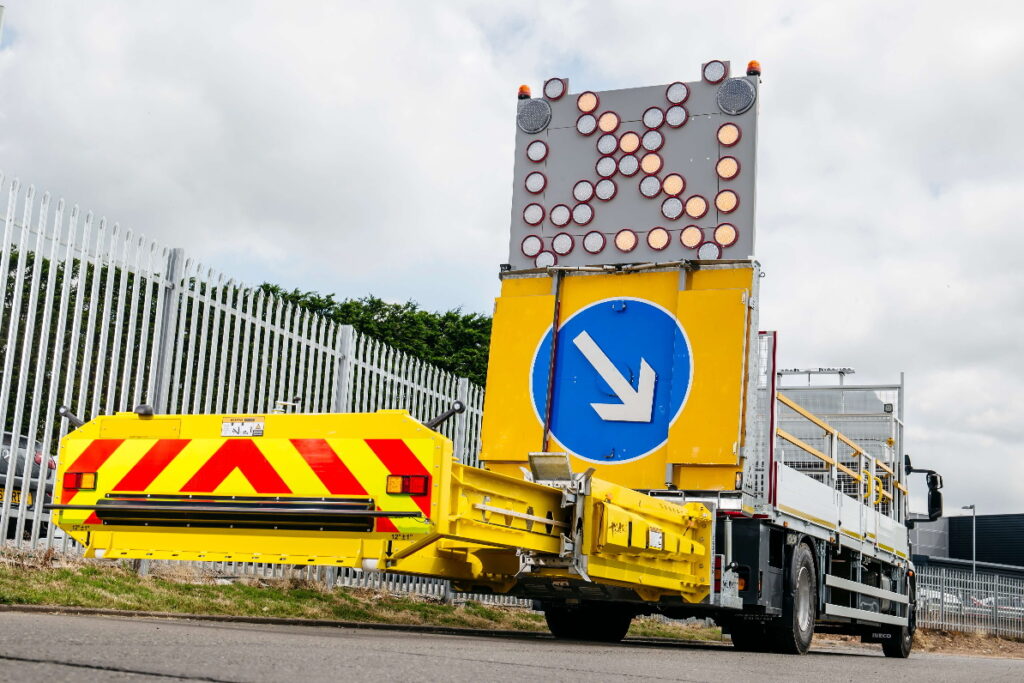
The TMA model that best fits your project depends primarily on the posted speed limit of the work zone, the gross vehicle weight of your host truck, and the crash test standard required by the contracting authority. These three factors narrow your options faster than any other criteria. Beyond that, configuration choices, such as whether you need a hydraulic lift, an arrow board, or a towable setup, refine the selection further. The sections below walk through each decision point in detail.
What factors determine which TMA model fits a project?
The right truck mounted attenuator model for a project is determined by four core factors: the work zone speed limit, the minimum host vehicle weight required by the attenuator’s certification, the applicable crash test standard in your jurisdiction, and any operational needs such as arrow boards or variable message signs. Getting any one of these wrong can result in a non-compliant deployment.
Start with the speed limit posted in the work zone, since every TMA is rated to a specific test level that corresponds to a maximum impact speed. Then confirm the gross vehicle weight (GVW) of the truck you plan to use as the host vehicle, as attenuators carry minimum weight requirements to absorb crash energy correctly. If the truck is too light, the system will not perform as tested.
Operational requirements come next. A long-term lane closure on a highway may justify the added investment in a hydraulic LED-lift mast and full-color VMS display. A short-duration maintenance job on a lower-speed road may need nothing more than a fixed-mount unit with a basic arrow board. Matching the configuration to the actual job scope keeps costs proportionate without compromising worker protection.
What is the difference between MASH and NCHRP 350 rated attenuators?
MASH (Manual for Assessing Safety Hardware) and NCHRP 350 are two generations of crash test standards used to evaluate roadside safety hardware in the United States. MASH 2016 is the current standard and uses heavier, more demanding test vehicles than NCHRP 350, which means a MASH-rated attenuator has passed a stricter evaluation. Most U.S. federal and state agencies now require MASH compliance for new procurements.
NCHRP 350 was the dominant standard for decades, and many attenuators still in service were approved under it. However, the Federal Highway Administration (FHWA) has progressively moved toward MASH as the baseline for new projects. If you are bidding on a government contract today, check whether the specification explicitly calls for MASH 2016 compliance, as many do, and submitting an NCHRP 350-only product can disqualify your bid.
The practical difference for buyers is straightforward: a MASH-rated TMA gives you the broadest acceptance across current and future projects. An NCHRP 350-rated unit may still be permissible on certain jobs, but its applicability is narrowing as agencies update their specifications.
How does speed limit affect TMA model selection?
The posted speed limit in the work zone directly determines the test level (TL) your truck mounted attenuator must meet. Test Level 3 (TL-3) covers impact speeds up to 100 km/h (62 mph) and is the standard required for most highway and freeway work zones. Lower-speed urban or arterial work zones may only require TL-2, which covers impacts up to 70 km/h (44 mph).
Selecting a TMA rated below the posted speed limit is a compliance failure and a serious safety risk. The attenuator is engineered to absorb a specific kinetic energy load. If an errant vehicle strikes at a speed higher than the rated test level, the system may not redirect or absorb the impact as designed.
Always confirm the regulatory speed limit of the road, not just the temporary work zone speed. In some jurisdictions, the attenuator rating must correspond to the normal operating speed of the road, not the reduced work zone speed, because drivers do not always comply with temporary speed reductions. Check the contract documents and local regulations before finalizing your model selection.
What’s the difference between shadow truck and host vehicle TMA configurations?
A shadow truck is a vehicle deployed specifically to carry a TMA and trail behind workers or equipment, providing a moving buffer zone. A host vehicle configuration refers to a work truck that carries the TMA as part of its normal operational role, for example, a line-marking truck or a maintenance vehicle that also serves as a crash cushion. The distinction matters because it affects vehicle weight, operational flexibility, and cost.
Shadow trucks are dedicated protection units. They follow the work crew at a set distance and absorb impacts from vehicles that fail to slow down or merge. Because the truck’s sole purpose is protection, it can be optimized for weight and stability without carrying additional equipment loads.
Host vehicle configurations integrate the TMA into a truck that also performs another function. This approach reduces the number of vehicles needed on site, which can lower operational costs and reduce traffic disruption. The trade-off is that the host vehicle must meet the TMA’s minimum weight requirements regardless of what else it is carrying, and the combined equipment load needs careful management.
For long-duration, high-speed highway projects, a dedicated shadow truck typically provides cleaner compliance and easier weight management. For urban or lower-speed jobs where flexibility and reduced vehicle count matter more, a host vehicle configuration is often the more practical choice.
When should a project use a hydraulic versus a fixed-mount attenuator?
A hydraulic attenuator is the right choice when the project requires an elevated arrow board or LED-lift mast that needs to be raised and lowered during operations. A fixed-mount attenuator suits projects where the TMA is deployed and remains stationary, and no height-adjustable signage is needed. The decision comes down to whether your traffic control plan requires visible overhead signage at height.
Hydraulic systems add mechanical complexity and require maintenance, but they deliver a significant visibility advantage on high-speed roads where drivers need early warning. An elevated arrow board or variable message sign mounted on a hydraulic mast is visible from much farther back than a board mounted at truck-bed height, giving drivers more time to react.
Fixed-mount systems are simpler, lighter, and more cost-effective for straightforward deployments. If the work zone layout provides adequate advance warning through static signs and the TMA is primarily there to absorb impacts rather than direct traffic, a fixed-mount unit performs that function reliably without the added weight or maintenance demands of a hydraulic system.
Consider the duration of the project as well. A multi-month highway resurfacing contract justifies the investment in a hydraulic setup. A one-week drainage repair on a secondary road typically does not.
Which TMA certifications matter most for government and contractor procurement?
For government and contractor procurement in 2026, the certifications that carry the most weight are FHWA acceptance letters under MASH 2016 and, where applicable, equivalent national approvals in the country of deployment. An FHWA acceptance letter confirms that the attenuator has been independently evaluated and accepted for use on federal-aid highway projects in the United States. It is the most widely recognized credential in North American procurement.
Beyond MASH compliance, look for the following when evaluating certifications:
- Test level documentation: Confirm which test levels (TL-2, TL-3) the unit is approved for, matched to your work zone speed requirements.
- Acceptance letter specificity: FHWA acceptance letters are issued per product model. Verify the letter covers the exact configuration you plan to deploy, including any accessories.
- European CE marking: For projects in EU member states, CE marking and compliance with relevant EN standards may be required alongside or instead of FHWA documentation.
- State or national DOT approvals: Some state departments of transportation maintain their own approved products lists. Federal acceptance does not automatically guarantee state acceptance.
Contractors bidding on public tenders should request certification documentation from manufacturers before purchasing. Submitting a product with incomplete or outdated certification can invalidate a bid or trigger contract penalties after deployment.
How Verdegro Helps You Select the Right TMA
We manufacture a range of truck mounted attenuator systems designed to cover the full spectrum of project requirements, from lower-speed urban maintenance work to high-speed highway construction. Our product line includes the TMA-US 100K, TTMA-US 100K, LTMA-US 70K, and BLADE TMA, each tested and approved to recognized crash safety standards.
Here is how our range maps to the selection criteria covered in this article:
- MASH 2016 compliance: We hold multiple FHWA acceptance letters under MASH 2016, the current standard, so our attenuators are accepted for federal-aid highway projects in the United States.
- Speed range coverage: Our models cover both TL-2 and TL-3 test levels, giving you certified options for urban and highway work zones.
- Host vehicle weight flexibility: The 100K and 70K designations in our model names reflect the minimum host vehicle weight requirements in pounds, making it straightforward to match the attenuator to your truck fleet.
- Optional accessories: All models are available with LED arrow boards, full-color VMS displays, and hydraulic LED-lift masts, so you can configure the system to your traffic control plan without sourcing components from multiple suppliers.
- Shadow truck and host vehicle configurations: Our range supports both deployment approaches, and we can advise on which configuration suits your specific project scope.
If you are comparing models or preparing a procurement specification, contact us directly and we will help you identify the right attenuator for your speed limit, truck weight, and certification requirements.
Related Articles
- Do all truck mounted attenuators come with arrow boards included?
- Can you customize a truck mounted attenuator with additional warning lights?
- How often are truck mounted attenuators hit by vehicles?
- What is NCHRP-350 and how does it apply to truck mounted attenuators?
- Does a heavier truck mounted attenuator offer better protection?