
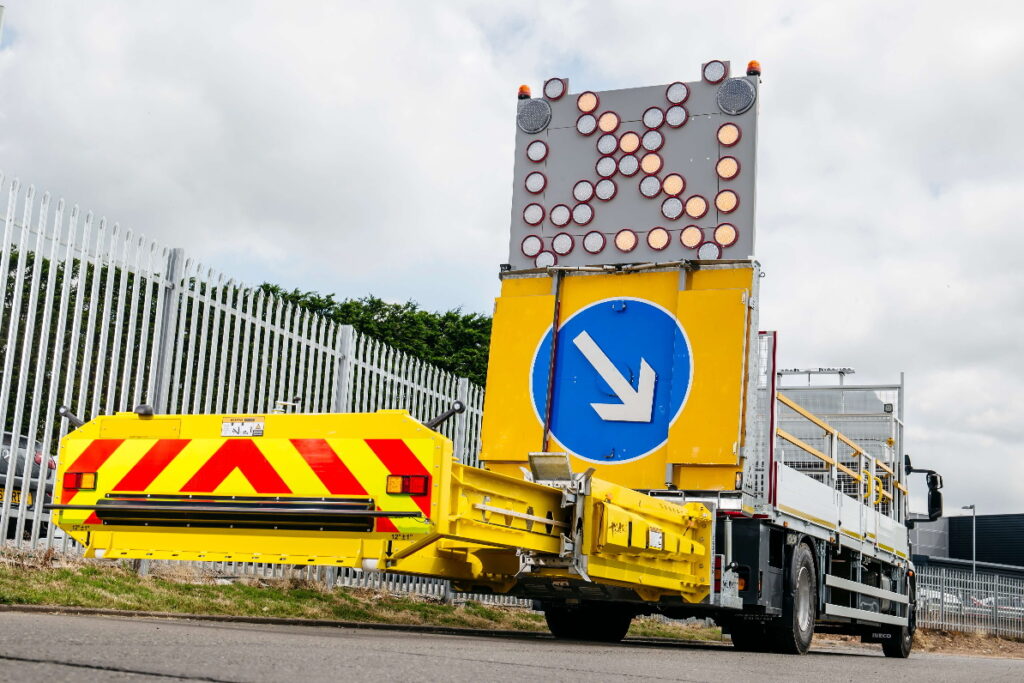
The choice between a truck-mounted attenuator (TMA) and a trailer-mounted attenuator depends on how you deploy your work zone. A TMA attaches directly to a host vehicle and moves with it, making it the right choice for mobile or slow-moving operations. A trailer-mounted attenuator is a standalone unit towed into position, which suits stationary setups where the attenuator stays fixed for extended periods.
Both types absorb impact energy to protect workers and drivers in active work zones, but they differ in flexibility, operational cost, and deployment context. The sections below break down those differences question by question so you can make an informed decision for your next project.
What are the key differences between truck-mounted and trailer-mounted attenuators?
A truck-mounted attenuator (TMA) is a crash cushion bolted to the rear of a host truck, making the vehicle and attenuator a single integrated unit. A trailer-mounted attenuator (TTMA) is an independent trailer with a crash cushion built in, towed to a location and left in place. The main distinction is mobility: a TMA moves continuously with the truck, while a TTMA is deployed and disconnected from the tow vehicle.
This difference shapes nearly every other aspect of how you use each system:
- Deployment speed: A TMA is always ready because it stays attached to the host vehicle. A TTMA requires positioning, leveling, and detaching the tow vehicle before the work zone is protected.
- Flexibility: TMAs are well-suited to dynamic operations where the protection point moves frequently. TTMAs work better when the attenuator needs to remain in one location for hours or days.
- Host vehicle dependency: A TMA occupies a truck full-time. A TTMA frees the tow vehicle once deployed, so that vehicle can perform other tasks on site.
- Footprint: TTMAs are generally larger and heavier than TMAs, which affects where you can position them and what vehicle you need to tow them.
Which attenuator type offers better protection in high-speed work zones?
Both truck-mounted and trailer-mounted attenuators can provide certified protection in high-speed work zones, provided they are tested and approved to the relevant standard for that speed category. The protection level depends on the test standard and impact speed rating of the specific unit, not the mounting type alone. For high-speed highways, you need an attenuator rated to MASH 2016 or NCHRP 350 TL-3 at minimum.
At higher impact speeds, the mass of the host vehicle or trailer becomes a factor. A TMA transfers crash energy partly through the host truck, so the truck’s weight directly influences how effectively the system manages an impact. A TTMA, being a standalone unit, must absorb and redirect impact energy independently, which is why heavier TTMAs are common in high-speed applications.
For mobile operations on live high-speed roads, such as lane closures on motorways where the shadow vehicle moves with a paving or striping crew, a TMA is the standard choice. For a stationary taper point on a high-speed road that remains in place for a full shift, a TTMA can be equally effective and frees up the tow vehicle for other work.
When should a contractor choose a trailer-mounted attenuator over a TMA?
Choose a trailer-mounted attenuator when your work zone is stationary and you need to free your tow vehicle for other tasks. TTMAs are the right tool when protection needs to remain in place for long periods, the host vehicle is more valuable doing other work on site, and the setup location is accessible enough to position a larger trailer unit.
Specific situations where a TTMA makes practical sense include:
- Long-duration lane closures on high-speed roads where the taper point does not move for an entire shift or multiple days
- Projects where the contractor has limited trucks and cannot dedicate one solely to carrying a TMA throughout the workday
- Locations where a fixed, highly visible attenuator trailer with LED arrow boards improves driver awareness at a static merge point
- Situations where the tow vehicle needs to transport materials, equipment, or crew within the work zone after setup
If your operation involves a moving work zone, such as a rolling road closure, a TMA is almost always the better fit because the protection travels with the crew continuously.
What are the maintenance and operational costs of each attenuator type?
Truck-mounted attenuators generally have lower standalone acquisition costs than TTMAs, but they tie up a host vehicle full-time, which adds an indirect operational cost. Trailer-mounted attenuators carry a higher upfront price and require towing equipment, but they release the tow vehicle after deployment, reducing idle vehicle time on long-duration sites.
Maintenance considerations also differ between the two types:
- TMA maintenance: After an impact, the crash cartridge or cushion system needs inspection and often replacement. Because the TMA is integrated with the truck, any repair work also takes the host vehicle out of service temporarily.
- TTMA maintenance: Repairs to the attenuator system do not affect the tow vehicle’s availability. However, the trailer itself adds maintenance items such as wheel bearings, lighting connections, and trailer brakes.
- Consumable components: Both types use replaceable impact-absorbing elements. Sourcing certified replacement parts from the original manufacturer keeps the system compliant after a strike.
- Downtime costs: A TMA impact grounds your shadow truck. A TTMA impact grounds the trailer only, which can be a meaningful operational advantage on large projects.
Over a full project lifecycle, the right choice depends on how frequently the attenuator is struck, how critical the host vehicle’s availability is, and the total number of units you need to protect multiple work zones simultaneously.
Do truck-mounted and trailer-mounted attenuators meet the same compliance standards?
Yes, both truck-mounted and trailer-mounted attenuators are tested and certified against the same crash safety standards. In the United States, the relevant standards are NCHRP 350 and the more current MASH 2016 (Manual for Assessing Safety Hardware). Both attenuator types must pass the same impact test criteria at the relevant test level to receive approval for use on public roads.
MASH 2016 is the most current standard and is now required for new products on federally funded projects in the US. When evaluating any attenuator, whether truck-mounted or trailer-mounted, confirm that the unit holds a valid FHWA acceptance letter under MASH 2016 if you are working on federally funded infrastructure. Older units approved under NCHRP 350 may still be permitted on some projects, but MASH 2016 approval reflects the highest current level of compliance.
One practical difference: because a TMA’s performance depends partly on the host vehicle’s weight, FHWA acceptance letters for TMAs often specify a minimum truck weight. Always verify that your host vehicle meets the weight requirement stated in the acceptance documentation for the specific TMA model you are using.
How Verdegro Can Help You Choose the Right Attenuator
We manufacture a range of truck-mounted attenuators and trailer-mounted systems designed for contractors and traffic management operators who need certified, field-ready crash protection. Our product line includes:
- TMA-US 100K and TTMA-US 100K: tested and approved to MASH 2016 for high-speed work zones
- LTMA-US 70K: a lighter-duty option for lower-speed applications
- BLADE TMA: a compact system approved to NCHRP 350 TL-3
All of our systems are available with optional LED arrow boards, full-color Variable Message Sign displays, and hydraulic LED-lift masts, so you can configure the unit to match your specific work zone requirements. We hold multiple FHWA acceptance letters under MASH 2016, giving you confidence that the equipment you deploy meets the most current compliance standard.
If you are unsure which attenuator type fits your project, we are ready to help you work through the decision based on your operational setup, host vehicle specifications, and the type of work zones you manage. Contact us to discuss your requirements directly with our team.
Related Articles
- What is a trailer light truck mounted attenuator and when is it used?
- What is CEN/TS 16786 for truck mounted attenuators?
- Is NCHRP-350 still valid or has it been replaced by MASH for truck mounted attenuators?
- Can a damaged truck mounted attenuator be repaired or does it need replacing?
- When is a truck mounted attenuator required at a roadwork site?