
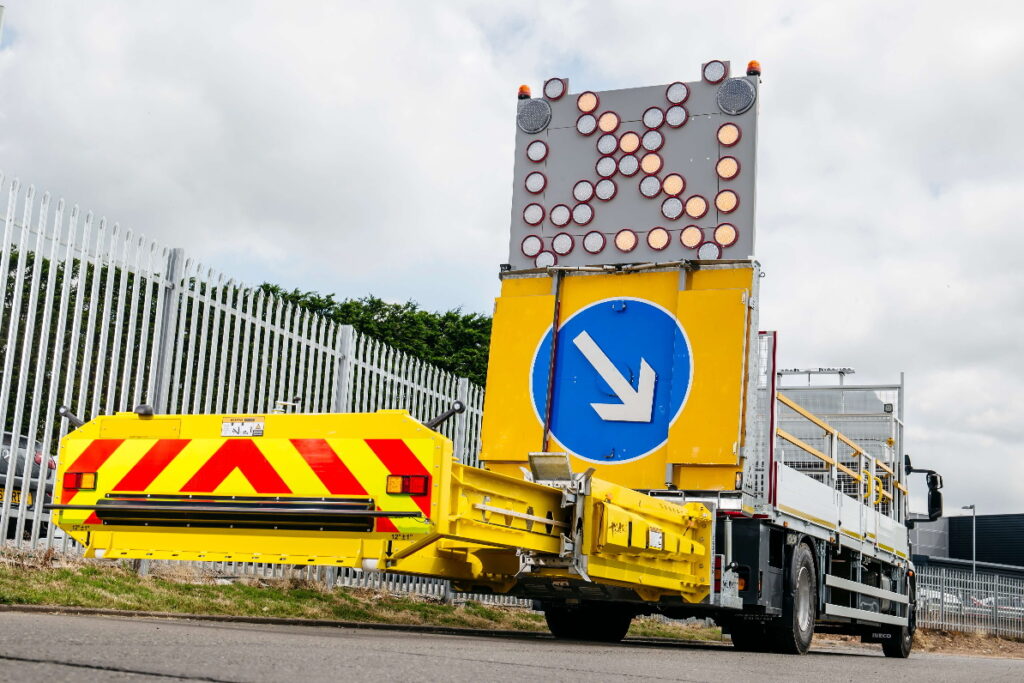
CEN/TS 16786 is a European technical specification that defines the testing and classification requirements for truck-mounted attenuators (TMAs) used in road work zone protection. It establishes standardized crash test procedures, performance categories, and marking requirements so that TMAs sold across European markets meet a consistent baseline of safety. The specification applies to manufacturers, procurement agencies, and contractors who deploy TMAs on public roads in Europe.
Below, we answer the most common questions about CEN/TS 16786 so you can understand what it requires, how it compares to North American standards, and what it means for your equipment choices.
How does CEN/TS 16786 classify truck-mounted attenuators?
CEN/TS 16786 classifies truck-mounted attenuators by impact speed category and the mass of the host vehicle. The specification defines performance levels based on the maximum speed at which a TMA must absorb a crash impact and redirect the errant vehicle safely. Classification also accounts for whether the host truck is stationary or moving at a shadow speed during impact.
The main classification parameters include:
- Impact speed: TMAs are tested at defined speeds, typically ranging from 50 km/h up to 110 km/h depending on the performance category.
- Host vehicle mass: The minimum mass of the carrier truck is specified, since a heavier host vehicle provides greater resistance and affects how the attenuator performs during impact.
- Shadow speed: Some test scenarios require the host vehicle to be moving slowly, simulating a moving work zone, while others test a stationary truck.
This classification system allows procurement teams to match the right TMA to the road environment. A motorway work zone operating at 110 km/h demands a higher performance category than a lower-speed urban maintenance operation.
What testing requirements does CEN/TS 16786 set for TMAs?
CEN/TS 16786 requires TMAs to undergo full-scale crash testing using defined impactor vehicles at specified speeds and angles. The tests evaluate whether the attenuator absorbs energy effectively, limits intrusion into the work zone, and controls the trajectory of the impacting vehicle to reduce the risk of secondary collisions.
Key testing requirements under the specification include:
- Head-on crash tests: A passenger car impacts the TMA directly from behind at the rated test speed.
- Occupant risk criteria: The test measures forces experienced by occupants of the impacting vehicle, including the Occupant Impact Velocity (OIV) and the Occupant Ridedown Acceleration (ORA), to confirm the crash is survivable.
- Exit box criteria: The post-impact trajectory of the impacting vehicle must stay within defined lateral boundaries to prevent it from entering the live traffic lane or the work zone.
- Structural integrity of the host vehicle: The test verifies that the carrier truck remains stable and that the attenuator mounting does not compromise the truck beyond acceptable limits.
Manufacturers must conduct these tests at accredited facilities and document results in a test report. The TMA can only be marked and sold as compliant once the test results satisfy all performance thresholds specified in the standard.
How does CEN/TS 16786 differ from MASH and NCHRP 350?
CEN/TS 16786 is the European technical specification for TMAs, while MASH (Manual for Assessing Safety Hardware) and NCHRP 350 are the North American standards used in the United States and Canada. All three evaluate crash performance, but they differ in test vehicles, speed thresholds, and acceptance criteria.
The most important differences are:
- Test vehicles: MASH uses specific vehicle models representing a small car and a pickup truck, with defined masses. CEN/TS 16786 uses European vehicle categories that reflect the European passenger car fleet, which can differ in mass and geometry.
- Speed categories: MASH TL-3 testing is conducted at 100 km/h (62 mph). CEN/TS 16786 defines its own speed tiers in metric terms, and the applicable speed depends on the performance category selected.
- Regulatory context: MASH acceptance letters are issued by the FHWA and are required for federally funded US highway projects. CEN/TS 16786 compliance is referenced within European procurement and road authority requirements.
- Technical specification vs. full standard: CEN/TS 16786 carries the designation “TS” (Technical Specification) rather than “EN” (European Norm), meaning it has a provisional status and is subject to review. MASH is a fully adopted guideline with established FHWA backing.
A TMA certified under MASH 2016 is not automatically accepted under CEN/TS 16786, and vice versa. If you operate in both markets, you need to verify that your equipment holds the relevant acceptance documentation for each region.
Which truck-mounted attenuators are certified under CEN/TS 16786?
Certification under CEN/TS 16786 depends on whether the manufacturer has submitted their TMA for testing at an accredited laboratory and received a conforming test report. Not all TMAs on the market carry this certification, so you should always request documentation before purchasing or specifying equipment for European road projects.
When evaluating a TMA for CEN/TS 16786 compliance, ask the manufacturer for:
- The full crash test report from an accredited test facility
- The performance category the TMA was tested to
- The host vehicle mass and configuration used during testing
- Any conditions or limitations attached to the certification
It is also worth confirming whether the certified configuration matches your intended deployment. A TMA tested on a specific truck type at a specific mass may not carry the same certification if you mount it on a different vehicle.
Does CEN/TS 16786 compliance satisfy EU road safety regulations?
CEN/TS 16786 compliance is widely referenced in European road authority specifications and public tender requirements, but it does not by itself constitute a legal obligation under EU law. Road safety equipment regulation in Europe operates primarily at the national level, meaning individual member states set their own procurement rules and may or may not mandate compliance with this specification.
In practice, many national highway agencies and large contractors treat CEN/TS 16786 as the de facto benchmark for TMA procurement in Europe. Compliance demonstrates that the equipment has been independently tested to a recognized European standard, which strengthens your position in tenders and reduces liability risk.
You should also be aware that CEN/TS 16786 is a technical specification rather than a harmonized standard under the EU’s Construction Products Regulation (CPR). This means it does not automatically trigger CE marking obligations in the same way a harmonized EN standard would. Always verify the specific regulatory requirements in the country where you plan to deploy the equipment.
How Verdegro Supports Your TMA Compliance Needs
We manufacture a range of truck-mounted attenuators that have been tested and approved to internationally recognized crash safety standards. Our TMA portfolio includes the TMA-US 100K, TTMA-US 100K, LTMA-US 70K, and BLADE TMA, all tested under NCHRP-350 TL-3 and MASH 2016. We hold multiple FHWA acceptance letters under MASH 16, the most current North American standard.
Here is what working with us gives you:
- Verified crash test documentation so you can demonstrate compliance to road authorities and tender committees
- A range of performance configurations to match your host vehicle and deployment environment
- Optional integrated accessories including LED arrow boards, full-color VMS displays, and hydraulic LED-lift masts
- Real-time fleet visibility through our Mobilityplanner platform, giving you GPS tracking, status updates, and remote control of your deployed equipment
If you are specifying TMAs for a project and need to understand which configuration fits your requirements, contact us and we will help you identify the right solution.
Related Articles
- What is the story behind the Armadillo truck mounted attenuator?
- Why is Verdegro's truck mounted attenuator called Armadillo?
- What happens to a truck mounted attenuator after it's been hit?
- What is the safe following distance behind a truck mounted attenuator?
- How do you choose the right truck mounted attenuator weight class?