
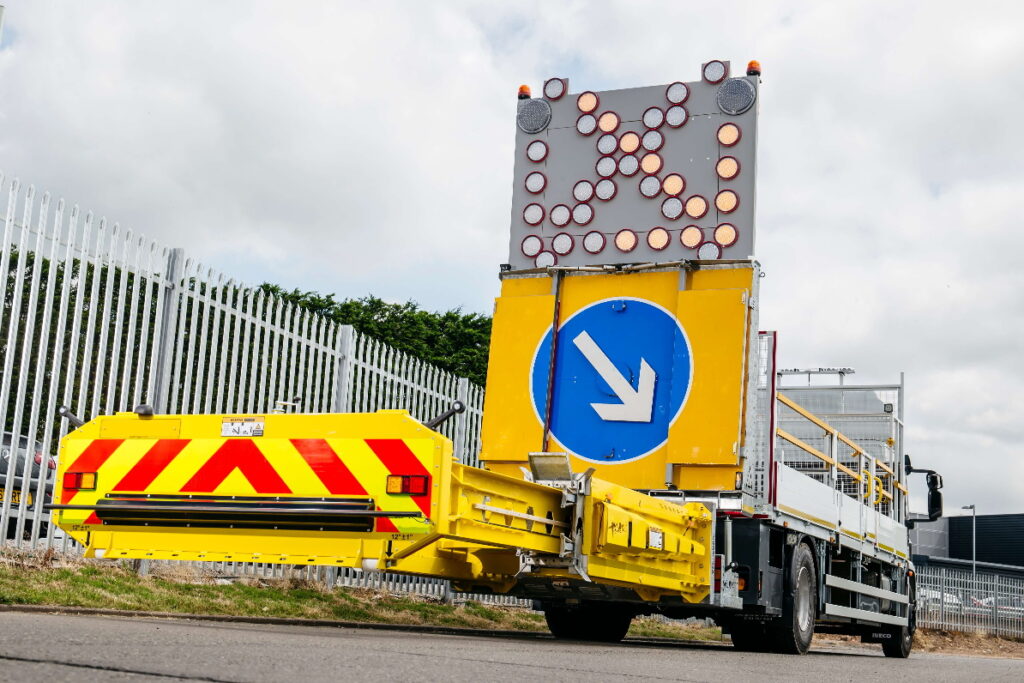
The safe following distance behind a truck-mounted attenuator is at least 100 feet (approximately 30 meters) at low speeds, but this increases significantly with speed. At highway speeds, drivers should maintain a minimum of one car length per 10 mph of travel speed, meaning 500 feet or more at 50 mph. The exact distance depends on road conditions, speed limits, and local regulations governing work zone safety. The sections below unpack the specific factors that shape this distance and what you should know before driving near an active work zone.
Why does the following distance behind a TMA vary by situation?
The following distance behind a truck-mounted attenuator varies because no two work zones are identical. Speed limits, road surface conditions, vehicle type, weather visibility, and the specific role the TMA is playing in traffic control all influence how much space a following driver needs to stop safely. A single fixed number cannot cover every scenario.
A TMA is not a static object. It moves with traffic, slows for lane closures, stops unexpectedly, and sometimes reverses. This dynamic behavior makes it fundamentally different from a parked vehicle or a fixed barrier. The following driver must account for the TMA’s potential to decelerate rapidly at any moment.
Additional factors that change the required buffer include:
- Road surface: Wet or uneven surfaces extend stopping distances considerably.
- Vehicle load: Heavier vehicles require more distance to stop than lighter ones.
- Visibility: Fog, rain, and night conditions reduce reaction time.
- Traffic density: Congested conditions increase the risk of rear-end collisions when a TMA slows abruptly.
- Work zone activity: Active lane changes or workers merging near the TMA demand extra caution.
Because these variables interact, traffic safety professionals and regulators consistently recommend erring on the side of greater distance rather than less.
What do traffic safety regulations say about TMA buffer zones?
Traffic safety regulations in most jurisdictions require a clearly defined buffer zone behind a TMA, though the exact measurement varies by country and standard. In the United States, the Manual on Uniform Traffic Control Devices (MUTCD) and state-level work zone safety guidelines typically specify a minimum buffer space of 100 feet at low speeds, scaling upward with posted speed limits. European standards follow similar principles under national road authority guidelines.
In the US, work zone regulations also distinguish between the “buffer space” (the distance between the TMA and the first active worker or piece of equipment) and the “taper length” (the distance over which traffic is directed to merge). Both are regulated separately, and both contribute to overall safety in the work zone.
Regulators design these requirements around stopping sight distance calculations. The logic is straightforward: a driver must be able to see the TMA, perceive a hazard, react, and bring their vehicle to a complete stop before making contact. At 60 mph, that process alone can consume more than 300 feet under ideal conditions.
Contractors and traffic management operators deploying TMAs are responsible for ensuring that signage, speed reductions, and approach tapers give drivers enough advance warning to comply with these buffer requirements before they reach the TMA itself.
How does vehicle speed affect the required following distance?
Speed has a direct and non-linear effect on following distance. Stopping distance does not simply double when speed doubles, it increases by roughly the square of the speed increase. A vehicle traveling at 60 mph needs approximately four times the stopping distance of one traveling at 30 mph. This means that at higher speeds, the required following distance behind a truck-mounted attenuator grows dramatically.
A practical rule used in many work zone safety programs is the one-second-per-10-mph rule for following distance, or the equivalent car-length method:
- 30 mph: Minimum 3 seconds of following time, roughly 130 feet
- 45 mph: Minimum 4-5 seconds, roughly 300 feet
- 60 mph: Minimum 6 seconds, roughly 500+ feet
- Highway speeds (65-70 mph): Many safety programs recommend 600 feet or more
These figures assume dry pavement and an alert driver with a standard reaction time. In wet conditions or reduced visibility, multiply these distances by at least 1.5. Heavy goods vehicles, which have longer braking distances than passenger cars, should apply even greater margins.
Work zones typically post reduced speed limits specifically to bring these stopping distances within manageable ranges. When you see a reduced speed limit approaching a work zone, it is not arbitrary, it is calibrated to make the buffer zone behind the TMA effective.
What happens if a vehicle follows a TMA too closely?
If a vehicle follows a TMA too closely and the TMA stops or slows suddenly, the result is a rear-end collision with a heavy work truck. Even at moderate speeds, this type of impact causes serious injury or death. The TMA is specifically designed to absorb and redirect this impact energy, but it is not a guarantee of survivability at all speeds and angles.
A TMA works by crushing progressively to dissipate crash energy and redirect the striking vehicle away from workers. This process is most effective within the tested impact parameters. Crashes that occur at speeds significantly above the TMA’s design threshold, or at oblique angles, can result in outcomes that exceed what the attenuator was engineered to manage.
Beyond the physical danger, following too closely also creates a legal liability. Work zone violations carry heavy fines in most jurisdictions, and in the event of a collision, a driver who was tailgating a TMA will typically bear full legal responsibility for the incident. Some regions have doubled fines for work zone traffic violations precisely because of how frequently close-following contributes to crashes in these environments.
For workers on foot or operating equipment behind the TMA, a close-following collision can be fatal. The buffer zone the TMA provides is not just for the driver, it is the last line of protection for road crews who have no escape route.
Should drivers behave differently around a TMA than a regular truck?
Yes, you should treat a TMA-equipped truck with significantly more caution than a standard commercial vehicle. A regular truck is generally moving at a consistent speed toward a fixed destination. A TMA is operating in an active work zone, which means it may slow, stop, turn, or reverse with little or no warning. The stakes of a collision are also higher because workers are present nearby.
Specific behaviors that matter around a TMA include:
- Increase your following distance well beyond what you would maintain behind a standard truck.
- Reduce your speed before you reach the work zone, not as you enter it.
- Avoid distractions, reaction time is the first thing that erodes following distance in practice.
- Do not attempt to overtake a TMA in a work zone unless signage and lane markings explicitly permit it.
- Watch for workers who may step into the roadway from areas shielded by the TMA.
- Follow instructions from traffic control personnel, whose signals override standard road rules.
The arrow boards and warning lights mounted on a TMA are not decoration. They signal that you are entering a higher-risk environment where normal driving assumptions no longer apply. Treating a TMA as you would any other large vehicle is one of the most common mistakes drivers make in work zones.
How Verdegro Helps with Truck-Mounted Attenuator Safety
We design and manufacture truck-mounted attenuators built to meet the most current international crash safety standards, including MASH 2016 and NCHRP-350 TL-3. Our TMA range includes the TMA-US 100K, TTMA-US 100K, LTMA-US 70K, and BLADE TMA, each engineered to absorb and redirect impact energy in real-world work zone conditions.
Our systems are built for road construction contractors and traffic management operators who need certified, durable crash protection that performs when it matters. To make our attenuators as visible and effective as possible, we offer:
- Integrated LED arrow boards that give approaching drivers early, clear directional guidance
- Full-color VMS displays for speed limit reminders and work zone warnings
- Hydraulic LED-lift masts for maximum visibility in low-light and night work conditions
We hold multiple FHWA acceptance letters under MASH 16, which means our products have passed the most rigorous crash testing requirements currently in effect. You can explore our full range of crash protection systems to find the right configuration for your work zone setup.
If you want to discuss your specific requirements or get advice on which TMA best fits your operation, contact our team directly. We are ready to help you protect your workers and comply with the safety standards that matter.
Related Articles
- What determines which type of impact attenuator you need?
- What types of safety vehicles should a road maintenance fleet include?
- Do you need a special license to tow a trailer truck mounted attenuator?
- Why do trucks have truck mounted attenuators attached?
- What speed can you safely crash into a truck mounted attenuator at?