
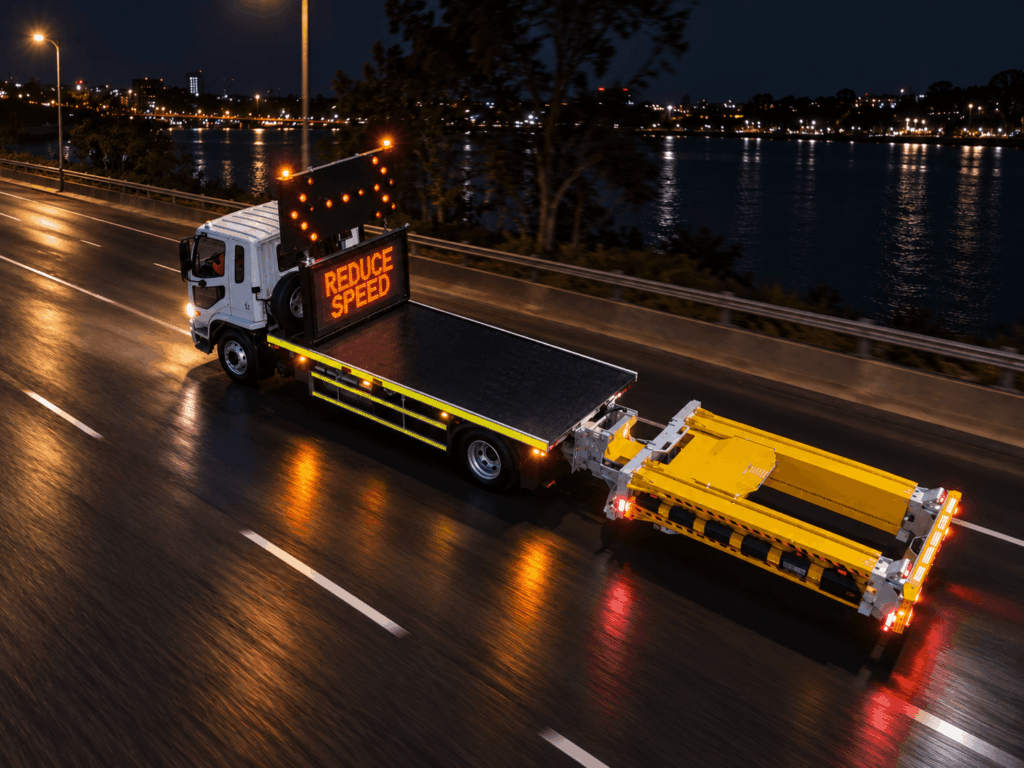
A road maintenance fleet should include truck mounted attenuators (TMAs), shadow vehicles, arrow board trucks, variable message sign (VMS) vehicles, and lane closure support vehicles. The exact combination depends on the type of work, road classification, and applicable safety standards in your region. This article walks through each vehicle type, what makes it safety-rated, and how to build a fleet that provides complete work zone coverage.
What makes a vehicle ‘safety-rated’ for road maintenance work?
A vehicle is considered safety-rated for road maintenance when it meets recognized crash test standards and carries the certifications required by the relevant transport authority. In most markets, this means the vehicle and any attached safety equipment have been tested and approved under standards such as MASH 2016 (Manual for Assessing Safety Hardware) or equivalent national frameworks. Without this certification, a vehicle may not be legally deployed in live traffic work zones.
Safety rating applies both to the host vehicle and the equipment mounted on it. A truck fitted with a crash cushion, for example, must have that cushion tested as a complete system, not just the cushion in isolation. Key factors that determine safety rating include:
- Crash test approval level — Test Level 3 (TL-3) covers impacts up to 100 km/h (62 mph), which is the standard required for most highway applications
- Certification documentation — Official crash test reports and CE marking (in Europe) or FHWA acceptance letters (in the US)
- Vehicle weight compatibility — The host truck must fall within the minimum and maximum weight range specified for the mounted system
- Visibility compliance — Arrow boards, LED displays, and reflective chevrons must meet national specifications
Fleet managers should request full certification documentation for every piece of safety equipment before procurement. Regulatory requirements vary by country, so always verify which standard applies to your operating territory.
What is a truck mounted attenuator and when is it required?
A truck mounted attenuator (TMA) is a crash cushion system fitted to the rear of a truck that absorbs the energy of an errant vehicle before it reaches workers or equipment in a work zone. The attenuator is designed to decelerate an impacting vehicle in a controlled way, significantly reducing the severity of the collision. Truck mounted attenuators are required whenever workers are exposed to live traffic, particularly on high-speed roads and motorways.
The truck carrying the TMA is typically positioned as a shadow vehicle, parked at the upstream end of the work zone to intercept any vehicle that drifts out of its lane. Most national road safety standards mandate TMA use on roads with speed limits above a defined threshold, commonly 50 mph (80 km/h) or higher.
When evaluating whether a TMA is required, consider the following:
- Road type — Motorways, dual carriageways, and high-speed rural roads almost always require a TMA-equipped shadow vehicle
- Work duration — Both short-duration and long-term stationary works typically require impact protection
- Worker exposure — Any task that places workers within the clear zone of live traffic triggers the requirement
- Applicable standard — In the US, MASH 2016 governs TMA approval; in the UK, the TD49/07 110K test applies; other regions follow their own frameworks
Modern TMAs are available for both heavy trucks and closed vans, giving fleet managers flexibility based on the host vehicle available.
What types of vehicles are essential in a road maintenance fleet?
A road maintenance fleet needs at minimum five vehicle types to manage work zone safety effectively: a TMA-equipped shadow vehicle, an arrow board truck, a VMS vehicle, a lane closure support vehicle, and a supervisor or incident response vehicle. Each serves a distinct function, and the absence of any one type creates a gap in work zone protection.
Here is a breakdown of the core vehicle types and their primary roles:
- TMA shadow vehicle — Protects the upstream end of the work zone by absorbing rear-end impacts; the most important crash protection asset in a moving or stationary operation
- Arrow board vehicle — Guides traffic away from the work area using a directional LED display; can be a standalone trailer or mounted on a truck
- VMS vehicle — Displays variable text messages to warn drivers of upcoming hazards, speed reductions, or lane changes well in advance of the work zone
- Lane closure support vehicle — Carries cones, barriers, and signs for setting up and removing lane closures; often fitted with a cone-laying or rumble mat system
- Supervisor/incident management vehicle — Coordinates the operation, responds to incidents, and communicates with traffic control centers
For larger or longer-duration projects, fleets may also include mobile lighting towers, rumble mat layers, and dedicated incident management trucks. The right mix depends on the scope and duration of the work.
How do arrow boards and VMS vehicles differ in a work zone?
Arrow boards and VMS vehicles serve different communication purposes in a work zone. An arrow board uses a directional LED display to physically direct drivers into a specific lane: it shows arrows, chevrons, or flashing patterns that indicate where to move. A VMS (Variable Message Sign) vehicle displays text-based messages that inform drivers of conditions, distances, or instructions ahead of the work zone. Both are needed, but they operate at different points in the traffic management sequence.
Arrow boards are positioned at or near the taper point, where the lane narrows or closes, to give drivers a clear directional cue at the moment they need to merge. VMS vehicles are typically positioned further upstream, giving drivers advance warning so they can adjust speed and position before reaching the closure.
Key differences at a glance:
- Function: Arrow boards direct movement; VMS signs inform and warn
- Position in zone: Arrow boards sit at the taper; VMS vehicles deploy 500 m to several kilometers upstream
- Message type: Arrow boards show symbols and directional patterns; VMS displays text messages and pictograms
- Programmability: VMS signs are remotely programmable in real time; arrow boards typically operate in preset modes
In many operations, a single vehicle carries both an arrow board and a VMS sign, reducing the number of vehicles needed while maintaining full communication coverage.
What should fleet managers look for when specifying safety vehicles?
Fleet managers should prioritize certification compliance, operational simplicity, and total cost of ownership when specifying safety vehicles. A vehicle or system that meets the required crash test standard but is difficult to deploy or maintain creates operational risk and cost over time. The best safety vehicles combine proven protection with straightforward daily use.
The following criteria help structure the specification process:
- Crash test standard compliance — Confirm the system holds current certification under the applicable standard (MASH 2016, TD49/07, or regional equivalent)
- Deployment speed — Systems that deploy in under 20 seconds while the vehicle is moving reduce setup time and worker exposure
- Mechanical simplicity — Fewer sensors and electronic components mean fewer failure points and lower maintenance burden in demanding environments
- Host vehicle compatibility — Check minimum and maximum vehicle weight requirements to ensure your existing trucks qualify
- Flatbed and door access — Systems that preserve full access to the truck’s load area or van’s rear doors maintain operational flexibility
- Visibility features — LED displays that remain visible in all operational positions, including during transport, improve site safety
- GPS and tracking integration — Real-time location data helps fleet managers monitor equipment deployment and respond to incidents faster
- Customization options — The ability to configure arrow boards, VMS signs, and RAL color finishes to match national or client specifications
It also helps to evaluate suppliers on their after-sales support, spare parts availability, and whether their systems integrate with existing fleet management platforms.
How does fleet size affect work zone safety coverage?
Fleet size directly determines how many simultaneous work zones you can protect and how quickly you can respond to unplanned incidents. A fleet that is too small forces crews to share safety vehicles between sites, leaving some locations underprotected. A well-sized fleet ensures every active work zone has the right vehicle in the right position throughout the full duration of the operation.
As fleet size grows, coverage gaps close and operational flexibility increases. Smaller fleets often rely on multipurpose vehicles, a single truck might carry both a TMA and an arrow board, while larger fleets can deploy dedicated vehicles for each function, improving performance at each position.
Fleet size planning should account for:
- Number of concurrent work zones — Each active site needs its own shadow vehicle, arrow board, and advance warning setup
- Vehicle downtime — Maintenance cycles, inspections, and repairs require reserve capacity so active sites are never left without coverage
- Incident response capacity — At least one vehicle should be available to respond to unplanned situations without pulling equipment from an active site
- Contract growth — Fleets built only for current workload create bottlenecks when new contracts require rapid mobilization
A practical approach is to calculate the minimum number of vehicles needed to cover peak concurrent operations, then add 15-20% reserve capacity to absorb downtime and unexpected demand.
How Verdegro Supports Your Road Maintenance Fleet
We design and manufacture the safety vehicles and systems that road maintenance fleets depend on, from truck mounted attenuators to arrow boards, VMS signs, and GPS tracking solutions. Here is how we help fleet managers build complete, compliant work zone protection:
- Armadillo TMA — Our newest truck mounted attenuator, introduced in 2026, is fully tested and approved under MASH 2016 TL-3 at 100 km/h. It deploys in under 20 seconds while driving at 80 km/h, operates without sensors or electronic components, and preserves full access to the truck’s flatbed in transport position. It fits trucks between 7,228 kg and 12,475 kg.
- VanGuard TMA — The world’s first TMA designed specifically for closed vans, available in rear-mounted, top-mounted, and swing-mounted versions. It keeps rear doors and the tow hitch accessible in all configurations and withstands impacts up to 80 km/h.
- Arrow boards and VMS signs — Configurable LED displays that can be combined on a single vehicle, available in any RAL color and compatible with national visibility requirements.
- Mobitrack GPS integration — Our tracking system provides real-time location data, deployment status, and integration with safety alert platforms including Waze, Google, and Flitsmeister, giving you live visibility across your entire fleet.
- Mobilityplanner platform — Our web-based portal lets you monitor all your equipment in real time, view statistics, and manage your fleet remotely from a single interface.
All our systems are delivered with official crash test certifications and CE marking. We work with government agencies, highway contractors, and road maintenance crews across international markets to ensure every work zone has the protection it needs.
Ready to specify the right safety vehicles for your fleet? Contact us and we will help you find the right configuration for your operations.
Related Articles
- What is a wings add-on used for on a truck mounted attenuator?
- What happens if a vehicle crashes into a truck mounted attenuator?
- How far behind a work zone should a truck mounted attenuator be positioned?
- What is the difference between MASH and CEN/TS 16786 for truck mounted attenuators?
- What are the advantages of a trailer-mounted attenuator?