
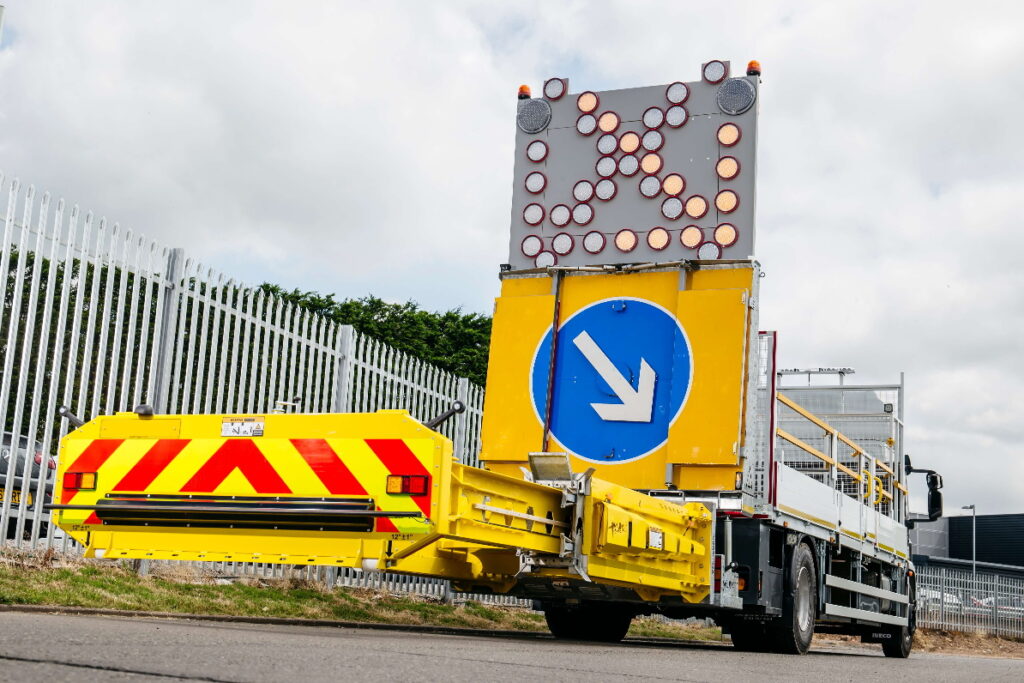
A wings add-on on a truck mounted attenuator is a set of lateral panels that extend outward from the sides of the attenuator to increase the protected width behind the host vehicle. Wings prevent errant vehicles from clipping the side of the attenuator or sliding alongside the host truck, reducing the risk of secondary impacts in work zones. The sections below address the most common questions about how wings work, when you need them, and how they affect compliance.
What protection do TMA wings actually provide?
TMA wings provide lateral protection by widening the impact-absorbing surface of the attenuator. Without wings, a vehicle that strikes the attenuator at an angle may deflect sideways and contact the host truck or work zone personnel. Wings redirect that energy and keep the impacting vehicle within a controlled path, reducing the chance of override or underride on the sides of the system.
In practical terms, wings act as a physical barrier on either side of the rear of the host vehicle. When a driver drifts into the work zone at an oblique angle rather than head-on, the wings engage first, absorbing and redirecting the impact before it reaches the truck cab or the workers ahead. This is particularly relevant on multi-lane highways where vehicles may approach from an angle due to lane-change behavior or driver distraction.
Wings also serve a secondary function: they improve the visual footprint of the attenuator. A wider rear profile, often fitted with reflective markings or lighting, makes the system more visible to approaching drivers, giving them more time to react and reducing the likelihood of impact altogether.
What types of vehicles require a wings add-on?
Wings add-ons are most commonly required on host vehicles operating in high-speed, multi-lane environments where angled impacts are more likely. Trucks deployed on highways, expressways, and arterial roads with speed limits above 45 mph are the primary candidates. These vehicles face the greatest exposure to oblique strikes from distracted or impaired drivers changing lanes at speed.
Shadow vehicles and mobile attenuator trucks used in rolling slowdowns also benefit from wings because they are in continuous motion and cannot rely on fixed barriers for lateral protection. In these dynamic work zone configurations, the attenuator is the only protective system between approaching traffic and the work crew, making the full-width protection of wings especially important.
Incident management trucks and trucks supporting lane closure operations on divided highways are also strong candidates for wings. Whenever the host vehicle is positioned where traffic approaches from multiple angles, or where the shoulder is narrow and vehicles may drift, wings add a meaningful layer of protection.
How do wings affect TMA crash test compliance?
Wings affect TMA crash test compliance because a system tested and approved with wings installed is only certified in that specific configuration. If wings are part of the tested setup, removing them voids the compliance of that configuration. Conversely, adding aftermarket wings to a certified TMA without retesting can also put the system’s approval status at risk.
Under MASH 2016 (Manual for Assessing Safety Hardware), the current standard for crash testing in the United States, the tested configuration must match what is deployed in the field. This means the attenuator, the host vehicle class, and all add-on components, including wings, must reflect the approved test article. Verdegro’s TMA systems are tested and approved under MASH 2016, and any optional components are evaluated as part of the certified configuration.
For projects requiring FHWA acceptance, you should always verify that the wings are part of the documented, accepted configuration for the specific attenuator model you are deploying. Using a non-tested configuration on a federally funded project can result in compliance issues during inspection.
What’s the difference between a standard TMA and a TMA with wings?
The key difference between a standard truck mounted attenuator and a TMA with wings is the width of protection and the range of impact angles the system can handle. A standard TMA absorbs energy from rear-end impacts along a relatively narrow central path. A TMA with wings extends that protective zone laterally, handling angled and offset impacts that would otherwise bypass the core cushion structure.
Beyond geometry, the two configurations also differ in their deployment suitability:
- Standard TMA: Well suited for lower-speed environments, narrow road sections, or situations where traffic approaches in a predictable, aligned path.
- TMA with wings: Better suited for high-speed highways, wide multi-lane roads, and dynamic work zones where angled impacts are a realistic risk.
The weight and mounting requirements also differ. Wings add mass to the rear of the host vehicle, which means the host truck must meet minimum weight specifications to maintain stability and ensure the attenuator performs as tested. Always check the manufacturer’s host vehicle requirements when configuring a system with wings.
When should a work zone specify wings on the attenuator?
You should specify wings on a truck mounted attenuator when the work zone involves high-speed traffic, multi-lane roads, or conditions where angled impacts are likely. If your project involves highway construction, rolling lane closures, or incident response on divided roads, wings are a practical requirement rather than an optional upgrade.
Consider specifying wings in the following situations:
- Posted speed limits above 45 mph where impact energy and oblique approach angles increase significantly.
- Multi-lane work zones where vehicles may approach from adjacent lanes at an angle.
- Rolling slowdowns and mobile operations where the host vehicle moves continuously and cannot rely on static barriers.
- Narrow shoulder configurations where drifting vehicles are more likely to contact the side of the attenuator rather than the rear.
- Jurisdictions or contracts that specify MASH 2016 compliance with a wing-equipped configuration as the accepted standard.
When in doubt, review the project’s traffic control plan and consult the attenuator manufacturer’s documentation to confirm which configuration meets both the safety requirements and the applicable crash test standard for your specific deployment.
How Verdegro Supports Your TMA Configuration Decisions
We manufacture a range of truck mounted attenuators, including the TMA-US 100K, TTMA-US 100K, LTMA-US 70K, and BLADE TMA, all tested and approved to MASH 2016. Our systems are available with optional accessories, including wing configurations, LED arrow boards, full-color VMS displays, and hydraulic LED-lift masts, so you can build a setup that matches both your operational requirements and your compliance obligations.
When you work with us, we help you identify the right configuration for your specific deployment:
- Confirming which TMA models are approved with wings under MASH 2016
- Verifying host vehicle weight and mounting requirements for wing-equipped setups
- Providing documentation to support FHWA acceptance requirements on federally funded projects
- Advising on accessory combinations that maintain the certified configuration
If you are specifying attenuators for an upcoming project and need clarity on whether wings are right for your work zone, contact our team and we will help you find the configuration that protects your crew and meets your compliance requirements.