
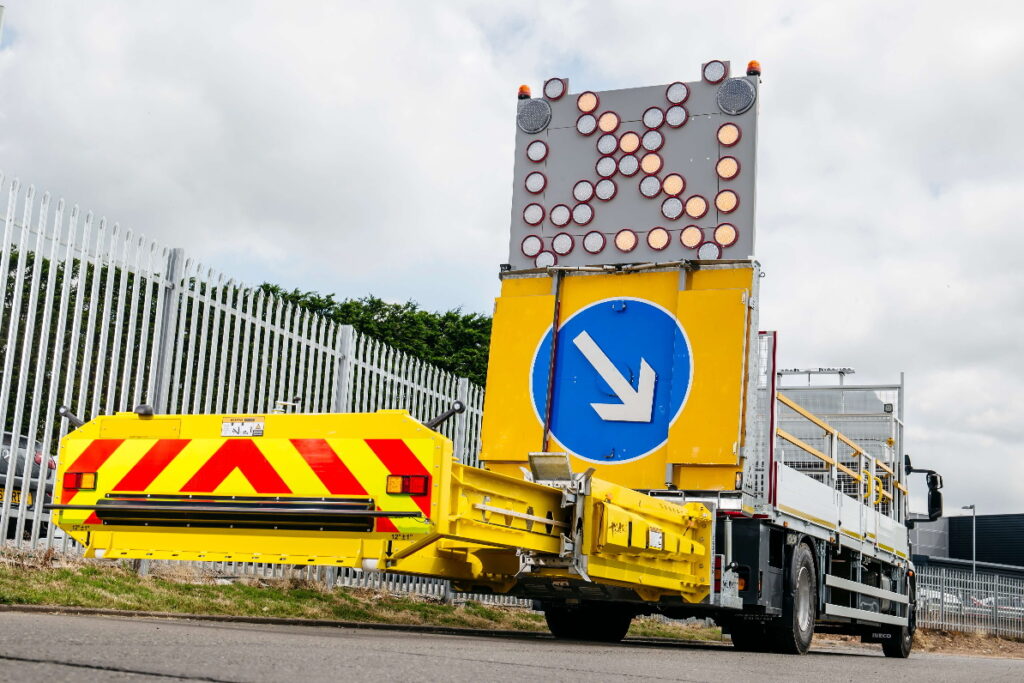
A light truck-mounted attenuator is sufficient when posted work zone speeds are at or below 70 km/h (roughly 45 mph) and the host vehicle meets the lower weight threshold required by the applicable standard. Once speeds exceed that threshold or the risk profile of the work zone increases, a full TMA becomes necessary to provide adequate crash protection.
The distinction comes down to the energy a crash cushion must absorb. Higher speeds and heavier impacting vehicles generate significantly more force, which only a full TMA is rated to handle. Understanding where each system fits helps you stay compliant, protect your crew, and avoid deploying more equipment than the situation demands.
What are the key differences between a light TMA and a full TMA?
A light TMA is designed for lower-speed work zones and mounts to lighter host vehicles, while a full TMA is built to absorb higher-energy impacts at greater speeds and requires a heavier host truck. The core difference lies in the rated test level, the host vehicle weight requirement, and the maximum speed at which each system provides certified protection.
Under MASH 2016 standards, a light TMA such as the LTMA-US 70K is tested at lower impact energies corresponding to reduced work zone speeds. A full TMA like the TMA-US 100K or TTMA-US 100K is tested to higher energy thresholds, meaning it can protect road workers and motorists in faster, higher-risk environments.
Other practical differences include:
- Host vehicle weight: A light TMA typically requires a host truck in the 70,000 lb class, while a full TMA requires a heavier platform, often in the 100,000 lb class.
- Physical size and deployment weight: Light TMAs are more compact and easier to deploy in tighter work zones or urban settings.
- Speed rating: Light TMAs are certified for lower posted speeds; full TMAs cover the higher-speed highway environment.
- Cost and logistics: Light TMAs generally cost less to acquire and operate, making them attractive where the risk level genuinely justifies the lower rating.
What work zone conditions require a full TMA instead of a light TMA?
A full TMA is required when the posted work zone speed exceeds the light TMA’s tested speed threshold, when the work zone is on a high-speed highway or freeway, or when the project specification or contracting authority mandates a higher test level. Any environment where vehicles approach at motorway speeds demands the full energy absorption capacity of a standard TMA.
Specific conditions that point toward a full TMA include:
- Work zones on roads with posted speeds above 70 km/h
- Highway maintenance or construction on motorways and expressways
- Projects governed by MASH TL-3 compliance requirements
- Situations where the host vehicle weight meets the 100,000 lb class threshold
- Locations with high traffic volume and limited runout distance behind the attenuator
In these conditions, the forces generated by an impacting vehicle far exceed what a light TMA is rated to manage. Deploying an undersized system in a high-speed environment does not meet the intent of the standard and puts both road workers and drivers at greater risk.
When is a light TMA legally and operationally acceptable?
A light TMA is legally and operationally acceptable when the posted work zone speed falls within the system’s certified test level, the host vehicle meets the required weight class, and the applicable project standard or national regulation does not mandate a higher-rated system. Urban maintenance work, low-speed road repairs, and municipal operations are typical environments where a light TMA fits.
Operationally, a light TMA also makes sense when:
- The work zone is in an urban or suburban setting with speed limits at or below 70 km/h
- The host vehicle available on site falls within the lighter weight class
- The contracting authority has not specified a higher test level in the project tender
- Maneuverability in tight spaces is a priority, since lighter systems are easier to position
Always verify that the specific light TMA model you intend to deploy holds the relevant acceptance documentation for your region. A system that is operationally suitable but lacks the required certification paperwork may still fail a compliance review.
How do MASH ratings affect which attenuator you must deploy?
MASH ratings define the speed and vehicle weight conditions under which a TMA has been crash-tested and proven to perform. The rating your project requires determines the minimum test level your attenuator must hold. If a project specification calls for MASH TL-3 compliance, you must deploy a TMA that has been tested and accepted at that level, regardless of the actual posted speed.
MASH 2016 is the most current standard, and many government agencies and highway authorities now require it as the baseline for all new deployments. Under MASH, test levels are tied to specific impact speeds and vehicle masses. A TMA approved at a lower test level cannot be substituted on a project that mandates a higher one, even if the site conditions appear comparable.
When reviewing attenuator options, check for FHWA acceptance letters or equivalent national approval documentation. These letters confirm that the system has been independently tested to the stated standard and is accepted for use on federally funded projects in the United States, or meets the equivalent national requirement in other markets. Deploying a system without current acceptance documentation creates compliance exposure, regardless of how well the hardware performs in practice.
What operational factors should influence the attenuator selection decision?
Beyond speed ratings and MASH compliance, several practical factors should shape your attenuator selection. The host vehicle available on site, the nature and duration of the work, the physical space in the work zone, and the frequency of repositioning all affect which system is the right fit for a given deployment.
Key factors to weigh before selecting a system:
- Host vehicle compatibility: The attenuator must be matched to the truck’s weight class and hitch system. Mismatching the two affects both performance and certification validity.
- Work zone duration: Short-duration operations may favor a simpler, faster-to-deploy light TMA, while long-term projects benefit from a full TMA with integrated accessories such as LED arrow boards or VMS displays.
- Repositioning frequency: If the shadow vehicle moves frequently along a rolling work zone, ease of deployment and vehicle agility matter more than on a static site.
- Accessory requirements: Some projects require the attenuator host vehicle to also carry arrow boards or variable message signs. Check whether the chosen system supports those additions without exceeding vehicle payload limits.
- Maintenance and inspection cycles: Heavier, more complex systems require more rigorous inspection routines. Factor in your crew’s capacity to maintain the system properly between deployments.
A structured selection process that checks speed rating, MASH compliance, host vehicle match, and operational requirements in sequence will consistently lead you to the right system for the job.
How Verdegro Supports Your TMA Selection
We manufacture a range of truck-mounted attenuators designed to cover the full spectrum of work zone conditions, from urban low-speed operations to high-speed motorway construction. Our product line includes:
- TMA-US 100K and TTMA-US 100K: Full TMAs tested to MASH 2016 and NCHRP-350 TL-3, suited for high-speed highway environments
- LTMA-US 70K: A light TMA for lower-speed work zones where a full system exceeds what the site requires
- BLADE TMA: A compact, certified option for operations where maneuverability and fast deployment are priorities
All our systems hold FHWA acceptance letters under MASH 2016, and several can be configured with LED arrow boards, full-color VMS displays, and hydraulic LED-lift masts to consolidate your work zone equipment onto a single host vehicle.
We help you match the right attenuator to your specific project requirements, host vehicle, and compliance obligations. If you are unsure whether a light TMA or a full TMA fits your next deployment, contact us and we will work through the selection with you.
Related Articles
- How can a road maintenance fleet prepare for different work zones?
- What is the difference between impact protection for vans and trucks?
- What is the average lifespan of a truck mounted attenuator?
- Do truck mounted attenuator prices vary by weight class or standard?
- What crash test levels apply to truck mounted attenuators?