
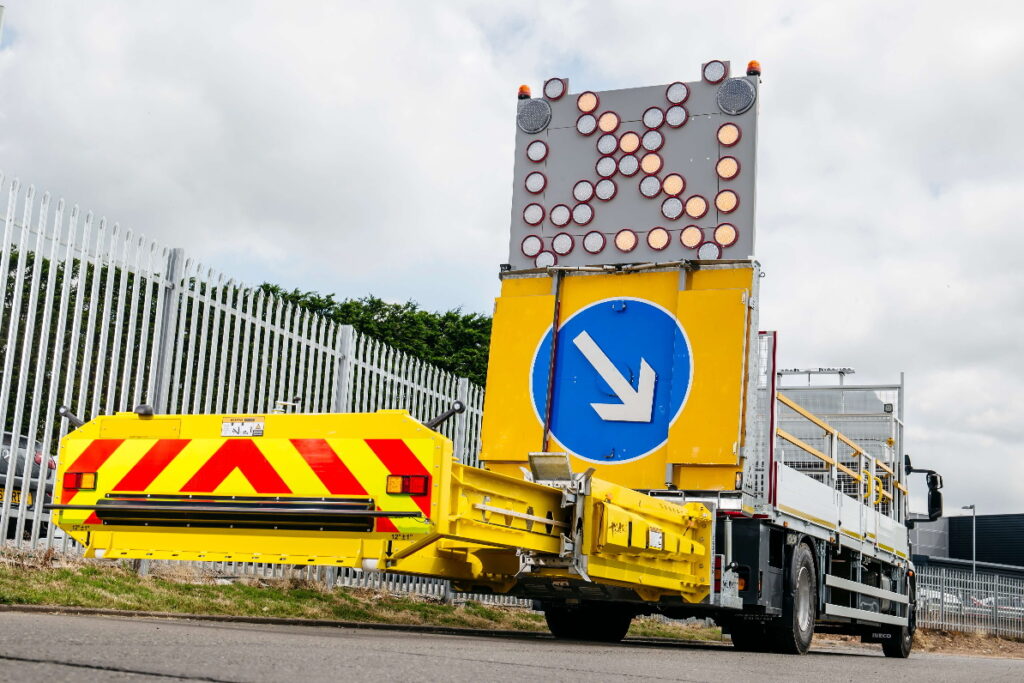
Truck mounted attenuators are tested under two main crash test standards: NCHRP 350 and MASH (Manual for Assessing Safety Hardware), with MASH 2016 being the current benchmark. The most commonly required crash test level for highway work zones is TL-3, which simulates a passenger car impact at 100 km/h (62 mph). The sections below walk through how these standards differ, what levels MASH defines, and what compliance looks like in practice.
What are the differences between NCHRP 350 and MASH crash test standards?
NCHRP 350 and MASH are both U.S.-developed crash test standards for roadside safety hardware, but MASH uses updated test vehicles, higher impact speeds, and more stringent occupant risk criteria. MASH replaced NCHRP 350 as the accepted standard for new product evaluations, reflecting advances in vehicle design and a more realistic representation of today’s traffic conditions.
NCHRP 350, developed in the 1990s, used a smaller 820 kg test vehicle for passenger car impacts. MASH updated this to a 1,100 kg vehicle, which better reflects the average weight of modern cars. This change alone significantly increases the energy a truck mounted attenuator must absorb to pass the same test level.
Beyond vehicle weight, MASH also revised the evaluation criteria for occupant risk, exit box boundaries, and post-impact vehicle behavior. A product that passed NCHRP 350 testing does not automatically meet MASH requirements, which is why the Federal Highway Administration (FHWA) now requires new installations on federally funded projects to use MASH-compliant hardware.
What crash test levels does MASH 16 define for TMAs?
MASH 2016 defines three test levels relevant to truck mounted attenuators: TL-2, TL-3, and TL-4. Each level represents a different combination of vehicle type, impact speed, and impact angle. TL-3 is the standard most commonly specified for highway work zones.
- TL-2: Tests a 1,100 kg passenger car at 70 km/h (44 mph) and a 2,270 kg pickup truck at 70 km/h. Suitable for lower-speed roadways.
- TL-3: Tests a 1,100 kg passenger car at 100 km/h (62 mph) and a 2,270 kg pickup truck at 100 km/h. Required for most highway and freeway work zones.
- TL-4: Adds a single-unit truck impact at higher mass. Used for higher-risk applications where larger vehicle impacts are a realistic concern.
For most road construction and maintenance scenarios, TL-3 is the minimum acceptable level. It represents the realistic worst-case impact from a passenger vehicle on a high-speed road and sets the baseline for FHWA acceptance under MASH.
How does a TMA earn FHWA acceptance under MASH?
A truck mounted attenuator earns FHWA acceptance by successfully completing the required crash tests under MASH protocols and submitting the results to the FHWA for review. If the device meets all performance criteria, the FHWA issues an acceptance letter confirming the product is eligible for use on federally funded highway projects.
The process involves full-scale physical crash tests conducted at an accredited testing facility. The TMA must demonstrate that it absorbs impact energy within defined limits, that the impacting vehicle stays within the exit box boundaries, and that occupant risk values remain below the thresholds set by MASH. Test reports are then submitted to the FHWA, which evaluates the data independently before issuing acceptance.
Holding an FHWA acceptance letter is not just a formality. It is the documentation that procurement teams, government agencies, and contractors rely on to confirm that a device meets current federal safety requirements. Without it, a TMA cannot be specified on federally funded projects in the United States.
Which crash test level is required for highway work zones?
TL-3 under MASH 2016 is the crash test level required for truck mounted attenuators deployed in highway work zones on federally funded projects in the United States. This level covers high-speed impacts from both passenger cars and pickup trucks at 100 km/h, which reflects the conditions workers and drivers face on active freeways and interstates.
Some project specifications may require TL-4 where heavier vehicle traffic is a significant factor, but TL-3 remains the standard baseline. State DOTs and transport agencies may also apply their own requirements on top of federal minimums, so it is always worth checking the specific project specification rather than assuming TL-3 alone is sufficient.
Outside the U.S., equivalent standards apply. In Europe, EN 1317 governs crash cushion and attenuator testing, and national highway authorities set their own minimum performance categories. Any TMA deployed in an international market should carry documentation confirming compliance with the applicable local standard.
Are older NCHRP 350-certified TMAs still compliant on today’s roads?
Older TMAs certified under NCHRP 350 are not acceptable for new installations on federally funded U.S. highway projects as of the FHWA’s compliance deadlines. The FHWA required that all new permanent and temporary traffic control devices installed on National Highway System projects meet MASH standards, making NCHRP 350-only certification insufficient for new procurement.
However, NCHRP 350-certified equipment already in service before the cutoff dates was generally permitted to remain in use until the end of its service life. This means you may still encounter older attenuators in active fleets, but purchasing or specifying new NCHRP 350-only devices for federally funded projects is no longer compliant.
For contractors and agencies reviewing their equipment inventory, the practical guidance is straightforward: any new TMA purchase should carry MASH 2016 FHWA acceptance documentation. Relying on older certifications creates procurement risk and potential liability if a device is deployed on a project where MASH compliance is contractually required.
How Verdegro Helps with TMA Crash Test Compliance
We manufacture a range of truck mounted attenuators tested and approved to both NCHRP 350 TL-3 and MASH 2016 standards, and we hold multiple FHWA acceptance letters under MASH 16. Our TMA lineup includes:
- TMA-US 100K and TTMA-US 100K: Full-size attenuators approved to MASH TL-3, suitable for highway and freeway work zones
- LTMA-US 70K: A lighter option for lower-speed applications
- BLADE TMA: A compact, high-performance attenuator designed for versatility in active work zones
Each system is designed to mount to the rear of a work truck and absorb impact energy to protect both road workers and drivers. You can also configure your TMA with optional LED arrow boards, full-color VMS displays, and hydraulic LED-lift masts to build a complete work zone safety solution on a single vehicle.
If you are specifying equipment for a federally funded project or need to verify which crash test level applies to your deployment, we can help you identify the right system and provide the compliance documentation you need. Contact us to discuss your requirements.
Related Articles
- How is roadwork impact protection changing for lighter vehicles?
- What should fleet managers look for in a roadwork safety vehicle?
- Can the same crash protection solution be used on every roadwork vehicle?
- What is the MASH standard for truck mounted attenuators?
- What is the biggest market for truck mounted attenuators?