
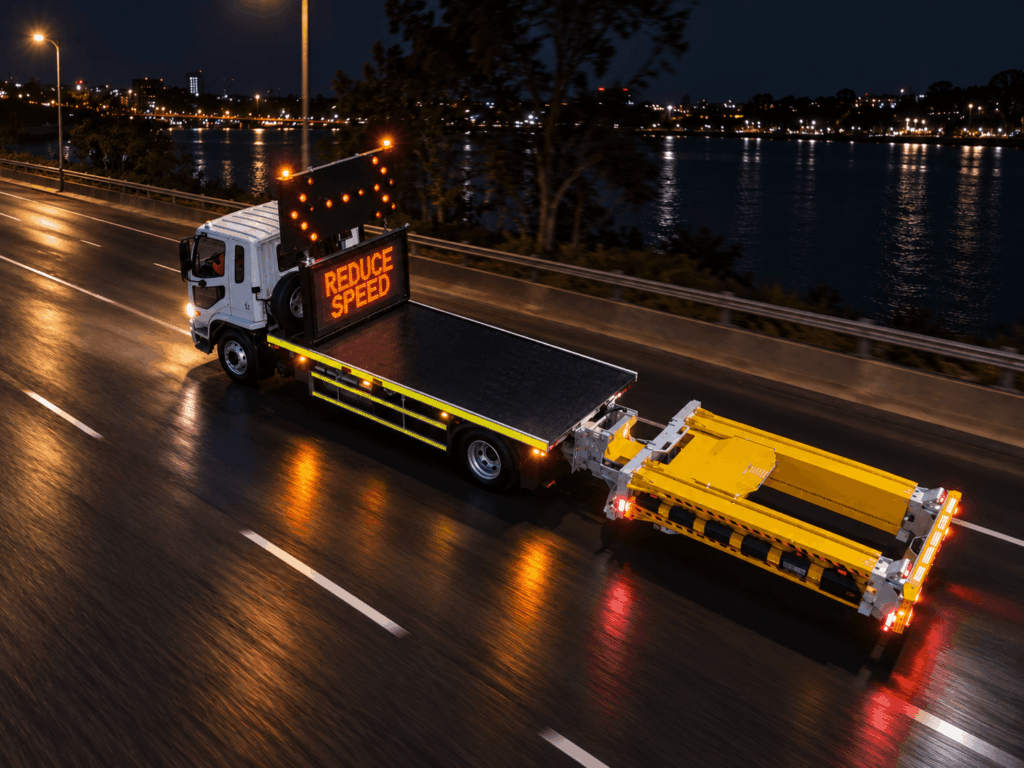
Fleet managers selecting a roadwork safety vehicle should prioritize crash-tested protection systems, certified attenuators, high-visibility equipment, and integrated telematics. The right combination of these features directly determines how well your vehicle protects workers and road users in active work zones. Below, we answer the most important questions fleet managers ask when evaluating these vehicles.
What safety certifications should a roadwork vehicle carry?
A roadwork safety vehicle should carry certifications that confirm its protection systems have been independently tested under recognized crash standards. The most important benchmark in 2026 is MASH 2016 (Manual for Assessing Safety Hardware), which defines the test conditions and performance thresholds that truck-mounted attenuators and other safety systems must meet. Vehicles without verified certification under this standard carry regulatory and liability risk.
For operations in North America, look for FHWA acceptance letters confirming compliance with MASH 2016 Test Levels (TL-2 or TL-3, depending on operating speeds). In the UK, the TD49/07 optional 110K test is the relevant benchmark for higher-speed environments. European deployments require CE marking and EMC compliance as a baseline.
When reviewing documentation, ask suppliers to provide the official crash test certifications directly, not just a reference to them. A credible manufacturer will supply these without hesitation. Certifications should cover the specific configuration you are deploying, because approval for one mounting variant does not automatically extend to another.
What protection systems are necessary on a work zone safety vehicle?
The most important protection system on a work zone safety vehicle is a truck-mounted attenuator (TMA), a crash cushion mounted to the rear of the vehicle that absorbs the energy of an errant vehicle striking the work zone. A TMA is the primary barrier between a distracted driver and your road crew. Beyond the attenuator itself, under-ride protection built into the vehicle’s steel framework prevents a striking vehicle from sliding beneath the truck.
Additional protection systems worth evaluating include:
- Arrow boards: Directional LED displays that guide traffic away from the work zone, reducing the risk of head-on collisions with workers.
- Variable Message Signs (VMS): Dynamic signs that communicate speed limits, lane closures, or hazard warnings in real time.
- Integrated hydraulic systems: Reliable hydraulic rams allow the crash cushion to deploy and retract quickly and consistently, reducing downtime at the start and end of each shift.
- Sealed protective housings: Enclosing hydraulic and electronic components in a sealed galvanised steel structure prevents weather damage and reduces maintenance requirements.
Mechanical simplicity also plays a role in protection. Systems that rely on fewer sensors and electronic components have fewer potential failure points, which matters when a vehicle is deployed in demanding, high-traffic environments day after day.
How does visibility equipment affect worker safety in roadwork zones?
Visibility equipment directly reduces the risk of vehicles entering a work zone unintentionally. When drivers receive clear, early warnings, through LED arrow boards, VMS signs, or geo-fenced alerts on navigation apps, they have more time to change lanes or reduce speed. That additional reaction time is what prevents many collisions before a truck attenuator ever needs to absorb an impact.
LED arrow boards are the standard tool for active lane guidance. Modern boards remain visible even when a crash cushion is folded or in transport position, which means your vehicle continues to communicate with approaching traffic throughout the journey to and from the site. Reflective foil chevrons on the rear of the vehicle add a passive layer of visibility that requires no power source and remains effective even if electrical systems fail.
Geo-fencing technology extends visibility into the digital environment. When a safety vehicle’s position is broadcast to navigation platforms such as Waze, Google Maps, Apple Maps, and Flitsmeister, drivers receive automatic alerts before they even see the work zone. This is particularly valuable on high-speed roads where reaction distances are long and driver attention is variable.
Should fleet managers prioritize telematics and remote monitoring in safety vehicles?
Yes, telematics and remote monitoring add meaningful operational value to a roadwork safety fleet, and fleet managers should treat them as a standard requirement rather than an optional upgrade. Real-time GPS tracking tells you where every vehicle is at any moment, which supports both operational planning and post-incident review. Remote status monitoring goes further, allowing you to confirm whether a cushion is deployed, an arrow board is active, or lights are on, without calling the driver.
For larger fleets, the ability to view all vehicles through a single platform significantly reduces the administrative burden of managing deployments across multiple sites. It also creates an auditable record of where vehicles have been and what their systems were doing, useful for compliance reporting and tender documentation.
Safety alert integration is a further reason to prioritize telematics. Systems that connect directly to traffic control platforms and navigation apps can automatically warn approaching drivers of a nearby safety vehicle, reducing the risk of rear-end collisions. This type of integration, across platforms like Monotch, Waze, and national traffic control systems, extends the protective reach of your vehicle beyond what physical equipment alone can achieve.
What’s the difference between a standard service vehicle and an incident management truck?
A standard service vehicle is configured for routine road maintenance tasks, carrying equipment, transporting crews, and supporting planned work zone operations. An incident management truck is purpose-built for rapid deployment at unplanned events such as collisions, breakdowns, or sudden lane closures, where speed of response and on-scene protection are the defining priorities.
The key operational differences are:
- Deployment speed: Incident management trucks are designed to reach operational status quickly. A TMA that deploys in under 20 seconds while the vehicle is moving at speed is a meaningful advantage in an emergency context.
- Equipment integration: These trucks typically combine a crash cushion, arrow boards, VMS signs, and lighting into a single, coordinated system, rather than carrying these as separate items.
- Crew protection priority: Because incident scenes are uncontrolled environments, the protection systems on these vehicles are specified to higher performance thresholds, often TL-3 at 100 km/h or above.
- Flatbed access: Incident management trucks often need to carry additional equipment to the scene. Attenuator designs that preserve full flatbed access in transport position, rather than obstructing it, are better suited to this role.
Fleet managers procuring for emergency response contexts should treat incident management trucks as a distinct vehicle category with its own specification requirements, separate from the vehicles used for planned maintenance operations.
How do procurement teams evaluate roadwork safety vehicles for large tenders?
Procurement teams evaluating roadwork safety vehicles for large tenders should assess candidates across four dimensions: certification and compliance, technical performance, operational practicality, and total cost of ownership. Each dimension carries weight in a formal tender, and a vehicle that scores well on one but poorly on another is unlikely to meet the full specification.
A practical evaluation framework looks like this:
- Certification: Confirm MASH 2016 compliance at the required test level, with official documentation. Check whether certifications cover the specific configuration being procured.
- Performance: Review crash test results, maximum impact speeds, and roll-ahead distances. For truck attenuators, compare weight ranges to your existing or planned support vehicles.
- Operational practicality: Assess deployment time, ease of operation (wired in-cab controller vs. remote control), maintenance requirements, and whether the system preserves access to the truck’s flatbed or rear doors.
- Fleet management capability: Evaluate whether the supplier offers telematics integration, a fleet management platform, and compatibility with national traffic alert systems.
- Customisation and scalability: Large tenders often require vehicles in multiple configurations. Suppliers who offer modular systems, with interchangeable arrow boards, VMS signs, and cushion variants, are easier to standardise across a fleet.
For government and municipal tenders in particular, documentation quality matters as much as product quality. Suppliers should be able to provide crash test certifications, CE marking, and compliance evidence in a format that satisfies procurement requirements without additional follow-up.
How We Help You Equip Your Fleet
We design and manufacture truck-mounted attenuators and complete roadwork safety systems that meet the requirements fleet managers and procurement teams face in practice. Here is what we offer:
- MASH 2016 TL-3 certified attenuators: Our Armadillo TMA and VanGuard TMA are fully crash-tested and approved, with official certifications and CE marking supplied as standard.
- Multiple TMA configurations: From heavy-duty truck-mounted systems to van-mounted options in rear, top, and swing variants, we cover a wide range of support vehicle types and operational contexts.
- Fast, reliable deployment: The Armadillo TMA deploys in under 20 seconds while moving at 80 km/h, with a single-stage hydraulic system that requires no sensors or electronic feedback components.
- Integrated visibility: Arrow boards and VMS signs are available across our range, with geo-fencing integration into Waze, Flitsmeister, Apple Maps, Google Maps, and national traffic control systems through our Mobitrack telematics module.
- Fleet management platform: Our Mobilityplanner web platform gives you real-time GPS tracking, system status monitoring, and location history across your entire fleet from a single interface.
- Tender documentation support: We supply all required certifications, compliance documentation, and technical specifications to support formal procurement processes.
If you are evaluating safety vehicles for your fleet or preparing for a tender, contact us to discuss your requirements and find the right configuration for your operations.
Related Articles
- How can a road maintenance fleet prepare for different work zones?
- What are signs that a truck mounted attenuator needs to be replaced?
- What is NCHRP-350 and how does it apply to truck mounted attenuators?
- What is the difference between a 70K and 100K truck mounted attenuator?
- What is the biggest market for truck mounted attenuators?