
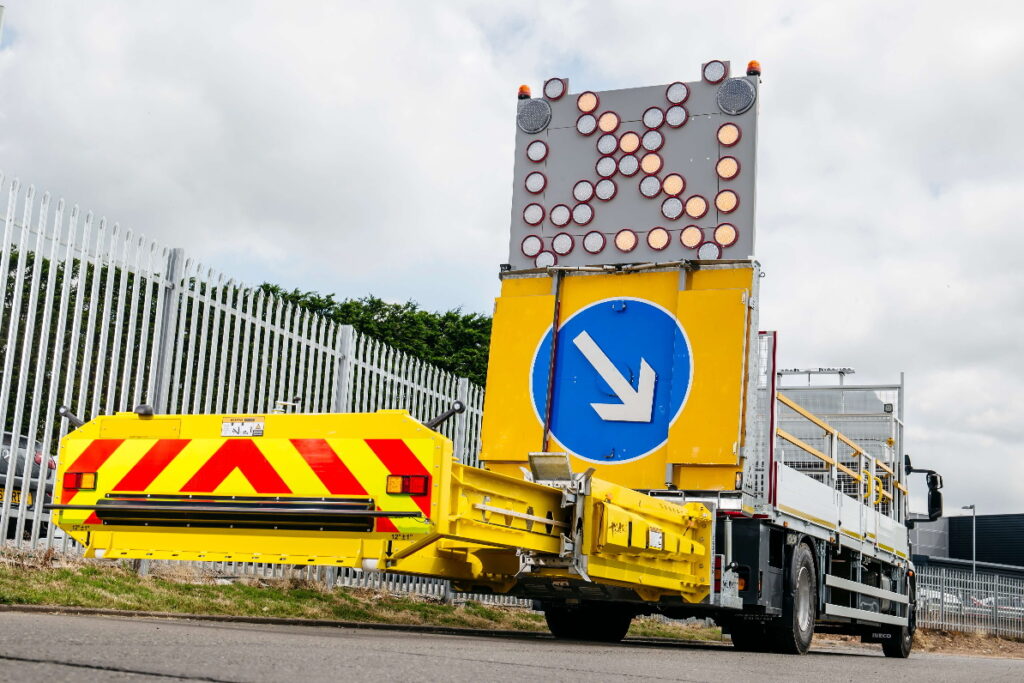
NCHRP-350 has been replaced by MASH (Manual for Assessing Safety Hardware) as the current standard for crash testing highway safety devices, including truck mounted attenuators. MASH 2016, also known as MASH 16, is now the accepted standard in the United States, and new devices submitted for FHWA eligibility must meet it. Equipment tested only under NCHRP-350 occupies a transitional status that varies by project, agency, and jurisdiction. The sections below unpack the key differences, what the transition means in practice, and how to confirm your TMA meets current requirements.
What replaced NCHRP-350 as the standard for crash testing?
MASH, the Manual for Assessing Safety Hardware, replaced NCHRP-350 as the governing standard for crash testing roadside safety hardware in the United States. AASHTO and FHWA developed MASH to address limitations in the older NCHRP-350 framework, introducing updated vehicle weights, impact conditions, and occupant risk criteria that better reflect modern traffic environments.
The first edition of MASH was published in 2009, but the 2016 edition, commonly referred to as MASH 16, became the benchmark that federal and state agencies now require for new product approvals. The FHWA issued guidance establishing MASH 16 as the standard for devices seeking new eligibility letters, effectively closing the door on NCHRP-350 for new submissions. For anyone procuring or specifying crash protection systems today, MASH 16 compliance is the relevant benchmark.
Is NCHRP-350 still accepted for truck mounted attenuators in active use?
NCHRP-350-tested truck mounted attenuators already in service are generally still permitted on projects, but their long-term acceptance depends on the contracting agency and applicable state or federal requirements. The FHWA did not mandate immediate replacement of NCHRP-350 devices, but it stopped issuing new acceptance letters under that standard. Devices tested only to NCHRP-350 are considered legacy equipment.
In practice, this means a TMA with NCHRP-350 TL-3 approval may still satisfy many state DOT contracts today, particularly for maintenance work. However, federally funded projects increasingly specify MASH-compliant hardware, and some agencies have set firm cutoff dates for accepting legacy-tested equipment. If you are planning new purchases or responding to tenders, relying on NCHRP-350 certification alone carries real procurement risk. Verifying agency-specific requirements before committing to equipment is always the right step.
What are the key differences between NCHRP-350 and MASH for TMAs?
The most significant differences between NCHRP-350 and MASH for truck mounted attenuators involve test vehicle specifications, impact scenarios, and occupant risk evaluation criteria. MASH uses heavier and more representative test vehicles, adds additional impact angles, and applies stricter occupant risk thresholds, making it a more demanding and comprehensive evaluation framework.
The key distinctions worth understanding include:
- Test vehicle weights: MASH uses a 2,270 kg (5,000 lb) passenger car and a 10,000 kg (22,000 lb) pickup truck for relevant tests, compared to lighter vehicles used in NCHRP-350.
- Impact conditions: MASH includes additional oblique and head-on impact scenarios that were not part of the original NCHRP-350 test matrix for TMAs.
- Occupant risk criteria: MASH applies updated Occupant Risk Index values and flail space model calculations to better assess injury potential for vehicle occupants during impact.
- Documentation requirements: MASH requires more detailed reporting of vehicle kinematics and debris trajectories, giving agencies better data to evaluate real-world performance.
The practical result is that a TMA approved under NCHRP-350 may perform well in many impact scenarios but has not been evaluated against the full range of conditions MASH now requires. This does not mean NCHRP-350 devices are unsafe, but it does mean their certification does not reflect the current testing baseline.
What does MASH 16 compliance mean for a truck mounted attenuator?
MASH 16 compliance means a truck mounted attenuator has been crash tested and evaluated according to the 2016 edition of the Manual for Assessing Safety Hardware, and has received an FHWA acceptance letter confirming it meets current federal eligibility criteria. This is the highest level of certification available for TMAs sold into the US market today.
For contractors and agencies, MASH 16 compliance signals that the device has passed tests reflecting current vehicle fleet characteristics and occupant safety standards. It also simplifies procurement on federally funded projects, where MASH compliance is increasingly a contractual requirement rather than a preference. A valid FHWA acceptance letter under MASH 16 is the document that confirms this status, and it should accompany any TMA submitted for approval on regulated projects.
Beyond regulatory compliance, MASH 16-tested devices offer a practical assurance that the attenuator has been evaluated against realistic impact scenarios. For work zone safety managers, that matters when you are positioning equipment behind a slow-moving shadow vehicle on a live highway.
How do you verify a TMA meets current MASH standards?
To verify a truck mounted attenuator meets current MASH standards, request the FHWA acceptance letter from the manufacturer and confirm it references MASH 2016 (not NCHRP-350 or the earlier 2009 MASH edition). The FHWA publishes its list of accepted devices online, which you can cross-reference against the product name and model number.
Follow these steps to confirm compliance before purchasing or specifying a TMA:
- Request the acceptance letter directly from the manufacturer or their distributor. A legitimate MASH 16 letter will reference the specific test report number and the applicable test level (typically TL-3).
- Check the FHWA’s online listings for accepted safety hardware. The agency maintains updated records of devices with active eligibility under MASH.
- Confirm the test level matches your application. Test Level 3 (TL-3) is the standard for most highway work zone applications, covering impact speeds up to 100 km/h (62 mph).
- Verify the host vehicle compatibility. MASH acceptance letters are often tied to specific weight classes of host truck. Confirm the TMA’s certification applies to the vehicle configuration you intend to use.
- Review project specifications. Some agencies specify MASH 16 explicitly; others may still accept NCHRP-350 devices. Knowing the contract requirement before procurement avoids costly substitutions.
How Verdegro Supports MASH-Compliant TMA Selection
We manufacture a range of truck mounted attenuators tested and approved to current international crash safety standards, including MASH 2016. Our TMA portfolio includes the TMA-US 100K, TTMA-US 100K, LTMA-US 70K, and BLADE TMA, each designed for road construction contractors and traffic management operators who need certified, durable crash protection for active work zones. We hold multiple FHWA acceptance letters under MASH 16, so you can verify compliance quickly and confidently.
When you work with us, you get more than a certified attenuator. Our systems are available with integrated options including:
- LED arrow boards for lane guidance and worker visibility
- Full-color Variable Message Sign (VMS) displays for real-time driver communication
- Hydraulic LED-lift masts for elevated signaling in complex work zones
We serve government agencies and contractors across international markets, and we understand the procurement requirements that come with federally funded and regulated projects. If you are evaluating your current TMA fleet against MASH 16 requirements, or specifying equipment for an upcoming project, we can help you identify the right solution.
Contact us to discuss your project requirements and confirm which TMA configuration meets your compliance and operational needs.