
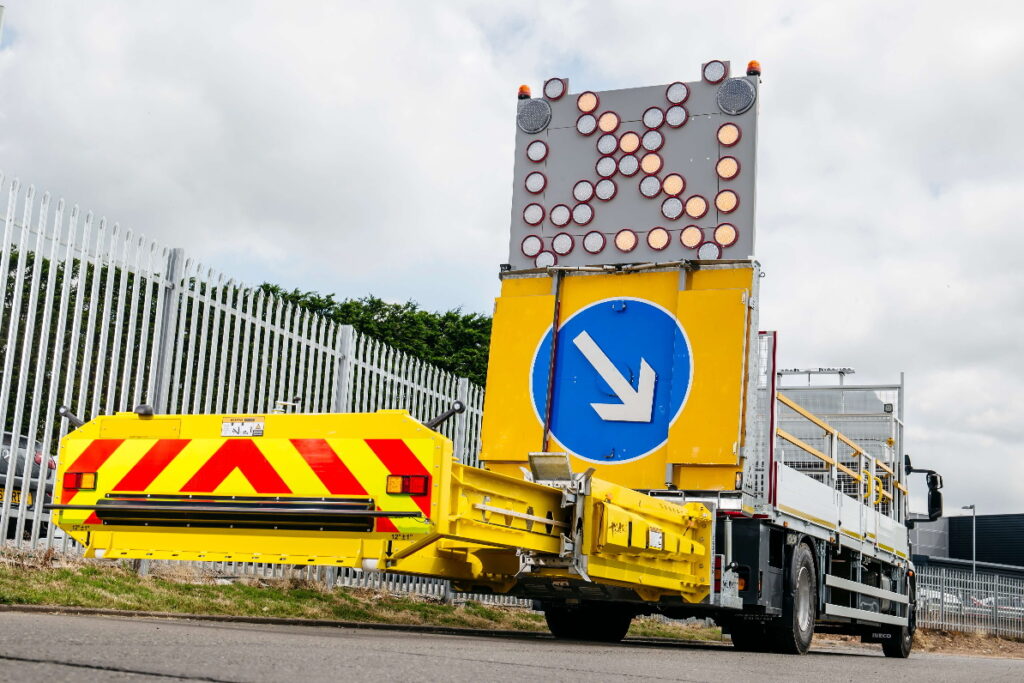
To choose the right truck mounted attenuator for your fleet, match the TMA’s test level to the speed limits of your typical work zones, confirm it meets current MASH 2016 compliance, and verify it suits your host vehicle’s weight class. Beyond compliance, prioritize features like ease of mounting, durability under repeated use, and compatibility with accessories such as arrow boards or VMS displays.
The right choice depends heavily on how and where your fleet operates. A contractor running high-speed highway projects has different requirements than a municipal crew managing low-speed urban maintenance. The sections below walk through the most important questions to ask before you commit.
What are the key MASH compliance requirements for truck mounted attenuators?
Truck mounted attenuators must meet the Manual for Assessing Safety Hardware (MASH) 2016 standard to be accepted on federally funded road projects in the United States. MASH 2016 replaced the older NCHRP 350 standard and introduced updated crash test conditions, vehicle weights, and impact angles that more accurately reflect today’s traffic. Any TMA without FHWA acceptance under MASH 2016 may no longer qualify for use on current federal-aid projects.
MASH compliance is not a single test but a series of them. A TMA must pass multiple crash test scenarios at defined speeds and angles, using standardized test vehicles. The attenuator must demonstrate that it absorbs impact energy effectively, limits intrusion into the work zone, and keeps the impacting vehicle from overriding or underriding the host truck in a way that endangers occupants.
When evaluating a TMA, look specifically for an FHWA acceptance letter that references MASH 2016. Some older products carry NCHRP 350 acceptance only, which is no longer sufficient for new federally funded contracts. Confirming this detail before purchase saves you from compliance problems on site.
What’s the difference between TL-2 and TL-3 truck mounted attenuators?
The core difference between TL-2 and TL-3 truck mounted attenuators is the posted speed limit they are designed to protect against. TL-2 attenuators are tested and rated for work zones with speed limits up to 70 km/h (approximately 45 mph), while TL-3 attenuators are rated for higher-speed environments up to 100 km/h (approximately 62 mph). Choosing the wrong test level for your operating environment creates a genuine safety risk.
TL-3 is the more demanding standard. It requires the attenuator to manage significantly higher impact energy, which typically means a more robust structural design and greater energy-absorption capacity. For highway and motorway work zones where traffic flows at speed, TL-3 is the appropriate choice.
TL-2 attenuators are well suited to urban road maintenance, lower-speed arterials, and temporary traffic control situations where posted speeds are restricted. They are often lighter and easier to handle, which can be an advantage for crews that move frequently between job sites. However, deploying a TL-2 unit on a high-speed corridor is a serious compliance and safety failure, regardless of how convenient the equipment may be.
How does host vehicle weight affect TMA performance?
Host vehicle weight directly affects how a truck mounted attenuator absorbs and redirects crash energy. A heavier host vehicle provides more resistance during an impact, which helps the TMA do its job of decelerating the impacting vehicle gradually. If the host truck is too light for the TMA’s design parameters, the system may not perform as tested, putting both the driver and work zone crew at risk.
Every TMA is designed and tested with a specific host vehicle weight range in mind. Manufacturers specify a minimum host vehicle weight, and you must stay within that range for the attenuator to perform as certified. Mounting a TMA rated for a heavier vehicle onto a lighter truck does not automatically improve safety. It can actually reduce effectiveness because the host vehicle may move excessively on impact rather than absorbing the energy as intended.
When building out your fleet, match each TMA model to the gross vehicle weight rating (GVWR) of the trucks you plan to use. If your fleet includes vehicles of varying sizes, you may need more than one TMA model to maintain compliance across all deployments.
Which TMA features matter most for high-frequency fleet deployment?
For fleets that deploy truck mounted attenuators frequently, the most important features are fast mounting and dismounting, structural durability, and compatibility with additional safety equipment. When a TMA is being transferred between vehicles or repositioned multiple times per week, the time and labor involved in each move adds up quickly. A system that takes one operator 15 minutes to mount is far more practical than one requiring two people and specialized tools.
Durability matters just as much. High-frequency deployment exposes the attenuator to repeated minor impacts, vibration during transport, and variable weather conditions. Look for units with corrosion-resistant materials and components designed to withstand operational wear without frequent replacement.
Accessory compatibility is another practical factor. Many work zones require an arrow board, a variable message sign, or a lighting mast in addition to the crash cushion itself. A TMA that integrates these accessories directly reduces the number of separate units your crew needs to manage and simplifies setup significantly. Hydraulic LED-lift masts and full-color VMS displays mounted directly to the TMA system can consolidate your equipment and improve overall site visibility.
Should you buy or rent truck mounted attenuators for your fleet?
Buying truck mounted attenuators makes more financial sense when your fleet deploys them regularly on long-term or recurring projects. Renting is more practical for occasional or short-duration needs where the capital investment is hard to justify. The break-even point depends on your deployment frequency, the duration of individual projects, and the total cost of ownership, including maintenance.
Ownership gives you full control over availability, condition, and compliance status. You know exactly what equipment you have, where it is, and whether it is certified. For contractors with consistent highway or road maintenance work, owning your TMAs also allows you to specify the exact configuration that suits your fleet, rather than accepting whatever rental stock is available.
Renting can make sense for contractors who handle occasional projects requiring a higher test level than their owned fleet supports, or for companies testing a new type of work before committing to capital expenditure. The risk with rental is availability. In peak construction season, rental stock can be limited, and delays in sourcing equipment can hold up project timelines.
If you are operating in multiple regions or internationally, owning certified equipment also removes the uncertainty of whether rental providers in each location carry MASH-compliant units.
What questions should you ask a TMA manufacturer before purchasing?
Before purchasing truck mounted attenuators, ask the manufacturer for documentation of MASH 2016 compliance, clarification on host vehicle weight requirements, and details on the warranty and parts availability. These three areas cover compliance, safety performance, and long-term operational reliability, which are the factors most likely to affect your fleet over time.
Here are the most useful questions to ask:
- Do you hold FHWA acceptance letters under MASH 2016? Ask for copies of the actual letters, not just a claim of compliance.
- What is the minimum host vehicle weight for each model? Confirm this against your fleet’s actual vehicle weights.
- What test levels are available across your product range? Check whether TL-2 and TL-3 options are both offered if your fleet operates in mixed-speed environments.
- What accessories are compatible with the system? Arrow boards, VMS displays, and lift masts should integrate without requiring custom fabrication.
- What does the warranty cover, and how long does it last? Understand whether impact damage is covered and what the claims process involves.
- How quickly can replacement parts be sourced? A TMA that is out of service waiting for parts creates real operational problems.
- Do you offer any fleet management or tracking tools? Platforms that provide GPS tracking and real-time status updates help you manage equipment across multiple sites.
A manufacturer that answers these questions clearly and provides documentation upfront is far more reliable than one that is vague about compliance details or redirects you to marketing materials instead of technical specifications.
How Verdegro Supports Your TMA Fleet Selection
We manufacture a range of truck mounted attenuator systems designed for road construction contractors and traffic management operators who need certified, field-ready crash protection. Our TMA lineup includes the TMA-US 100K, TTMA-US 100K, LTMA-US 70K, and BLADE TMA, each tested and approved to NCHRP 350 TL-3 and MASH 2016 standards. We hold multiple FHWA acceptance letters under MASH 2016, so you can deploy our equipment on federally funded projects with confidence.
Here is what working with us gives you:
- Verified compliance documentation: FHWA acceptance letters available for every model in our TMA range
- Multiple test level options: systems available for different host vehicle weight classes and operating speed environments
- Integrated accessories: LED arrow boards, full-color VMS displays, and hydraulic LED-lift masts compatible with our TMA systems
- Mobilityplanner platform: GPS tracking, real-time status updates, and remote control capabilities for your full fleet of equipment
- Global delivery: we serve government agencies and contractors across international markets
If you are comparing models, evaluating compliance documentation, or planning a fleet expansion, we are ready to help you work through the specifics. Contact us to discuss your requirements directly with our team.
Related Articles
- What is the difference between MASH and CEN/TS 16786 for truck mounted attenuators?
- What makes one truck mounted attenuator model better suited to your project?
- What is the difference between a 70K and 100K truck mounted attenuator?
- What is inside a truck mounted attenuator?
- How much does a truck mounted attenuator cost?