
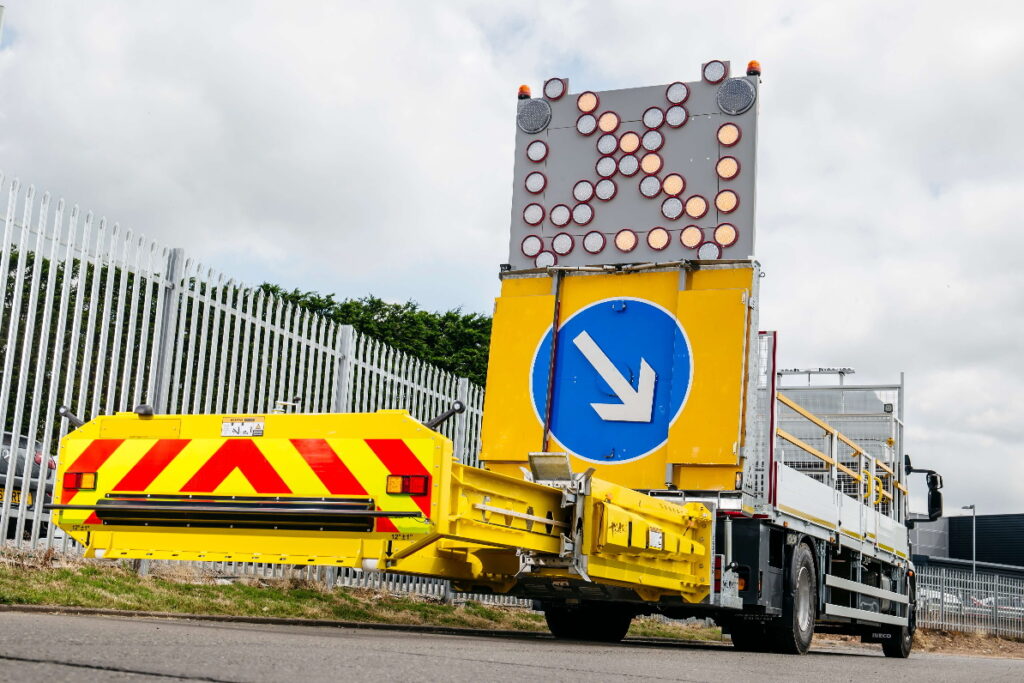
A truck mounted attenuator contains a layered crash cushion system mounted to the rear of a work truck, designed to absorb and redirect the kinetic energy of an errant vehicle before it reaches road workers. The core structure typically combines a steel frame, energy-absorbing cartridges or foam elements, and a guided deformation zone that collapses in a controlled sequence on impact. The sections below unpack each layer of that system in detail.
How does a truck mounted attenuator absorb crash energy?
A truck mounted attenuator absorbs crash energy by converting the kinetic force of an incoming vehicle into controlled structural deformation. Rather than stopping a vehicle abruptly, the TMA guides it through a progressive collapse sequence that slows it down over a longer distance, reducing the peak force transferred to the occupants and the host truck.
This process works through a combination of mechanisms. The attenuator’s rear-facing structure begins to compress the moment a vehicle makes contact. Internal energy-absorbing elements deform in a deliberate, staged pattern, dissipating force incrementally. At the same time, the TMA’s mounting system allows the unit to redirect some of the impact force away from the truck cab, protecting workers ahead of the collision point.
The effectiveness of this energy management depends heavily on the attenuator’s design geometry. The angle at which force is distributed, the stiffness of each deformation stage, and the total crush distance all determine how much energy the system can safely absorb before the vehicle comes to rest or clears the work zone.
What are the main structural components of a TMA?
The main structural components of a truck mounted attenuator are the mounting frame, the energy-absorbing crash head, the guide rail or spine, and the attachment interface that connects the unit to the host vehicle’s hitch or rear frame. Each component plays a distinct role in managing a collision safely.
- Mounting frame: The rigid backbone of the TMA that transfers load from the crash head to the host truck and keeps the system aligned during impact.
- Crash head: The rearmost element that makes first contact with an impacting vehicle. It initiates the deformation sequence and distributes force across the structure.
- Energy-absorbing core: Positioned behind the crash head, this section contains the cartridges, foam blocks, or hydraulic elements that do the work of converting kinetic energy into deformation.
- Guide spine or rail: Keeps the collapsing structure aligned during impact, preventing the attenuator from buckling sideways and ensuring a predictable deformation path.
- Hitch or attachment interface: Connects the entire assembly to the host truck. This connection must be strong enough to transfer load without failure, but also be designed to limit the force transmitted to the truck cab.
Some crash protection systems also integrate supplementary components such as LED arrow boards or variable message signs mounted above the attenuator frame, combining active warning with passive protection in a single unit.
What materials are used to build a truck mounted attenuator?
Truck mounted attenuators are primarily built from high-strength steel for the structural frame, combined with energy-absorbing materials such as aluminum honeycomb, polyurethane foam, or hydraulic cartridges in the crush zone. The choice of materials directly affects how the system performs across different impact speeds and angles.
Steel is used for the frame and spine because it offers the structural rigidity needed to keep the system aligned and transfer loads predictably. High-strength variants allow manufacturers to reduce weight without sacrificing performance, which matters for host vehicle payload limits.
Aluminum honeycomb is a common energy-absorbing material because it crushes at a consistent, predictable force level. This uniformity is important for crash testing, where the deceleration profile must stay within limits that protect vehicle occupants.
Polyurethane foam offers a lighter alternative for lower-speed applications. It is less expensive and easier to replace after a minor impact, making it practical for attenuators designed for frequent low-severity collisions.
Hydraulic or pneumatic cartridges appear in more advanced designs. These elements can absorb larger amounts of energy in a compact space and are sometimes reusable after minor impacts, reducing the cost of returning a unit to service.
What safety and compliance standards must a TMA meet?
A truck mounted attenuator must meet standardized crash-test protocols before it can be deployed on public roads. In the United States, the two governing standards are NCHRP-350 and the more current MASH 2016 (Manual for Assessing Safety Hardware). MASH 2016 sets stricter test conditions and is now the required standard for new installations on federally funded projects.
Under these standards, a TMA must pass a series of full-scale vehicle impact tests at defined speeds and angles. The tests evaluate occupant risk, vehicle trajectory after impact, and whether the attenuator keeps the impacting vehicle within an acceptable corridor. The Federal Highway Administration (FHWA) issues acceptance letters to products that pass, confirming they meet the required test level, typically Test Level 3 (TL-3), which covers impacts up to 100 km/h.
Beyond US standards, TMAs deployed in other markets must comply with local or regional requirements. European deployments, for example, follow EN standards for vehicle restraint systems, and products must carry the relevant certification before use on public infrastructure projects.
Compliance is not a one-time event. Manufacturers must document test results, maintain traceability of materials and production processes, and ensure that any design change undergoes re-evaluation. Buyers should always request the relevant acceptance letters or certification documentation before purchasing a TMA for a regulated work zone.
What happens to a TMA’s internal parts after a collision?
After a collision, the internal parts of a truck mounted attenuator are typically deformed, compressed, or displaced depending on the severity of the impact. In a significant hit, the energy-absorbing core is partially or fully consumed, the crash head is damaged, and the guide spine may be bent or shortened. The unit must be inspected and usually rebuilt before it can be redeployed.
The extent of internal damage depends on the impact speed and angle. A low-speed glancing blow may only deform the outermost crash head, leaving the energy-absorbing core largely intact. A high-speed direct hit at TL-3 conditions will typically consume most of the crush zone, requiring full replacement of the absorbing elements and possibly the frame components.
After any impact, the correct procedure is to take the unit out of service immediately and conduct a thorough inspection. This includes checking the mounting interface for cracking or distortion, assessing the guide spine for lateral deformation, and evaluating whether the energy-absorbing cartridges or foam blocks have reached the end of their usable crush distance.
Some attenuator designs use modular or replaceable cartridge systems, which makes post-collision restoration faster and more cost-effective. Rather than replacing the entire unit, technicians swap out the damaged modules and return the host truck to service more quickly. This modular approach is increasingly common in designs built for high-frequency deployment environments such as highway maintenance fleets.
How Verdegro Supports Your Work Zone Protection
We manufacture a range of truck mounted attenuators built and tested to the standards described in this article. Our TMA lineup includes the TMA-US 100K, TTMA-US 100K, LTMA-US 70K, and BLADE TMA, all tested and approved to NCHRP-350 TL-3 and MASH 2016. Each system is designed to give road construction contractors and traffic management operators a certified, durable crash protection solution they can deploy with confidence.
Here is what you get when you work with us:
- FHWA-accepted products backed by multiple acceptance letters under MASH 2016, the current required standard for federally funded projects in the US
- Modular configurations that allow you to add LED arrow boards, full-color VMS displays, and hydraulic LED-lift masts to the same unit
- International compliance so you can deploy our systems across different regulatory environments without sourcing separate products
- Real-time fleet visibility through our Mobilityplanner platform, which gives you GPS tracking, status updates, and remote monitoring across your entire TMA fleet
If you are specifying crash protection for an upcoming project or want to understand which TMA configuration fits your host vehicle and speed environment, contact our team and we will help you find the right solution.
Related Articles
- Who is responsible for positioning a truck mounted attenuator correctly on site?
- Are truck mounted attenuators mandatory on highways?
- What is the VanGuard truck mounted attenuator and when is it used?
- What does the weight class of a truck mounted attenuator mean?
- Does a heavier truck mounted attenuator offer better protection?