
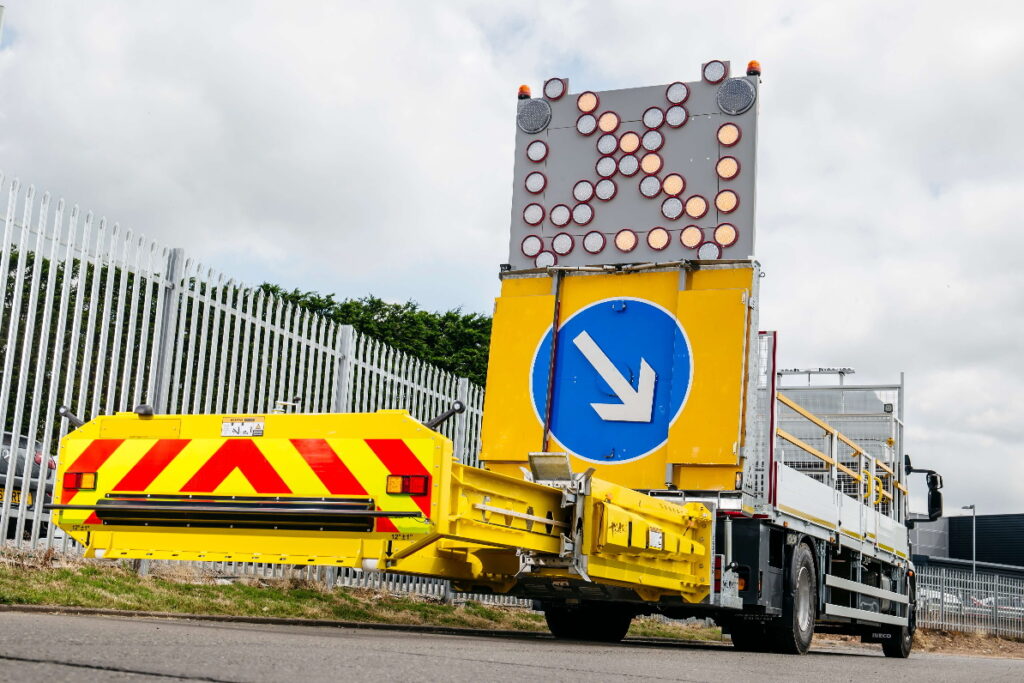
The most effective accessories for improving truck mounted attenuator visibility at night are LED arrow boards, retroreflective sheeting, warning lights, and variable message signs. These tools work together to alert approaching drivers well before they reach the work zone, giving them time to slow down and merge safely. The sections below break down how each accessory works and what to look for when equipping your TMA for nighttime operations.
What lighting accessories are required on a truck mounted attenuator?
A truck mounted attenuator typically requires rear-facing warning lights, amber strobes or LED beacons, and brake/tail lights that meet the visibility standards of the relevant road authority. In most jurisdictions, work zone vehicles must also carry flashing amber lights visible from a minimum distance, often 300 meters or more, depending on national or state regulations.
Beyond the minimum legal requirements, practical nighttime deployments benefit from additional lighting layers. Perimeter LED strips along the sides of the TMA chassis increase the vehicle’s visible profile, helping drivers judge its width and position. Underbody lighting can also improve visibility on unlit rural roads where ambient light is low.
When selecting lighting accessories, prioritize units rated for vibration resistance and waterproofing (IP67 or higher). TMA trucks operate in demanding conditions, and lighting that fails mid-shift creates exactly the hazard it was meant to prevent. LED technology is now the standard choice because it delivers high lumen output at low power draw, with a significantly longer operational lifespan than traditional halogen or incandescent alternatives.
How does an arrow board improve TMA visibility at night?
An arrow board improves TMA visibility at night by projecting a large, high-brightness directional signal that guides drivers away from the work zone lane. The dynamic arrow or chevron pattern is far more attention-grabbing than static markings, and LED arrow boards remain clearly readable even in rain, fog, and low-light conditions.
Arrow boards mounted on truck mounted attenuators serve a dual function: they mark the presence of the vehicle and communicate the required merge direction to approaching traffic. This removes ambiguity for drivers who may be unfamiliar with the road layout or distracted.
Key performance factors to evaluate in an arrow board include:
- Luminous intensity: Boards rated for daytime use (typically 10,000 cd/m² or above) also perform well at night without blinding drivers at close range
- Display modes: Arrow, sequential chevron, and caution flash modes cover different traffic management scenarios
- Automatic dimming: Ambient light sensors that reduce brightness at night prevent glare and improve legibility
- Panel size: Larger boards are visible from greater distances, which is particularly valuable on high-speed roads
Full-color LED arrow boards also allow operators to display additional symbols or text, giving more flexibility for complex work zone configurations.
What retroreflective materials work best on truck mounted attenuators?
High-intensity prismatic retroreflective sheeting, classified as Type IV or higher under ASTM D4956, works best on truck mounted attenuators. This material reflects headlight beams directly back toward the driver across a wide range of angles, making the TMA visible from several hundred meters even in complete darkness.
Retroreflective markings are applied to the rear and sides of the TMA in alternating yellow and red diagonal stripes, a pattern widely recognized as a work zone warning. This chevron configuration is specified in standards such as the MUTCD in the United States and equivalent European directives, so using the correct pattern also ensures regulatory compliance.
When choosing retroreflective materials, consider the following:
- Sheeting grade: Engineer-grade (Type I) is the minimum, but high-intensity prismatic (Type IV) and diamond-grade (Type IX/XI) offer significantly better nighttime performance
- Surface preparation: Retroreflective film bonds best to clean, primed metal surfaces, and poor adhesion leads to peeling that reduces effectiveness
- Durability rating: Outdoor-rated sheeting with a seven-year or longer warranty maintains its reflectivity through weather exposure and vehicle washing
Retroreflective materials are passive, meaning they require no power source. This makes them a reliable backup layer of visibility even if electrical systems fail during a shift.
How do variable message signs support nighttime TMA operations?
Variable message signs (VMS) support nighttime TMA operations by displaying real-time text warnings, speed limits, and lane closure information to approaching drivers. Unlike static signs, a VMS can be updated remotely as conditions change, giving traffic managers the ability to adapt messaging without sending personnel into the live traffic stream.
Mounted on or near a TMA truck, a VMS extends the advance warning zone well beyond what lighting and arrow boards alone can achieve. Drivers encounter the message at a distance where they still have time to reduce speed smoothly, which reduces the risk of rear-end collisions at the work zone taper.
At night, VMS brightness management becomes particularly important. A sign that is correctly calibrated for daylight will be uncomfortably bright after dark and may actually reduce legibility by creating glare. Automatic photocell dimming addresses this by adjusting output to match ambient light levels continuously.
Full-color LED displays offer an additional advantage: they can show both text and graphic symbols, which improves comprehension for drivers who may not be fluent in the local language, a relevant consideration on international freight corridors and cross-border infrastructure projects.
Which TMA visibility accessories are compatible with fleet tracking platforms?
Arrow boards, variable message signs, and LED warning systems that include CAN bus or cellular connectivity are compatible with fleet tracking platforms. These connected accessories allow operators to monitor device status, control display content, and verify that all visibility systems are active, all from a central dashboard.
Integration between visibility accessories and fleet management software gives traffic managers a real-time operational picture. If an arrow board loses power or a VMS goes offline during a night shift, the platform flags the fault immediately rather than waiting for a site inspection. This kind of remote oversight is particularly valuable when managing multiple simultaneous work zones across a road network.
GPS tracking of the TMA truck itself adds another layer of situational awareness. Knowing the precise location of each deployed vehicle lets dispatchers confirm that trucks are correctly positioned before a shift begins and monitor whether they move unexpectedly during operations.
How Verdegro Helps with TMA Nighttime Visibility
We design and manufacture truck mounted attenuators with nighttime visibility built in from the start, not treated as an afterthought. Our TMA range, including the TMA-US 100K, TTMA-US 100K, LTMA-US 70K, and BLADE TMA, is all tested and approved to MASH 2016 and NCHRP-350 TL-3 crash safety standards, and they are available with a full suite of integrated visibility accessories:
- LED arrow boards with automatic dimming and multiple display modes
- Full-color VMS displays for real-time messaging and remote content management
- Hydraulic LED-lift masts that raise lighting and signage to the optimal height for long-range visibility
- High-grade retroreflective markings applied to meet international work zone standards
All of these accessories are compatible with Mobilityplanner, our web-based fleet platform. Through Mobilityplanner, you can track the GPS location of every deployed TMA, monitor the status of connected visibility systems in real time, and control VMS content remotely, without needing to send staff into active traffic.
You can explore our full range of crash and TMA systems to find the right configuration for your work zone requirements. If you want to discuss which visibility accessories suit your specific operations, get in touch with us and we will help you build the right setup.
Related Articles
- Why is Verdegro's impact protection system called VanGuard?
- When is a light truck mounted attenuator sufficient instead of a full truck mounted attenuator?
- What is the difference between MASH and NCHRP-350 for truck mounted attenuators?
- How does a truck mounted attenuator work?
- What is a trailer truck mounted attenuator?