
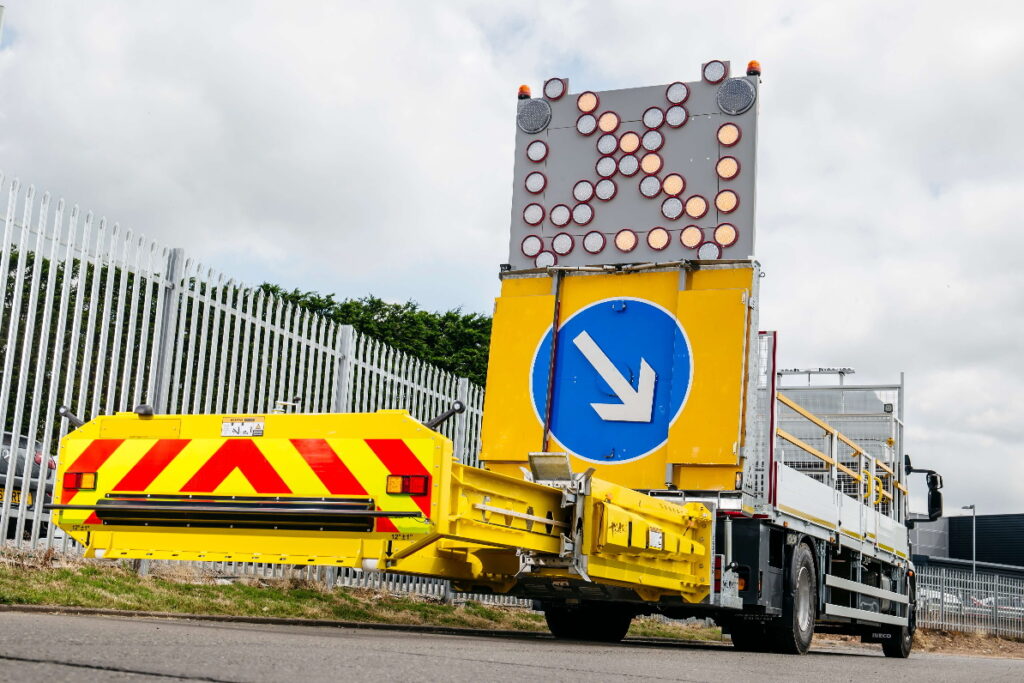
A trailer truck mounted attenuator (TTMA) is a crash cushion system mounted on a trailer that is towed behind a work vehicle into an active work zone. It absorbs the energy of an errant vehicle striking the rear of the trailer, redirecting and decelerating the impact to protect both road workers and the driver of the striking vehicle. TTMAs are widely used in highway construction, road maintenance, and traffic management operations where a moving or stationary buffer is needed between live traffic and workers.
Unlike attenuators bolted directly to a truck, the trailer version offers flexibility, it can be towed by different host vehicles and repositioned quickly as work progresses. The sections below answer the most common questions about how these systems work, how they compare to other attenuator types, and what to look for when selecting one.
How does a trailer truck mounted attenuator work?
A trailer truck mounted attenuator works by using a series of energy-absorbing cartridges, foam elements, or hydraulic components mounted in a collapsible frame at the rear of the trailer. When a vehicle strikes the attenuator, the frame progressively crushes or deforms, converting the kinetic energy of the impact into controlled deformation rather than transmitting it directly to the trailer, tow vehicle, or workers ahead.
The system is designed to bring an errant vehicle to a controlled stop while keeping the occupants within survivable deceleration limits. After a significant impact, the attenuator unit is typically replaced or rebuilt using a repair kit, while the trailer frame itself often remains structurally intact. This modular approach keeps downtime short and costs manageable.
Most modern trailer TMAs also carry active warning equipment. LED arrow boards, variable message signs (VMS), and high-visibility lighting are commonly integrated into the trailer to alert approaching drivers well before they reach the work zone. This combination of passive crash protection and active warning makes the TTMA a complete work zone safety solution in a single towed unit.
What is the difference between a trailer TMA and a vehicle-mounted attenuator?
The key distinction is how the attenuator is attached to the host vehicle. A vehicle-mounted attenuator (TMA) is bolted directly to the hitch or rear frame of a truck, making the truck and the attenuator a single unit. A trailer TMA (TTMA) is a separate wheeled trailer towed behind the host vehicle, connected via a standard fifth-wheel or pintle hitch coupling.
This difference has practical consequences for how each system is deployed:
- Flexibility: A TTMA can be decoupled from the tow vehicle, allowing the truck to be used for other tasks while the trailer remains in position as a static barrier.
- Host vehicle compatibility: Because the TTMA is a separate trailer, it can be towed by different trucks without requiring each truck to carry a permanently mounted attenuator.
- Impact behavior: In a collision, the trailer absorbs the impact independently. The hitch coupling is designed to release or absorb load in a way that limits force transferred to the tow vehicle and its occupants.
- Payload capacity: TTMAs can carry additional equipment such as traffic control devices, signs, or cones, making them useful as mobile supply trailers as well as crash cushions.
Vehicle-mounted TMAs, by contrast, are simpler to deploy and better suited to operations where the truck must remain continuously attached and mobile, such as rolling slowdowns on highways.
What safety standards do truck mounted attenuators have to meet?
Truck mounted attenuators must meet crash test standards that define the vehicle speeds, impact angles, and occupant risk criteria a system must survive to be approved for use on public roads. In the United States, the two primary standards are NCHRP Report 350 and the more current MASH 2016 (Manual for Assessing Safety Hardware). MASH 2016 is now the required standard for new products seeking Federal Highway Administration (FHWA) acceptance.
MASH testing evaluates attenuators at Test Level 3 (TL-3), which involves a passenger car and a pickup truck striking the system at defined speeds and angles. The test measures whether the attenuator contains the vehicle, limits intrusion into the occupant compartment, and keeps deceleration forces within survivable thresholds.
In Europe, EN 1317 governs roadside restraint systems, and national authorities may require additional compliance documentation before a system can be deployed on public infrastructure. For government tenders and contractor procurement, holding a current FHWA acceptance letter under MASH 2016 is often a minimum requirement and a strong indicator of product quality and compliance rigor.
When should a trailer truck mounted attenuator be used?
A trailer TMA should be used whenever a work zone requires a mobile or semi-static crash buffer between live traffic and workers, and when the operational setup benefits from a separable, towable unit rather than a permanently mounted system.
Typical scenarios where a TTMA is the right choice include:
- Long-duration road construction projects where the work zone moves progressively along a route and the attenuator needs to advance with it
- Maintenance operations where the host truck must occasionally leave the work zone for resupply or repositioning, but a crash barrier still needs to remain in place
- Multi-contractor sites where a single trailer can be shared between different tow vehicles across shifts
- Operations requiring onboard equipment storage, such as cone laying, sign deployment, or signal equipment, where the trailer’s deck space adds operational value
- High-speed environments such as motorways where TL-3-rated protection is required and the trailer configuration provides the right impact geometry
For short-duration or highly mobile operations such as rolling lane closures, a vehicle-mounted TMA may be more practical. The choice depends on how often the attenuator needs to move, whether the host truck must operate independently, and the specific compliance requirements of the project.
What should you look for when choosing a trailer TMA?
When choosing a trailer TMA, prioritize crash test certification, repairability, and compatibility with your operational setup. A system that meets the current MASH 2016 standard at TL-3 gives you the strongest compliance position for government contracts and public road deployment in 2026.
Beyond certification, consider these factors:
- Repair kit availability: After an impact, how quickly and cost-effectively can the attenuator be restored to service? Systems with modular cartridges or foam elements that can be replaced in the field minimize downtime.
- Integrated warning equipment: Does the trailer support LED arrow boards, VMS displays, or lighting masts? Integrated systems reduce setup time and wiring complexity compared to adding equipment separately.
- Hitch compatibility: Confirm that the trailer’s coupling system matches your tow vehicle fleet. Mismatched hitch types create operational delays and safety risks.
- Weight and tow ratings: The trailer’s gross vehicle weight must fall within your truck’s tow capacity, particularly when the trailer is loaded with additional equipment.
- Manufacturer support: Access to spare parts, technical documentation, and after-sales service matters as much as the initial product specification, especially for international deployments.
- GPS and remote monitoring: Some modern systems support real-time tracking and status monitoring, which is useful for fleet management across multiple active sites.
Comparing options across these criteria rather than on price alone helps you select a system that performs reliably over its full operational life.
How Verdegro Helps with Trailer Truck Mounted Attenuators
We manufacture a range of truck mounted attenuator systems designed for road construction contractors and traffic management operators worldwide. Our lineup includes the TTMA-US 100K, a trailer-based attenuator tested and approved to both NCHRP-350 TL-3 and MASH 2016, alongside vehicle-mounted options such as the TMA-US 100K, LTMA-US 70K, and BLADE TMA. All systems hold FHWA acceptance letters under the current MASH 2016 standard.
Here is what you get when you work with us:
- Certified crash protection tested to MASH 2016 TL-3, meeting the requirements for government tenders and public road deployment
- Optional integrated equipment including LED arrow boards, full-color VMS displays, and hydraulic LED-lift masts, reducing the need for separate traffic control setups
- Mobilityplanner platform access for real-time GPS tracking, status monitoring, and remote control of your deployed units across multiple sites
- Modular repair systems that allow fast field restoration after an impact, keeping your operation moving
- International deployment experience, with systems supplied to government agencies and contractors across Europe and beyond
If you are specifying a trailer TMA for an upcoming project or want to compare our systems against your current setup, contact our team and we will help you identify the right solution for your operational requirements.
Related Articles
- Should you use a van or truck for roadwork protection?
- What is another name for a truck mounted attenuator?
- What is the difference between a truck mounted attenuator and an arrow board?
- How do you choose the right truck mounted attenuator weight class?
- When is a truck mounted attenuator required at a roadwork site?