
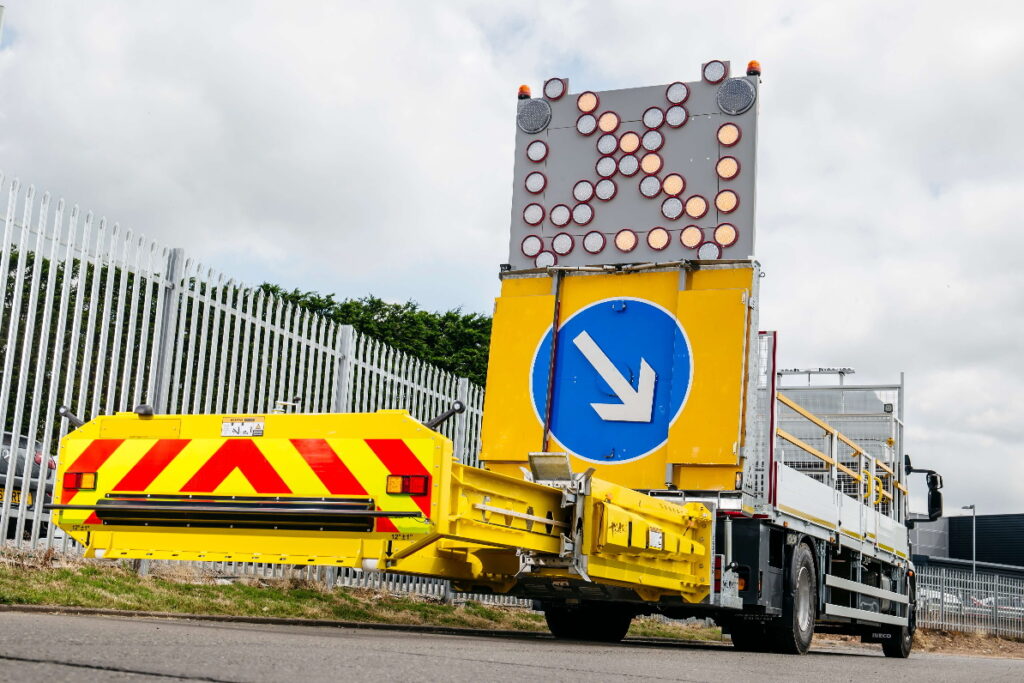
A truck-mounted attenuator is also commonly called a TMA, a crash truck, a cushion truck, or an impact attenuator vehicle (IAV). The abbreviation TMA is by far the most widely used term across road construction and traffic management industries worldwide. Depending on the country, specification document, or contractor, you may also hear it referred to as a mobile attenuator or a shadow vehicle.
All of these names describe the same piece of equipment: a crash cushion device mounted to the rear of a work truck that absorbs the energy of an errant vehicle and protects workers in an active work zone. The variation in naming reflects regional conventions, procurement language, and the different roles the device plays in a traffic safety setup.
Below, we answer the most common questions about truck-mounted attenuators so you can make informed decisions about work zone protection.
Why does a truck-mounted attenuator go by so many names?
A truck-mounted attenuator goes by many names because the device serves multiple functions and is described from different perspectives depending on who is talking about it. Engineers focus on its mechanical role (attenuator), operators describe it by its appearance (crash truck), and procurement documents use formal terminology (impact attenuator vehicle or IAV). Each name is technically accurate, just emphasizing a different aspect.
The most common alternative names you will encounter include:
- TMA — the universal industry abbreviation
- Crash truck — used by road crews and operators on site
- Shadow vehicle — used when the truck is positioned behind slow-moving work equipment
- Impact attenuator vehicle (IAV) — common in formal engineering and specification documents
- Mobile attenuator — used when distinguishing it from fixed, roadside crash cushions
- Cushion truck — an informal term reflecting the energy-absorbing function
In the United States, the Federal Highway Administration (FHWA) and MASH testing documentation typically use “truck-mounted attenuator” or “TMA.” In the UK and parts of Europe, “impact attenuator vehicle” or simply “attenuator truck” appears more frequently in national standards and tender documents.
What is the difference between a TMA and a crash cushion?
A TMA is a mobile device mounted to a moving or parked truck, while a crash cushion is a fixed roadside barrier installed at a specific location such as the end of a guardrail or a concrete divider. Both absorb vehicle impact energy, but a TMA travels with the work zone and a crash cushion stays in place permanently or semi-permanently.
The practical difference matters for work zone planning. A crash cushion protects a fixed hazard that drivers approach at full speed. A TMA protects workers from vehicles that drift into an active, moving work zone. Because work zones change location constantly, the mobility of a TMA makes it the right tool for road construction and maintenance operations.
Another distinction is reusability. Many modern TMAs are designed to be reset and reused after an impact, which reduces replacement costs. Fixed crash cushions often require full replacement or significant repair after a serious strike. You can read more about the full range of crash protection systems to understand how these categories fit together.
How does a truck-mounted attenuator actually work?
A truck-mounted attenuator works by absorbing and redirecting the kinetic energy of an impacting vehicle through a controlled deformation process. When a vehicle strikes the rear of the TMA, the attenuator compresses or collapses in a structured way, slowing the impacting vehicle gradually rather than stopping it abruptly. This dramatically reduces the force transferred to the occupants of the striking vehicle and to the work truck itself.
The attenuator is mounted to the rear of a host truck using a mounting bracket system. The host truck adds mass, which helps resist forward movement on impact. The attenuator itself typically uses one of several energy-absorbing mechanisms:
- Aluminum honeycomb cells that crush progressively under load
- Hydraulic or pneumatic cylinders that compress and dissipate energy
- Foam-filled cartridges designed to deform at a controlled rate
After impact, the host truck and attenuator combination ideally remain ahead of the striking vehicle, separating it from workers further up the road. The design prioritizes occupant ride-down, meaning the goal is to slow the impacting vehicle at a rate that keeps deceleration forces survivable.
What standards and certifications apply to TMAs?
Truck-mounted attenuators must meet crash-testing standards that verify they perform safely under real impact conditions. In the United States, the two primary standards are NCHRP-350 and the more current MASH 2016 (Manual for Assessing Safety Hardware). MASH 2016 uses heavier test vehicles and stricter evaluation criteria, making it the more demanding benchmark. FHWA acceptance letters confirm that a specific TMA model has passed the required tests.
In Europe, EN 1317 governs crash cushion performance, and national highway agencies may layer additional requirements on top of this standard. Many international procurement processes now require MASH 2016 compliance as a minimum, particularly for government-funded projects.
When evaluating a TMA, you should check:
- Whether the device holds a current FHWA acceptance letter (for US projects)
- Which test level it was certified at (TL-2 or TL-3, with TL-3 covering higher-speed environments)
- Whether the certification applies to the specific truck weight class you intend to use
- Whether the certification covers the configuration with any add-on accessories such as arrow boards or VMS displays
When should a TMA be used in a work zone?
A TMA should be used in any work zone where workers are exposed to live traffic and where an errant vehicle could enter the work area. This includes highway maintenance operations, road resurfacing, lane closures, bridge work, and any situation where a slow-moving or stationary work vehicle operates near active traffic lanes. The higher the posted speed limit, the more important a TMA becomes.
Most national and state highway standards require a TMA when work is performed on roads above a certain speed threshold, commonly 45 mph (70 km/h) or higher. However, using one at lower speeds on high-volume roads is also considered good practice, particularly in urban environments where rear-end collisions remain a significant risk.
Situations that specifically call for a TMA include:
- Moving operations such as line painting, pothole patching, or sweeping on live roads
- Stationary lane closures on high-speed roads where a shadow vehicle provides a physical buffer
- Incident management scenarios where emergency vehicles are stopped in or near live lanes
- Any operation where workers are on foot near traffic
How Verdegro Helps with Truck-Mounted Attenuator Selection
We manufacture a full range of truck-mounted attenuators designed for different truck weight classes and project requirements. Our TMA lineup includes the TMA-US 100K, TTMA-US 100K, LTMA-US 70K, and BLADE TMA, all tested and approved to NCHRP-350 TL-3 and MASH 2016 standards. Each model holds FHWA acceptance letters, so you can deploy them on US federal and state projects with confidence.
Here is a quick overview of what our TMA systems offer:
- Multiple weight class options so you can match the attenuator to your available host trucks
- MASH 2016 and NCHRP-350 certification covering current compliance requirements
- Optional integrated accessories including LED arrow boards, full-color VMS displays, and hydraulic LED-lift masts
- Durable construction built for repeated deployment in demanding road environments
- International availability for contractors and agencies operating outside the US
Whether you are outfitting a single maintenance truck or specifying equipment for a large road construction program, we can help you identify the right system for your speed environment, truck fleet, and compliance requirements. Get in touch with us to discuss your work zone protection needs and find out which TMA is the right fit for your operation.