
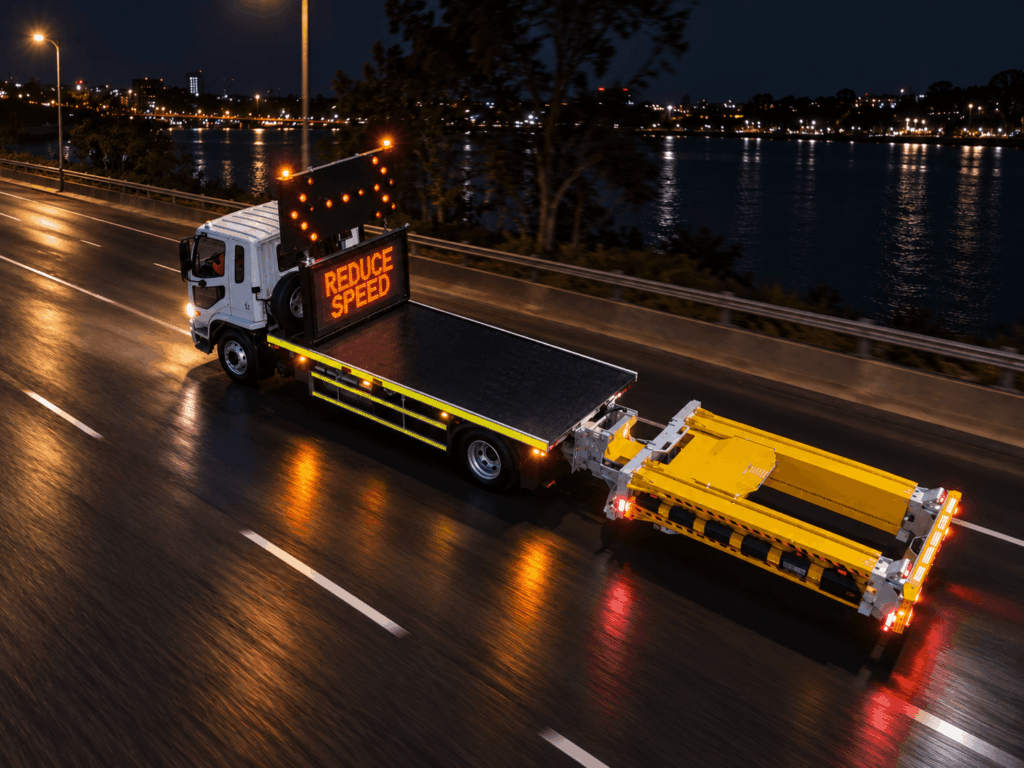
You choose impact protection for mobile roadworks by matching the system to your vehicle type, site speed limit, regulatory standard, and operational requirements. A van-mounted attenuator suits lighter vehicles in lower-speed environments, while a full truck-mounted attenuator is the right choice for high-speed highway work zones. The sections below walk through each decision factor in detail.
What types of impact protection are used in mobile roadworks?
The two main types of impact protection used in mobile roadworks are Truck Mounted Attenuators (TMAs) and van-mounted crash cushions. Both absorb the energy of an errant vehicle before it reaches workers, but they differ in size, vehicle compatibility, and the speed range they are designed to handle.
A Truck Mounted Attenuator is a crash cushion fitted to the rear of a heavy support truck. It deploys into a horizontal operational position behind the vehicle, creating a buffer zone between live traffic and the work crew ahead. TMAs are built for high-speed roads and are tested against stringent crash standards at speeds up to 100 km/h (62 mph) or higher.
A van-mounted crash cushion serves the same protective purpose but is designed for closed vans rather than heavy trucks. This category covers a range of mounting configurations, including rear-mounted, top-mounted, and swing-mounted variants. Van-mounted systems are well suited to lower-speed environments, urban maintenance operations, and situations where a lighter, more maneuverable vehicle is preferable.
Beyond attenuators, work zones also use arrow boards, Variable Message Signs (VMS), and rumble mats to manage traffic flow and alert approaching drivers. These tools support the attenuator but do not replace it as the primary crash protection device.
What safety standards apply to mobile roadwork protection equipment?
The most widely referenced safety standard for mobile roadwork protection equipment is MASH 2016 (Manual for Assessing Safety Hardware), published by AASHTO and FHWA. In the United States, MASH 2016 is the current standard, and products must hold FHWA acceptance letters to be used on federally funded projects. In the United Kingdom, the equivalent standard is TD49/07, which includes an optional 110K test at higher impact speeds.
MASH defines Test Levels (TL) that correspond to vehicle weight and impact speed. For high-speed highway work zones, TL-3 is the relevant benchmark, requiring the system to withstand a 2,270 kg vehicle impact at 100 km/h. Lower test levels apply to lower-speed environments. When evaluating any attenuator, confirm which test level it has been certified to, not just whether it carries a MASH label.
In Europe, CE marking and EMC compliance are also required for equipment sold across EU member states. Some countries add national requirements on top of these baseline standards, so always verify the specific regulations that apply in the country where the equipment will be deployed.
How does a Truck Mounted Attenuator differ from a crash cushion?
A Truck Mounted Attenuator (TMA) is a specific type of crash cushion, one that is permanently or semi-permanently mounted on the rear of a support truck and travels with the work zone. A static crash cushion, by contrast, is a fixed roadside device installed at a hazard point such as a gore area or barrier end, and it does not move with traffic.
The key operational difference is mobility. A TMA provides moving protection for slow-moving or stationary work convoys, absorbing rear-end impacts from vehicles that fail to slow down in time. Static crash cushions protect against vehicles leaving the travel lane and striking a fixed object. Both are energy-absorbing devices, but they serve different scenarios.
Within the TMA category, designs also vary. Some systems use multiple cushion elements with extension mechanisms, while others, like more recent designs, use a single cushion element that deploys in one continuous motion. Single-stage systems reduce mechanical complexity, lower maintenance demands, and deploy faster, which matters in active traffic conditions.
What factors determine which impact protection system is right for a job?
The right impact protection system depends on four main factors: vehicle type, site speed limit, applicable safety standard, and operational environment. Getting all four right ensures both legal compliance and genuine worker protection.
- Vehicle type: Heavy support trucks (typically 7,000 kg and above) can carry a full TMA. Lighter vehicles require a van-mounted system matched to the van’s weight class.
- Speed limit: High-speed roads (80 km/h and above) require a TL-3-certified attenuator. Lower-speed urban or suburban sites may permit a lower test level, which opens up lighter and more compact options.
- Regulatory standard: Confirm whether the project requires MASH 2016, NCHRP 350, TD49/07, or a national equivalent. Using a non-compliant product on a regulated project creates liability and can invalidate contracts.
- Operational environment: Narrow lanes, frequent repositioning, and confined urban sites favour compact, maneuverable systems. Wide highway work zones with longer stationary periods allow for larger, heavier attenuators.
Maintenance requirements and ease of operation are also worth weighing. A system with fewer electronic components and no sensors is generally easier to service in harsh field conditions, reducing downtime between deployments.
How do speed limits affect the choice of impact protection?
Speed limits directly determine the Test Level a crash protection system must meet. Higher speed limits require higher-rated equipment because the energy transferred in a collision increases significantly with speed. Deploying an under-rated attenuator at a speed above its certification limit is both unsafe and non-compliant.
As a practical guide:
- Up to 50 km/h (30 mph): Lower-test-level systems are generally acceptable. Van-mounted cushions designed for urban environments typically cover this range.
- 50 to 80 km/h (30 to 50 mph): Mid-range test levels apply. Check the specific certification of any system you consider, as manufacturer claims can vary.
- 80 to 100 km/h (50 to 62 mph): TL-3 certification is required. At this speed range, a fully tested and approved TMA on a qualifying support truck is the standard solution.
- Above 100 km/h: Some jurisdictions require the UK optional 110K test or equivalent high-speed certification. Confirm local requirements before specifying equipment.
Note that the work zone speed limit applies, not the posted road speed. Many high-speed roads reduce the limit through the work zone, which can affect which equipment tier is technically required. Always base your selection on the speed that applies during active operations.
What questions should you ask a supplier before buying road safety equipment?
Before purchasing any road safety equipment, ask the supplier to provide documentation and specific answers on compliance, testing, and support. Vague claims are not enough when worker safety and contract compliance are at stake.
- Which crash standard has the product been tested and certified to? Ask for the specific test level (e.g. MASH 2016 TL-3) and request the official crash test certification documents.
- Does the product hold an FHWA acceptance letter? For US federally funded projects, this is a mandatory requirement, not an optional extra.
- What is the compatible vehicle weight range? TMAs have minimum and maximum support truck weight requirements. Confirm your fleet vehicles fall within the approved range.
- How long does deployment take, and can it be done while moving? Faster deployment reduces exposure time for operators. Some systems deploy in under 20 seconds at highway speeds; others require the vehicle to stop.
- What does maintenance involve, and how often is it required? Ask about inspection intervals, replacement parts availability, and whether the system requires specialist technicians or can be serviced by your own crew.
- Is GPS tracking or safety alert integration available? Real-time location data and integration with navigation platforms such as Waze or Google Maps can warn approaching drivers of nearby workers, adding an active safety layer beyond the physical attenuator.
- What happens after a crash event? Find out whether the system can be reset and redeployed after an impact, and what the process and cost of post-impact inspection or replacement looks like.
How We Help You Choose the Right Impact Protection
We design and manufacture a range of crash protection systems built to meet the demands of real work zones, from high-speed motorway operations to urban maintenance convoys.
Our current TMA lineup includes:
- Armadillo TMA: Our newest Truck Mounted Attenuator, introduced in 2026. Fully tested and approved to MASH 2016 TL-3 at 100 km/h. The Armadillo uses a single cushion element that deploys in one continuous motion in under 20 seconds while driving at 80 km/h. It operates without sensors or electronic feedback systems, which means fewer potential failure points and simpler field maintenance. Compatible with support trucks between 7,228 kg and 12,475 kg.
- VanGuard TMA: The world’s first TMA designed specifically for closed vans. Available in three configurations: rear-mounted, top-mounted, and swing-mounted. The swing-mounted variant rotates the cushion sideways so rear doors remain accessible during operation. All versions withstand impacts at up to 80 km/h (50 mph) and can be fitted with arrow boards, VMS signs, or both.
Both systems can be equipped with Mobitrack, our GPS tracking module that integrates with safety alert platforms including Google Maps, Waze, Flitsmeister, and Monotch. This means approaching drivers receive real-time warnings about your work zone, adding an active protective layer alongside the physical attenuator. Our Mobilityplanner platform gives you remote visibility of product status, location history, and operational data across your entire fleet.
If you are comparing systems or need guidance on which configuration suits your vehicles and site conditions, contact us directly and we will help you find the right solution.
Related Articles
- Why do truck mounted attenuator standards differ between the US and Europe?
- Can you customize a truck mounted attenuator with additional warning lights?
- What should you consider before buying a truck mounted attenuator?
- Should you choose a truck-mounted or trailer-mounted attenuator?
- What is a truck mounted attenuator used for?