
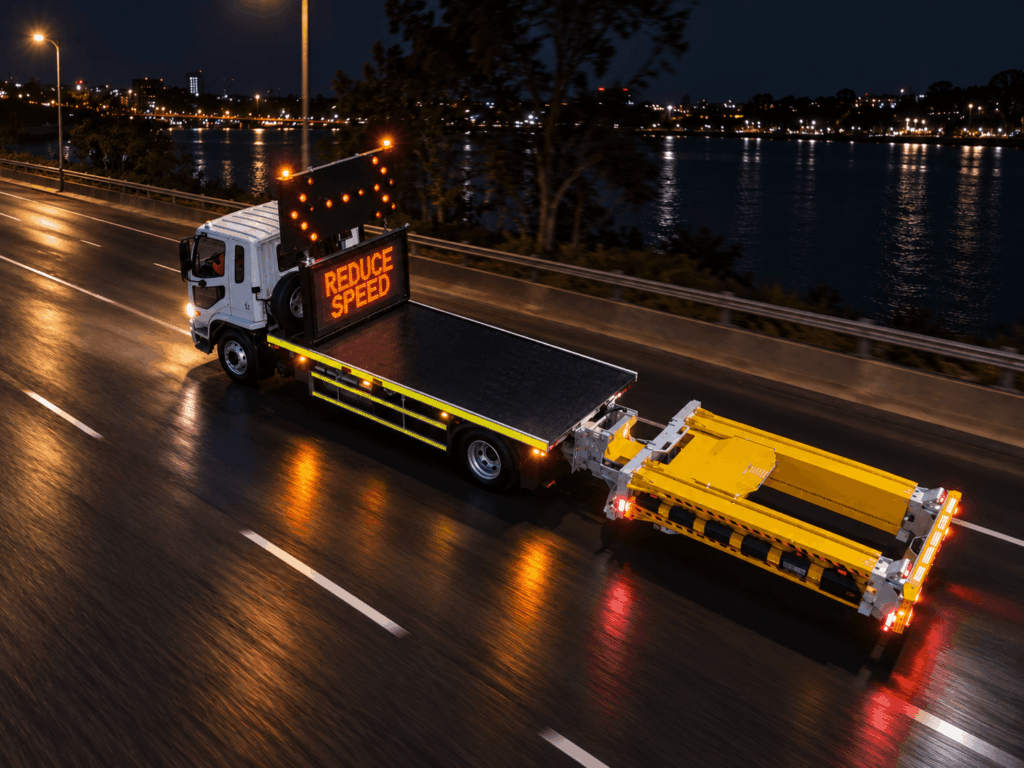
You need a full-size impact protection vehicle when your work zone operates on high-speed roads where errant vehicles pose a direct threat to workers and equipment, and where a standard van-mounted system does not provide sufficient mass or crash performance to meet the required protection level. Full-size impact protection vehicles are typically specified for motorway and expressway operations running at or above 100 km/h (62 mph), where regulatory standards demand heavier, more robust crash attenuation. This article walks through the key questions road safety professionals ask when evaluating whether a full-size IPV is the right choice for a project.
What qualifies as a full-size impact protection vehicle?
A full-size impact protection vehicle is a heavy truck, typically between 7,000 and 12,500 kg, fitted with a certified crash cushion mounted at the rear. It is deployed in a work zone to absorb the energy of an errant vehicle, protecting workers and stationary equipment behind it. The vehicle’s mass and the attenuator’s engineering together determine the protection level the system can deliver.
What separates a full-size IPV from lighter alternatives is the combination of vehicle weight class and crash test performance. The supporting truck must fall within a specific weight range to ensure the attenuator functions as tested. Too light, and the truck moves too far on impact; too heavy, and the cushion cannot deform correctly. This is why crash standards specify minimum and maximum vehicle weights as part of the certification, not just the attenuator design itself.
Full-size IPVs are generally distinguished by their ability to meet Test Level 3 (TL-3) requirements, which simulate impacts at 100 km/h (62 mph). This makes them the standard choice for high-speed road environments where lighter van-based systems would not provide adequate protection.
What work zone conditions require a full-size IPV?
A full-size IPV is required when your work zone is located on a high-speed road, typically a motorway, dual carriageway, or expressway with posted speeds of 80 km/h or above, where errant vehicle speeds and impact forces exceed what lighter systems are rated to handle. Project specifications, national standards, and client requirements usually define this threshold explicitly.
Beyond speed, several other conditions point toward a full-size IPV:
- Extended exposure time: Long-duration work zones where crews remain on the carriageway for hours or days increase the statistical likelihood of an impact event, making robust protection more important.
- High traffic volumes: Roads carrying heavy commercial traffic, including HGVs and buses, raise the severity of potential impacts and justify a higher protection class.
- Narrow lane configurations: When traffic is channelled close to the work area with minimal buffer, a full-size IPV provides a physical barrier that reduces the risk of direct worker contact.
- Regulatory or contract requirements: Many national highway agencies and project specifications mandate TL-3-certified protection on motorways regardless of site-specific risk assessment.
- Night-time and low-visibility operations: Reduced driver reaction time at night increases the probability of late-stage errant vehicle events, making higher-rated protection more appropriate.
If your operation involves lane closures on a motorway or a high-speed arterial road, a full-size IPV is almost always the correct choice. Lighter systems are better suited to urban environments and lower-speed roads where impact energy is significantly reduced.
How does a full-size IPV differ from a truck mounted attenuator?
A full-size impact protection vehicle and a truck mounted attenuator are closely related: a full-size IPV is, in most cases, a heavy truck with a truck mounted attenuator fitted to it. The distinction lies in scope: “truck mounted attenuator” refers specifically to the crash cushion system, while “impact protection vehicle” refers to the complete operational unit, truck, attenuator, signage, and all associated equipment working together.
In practical terms, the difference matters when comparing full-size IPVs against van-based or light-vehicle TMA systems. Truck mounted attenuators designed for full-size vehicles operate within a higher vehicle weight class and are crash-tested to absorb greater impact forces. Van-mounted systems like those used on closed vans are tested to lower performance levels and are suited to urban or lower-speed environments.
Key differences between a full-size IPV and a van-based TMA system include:
- Vehicle weight class: Full-size IPVs use trucks typically above 7,000 kg; van-based systems use light commercial vehicles.
- Crash test performance: Full-size truck attenuators are tested at TL-3 (100 km/h); van-mounted systems are generally tested at lower impact speeds.
- Deployment environment: Full-size IPVs are specified for motorways and high-speed roads; van-based systems suit urban and low-speed work zones.
- Flatbed access: Full-size IPVs often carry additional equipment, cones, signs, barriers, on the truck bed alongside the attenuator, making flatbed access a practical consideration in attenuator design.
Understanding this distinction helps you select the right system for the right environment rather than over- or under-specifying protection for a given project.
What compliance standards govern full-size impact protection vehicles?
Full-size impact protection vehicles must comply with crash test standards that define acceptable performance in terms of vehicle deceleration, occupant risk, and post-impact behaviour. The two most widely referenced standards are MASH 2016 (Manual for Assessing Safety Hardware) in North America and TD49/07 in the United Kingdom, with EN 1317 applying across much of Europe.
MASH 2016 replaced the earlier NCHRP 350 standard and is now the current benchmark for crash attenuation equipment. Test Level 3 under MASH 2016 is the relevant performance category for full-size IPVs, covering impact speeds up to 100 km/h (62 mph) with defined vehicle types. Systems tested and approved under MASH 2016 TL-3 carry official crash test certifications that highway agencies require before approving equipment for use on public roads.
In the UK, the optional 110K test under TD49/07 extends performance requirements further, covering higher-speed impact scenarios. Equipment that passes this test is accepted for use on UK motorways and high-speed trunk roads.
Beyond crash performance, full-size IPVs must also meet:
- CE marking and EMC compliance for electrical and electronic components in European markets.
- FHWA acceptance in the United States, where the Federal Highway Administration issues acceptance letters for systems that pass MASH testing.
- National road authority approvals, which vary by country and may require additional documentation or local testing beyond the base standard.
Always verify which standard your project’s contract or national authority requires before specifying an IPV. MASH 2016 acceptance letters and official crash test certifications should accompany any system you deploy on a regulated highway.
Who is responsible for specifying an IPV on a road project?
Responsibility for specifying an impact protection vehicle typically sits with the traffic management designer or the principal contractor, working within a framework set by the highway authority or client. On publicly funded road projects, national or regional highway agencies issue standards and design guidance that define when an IPV is required and what performance level it must meet. The contractor is then responsible for sourcing a compliant system.
In practice, specification responsibility is shared across several roles:
- Highway authority or client: Sets the baseline requirements through project specifications, design standards, and contract documents. These documents define the required crash test level and any mandatory equipment approvals.
- Traffic management designer: Translates the authority’s requirements into a site-specific traffic management plan that identifies where an IPV is needed, how it should be positioned, and what signage it must carry.
- Principal contractor: Responsible for ensuring the deployed IPV matches the specification, carries valid certifications, and is operated correctly on site.
- Traffic management subcontractor: Responsible for day-to-day operation, deployment, and maintenance of the IPV in accordance with the approved plan.
Where a project involves multiple stakeholders, it is important that the specification is agreed in writing before procurement begins. Misalignment between what the authority requires and what the contractor sources is a common source of compliance problems on site.
What features should a full-size IPV include beyond crash protection?
Beyond the crash cushion itself, a full-size IPV should include arrow boards, variable message signs, lighting systems, and tracking capabilities. These features transform the vehicle from a passive barrier into an active traffic management tool that warns approaching drivers, guides them through the work zone, and allows the operator to monitor the vehicle remotely.
The most important additional features to look for include:
- Arrow boards: A rear-mounted arrow board directs traffic away from the work zone and is a standard fitment on most IPVs. Look for LED arrow boards with high visibility in daylight and adjustable brightness for night operations.
- Variable Message Signs (VMS): VMS panels allow operators to display dynamic messages, speed limits, lane closures, hazard warnings, directly from the vehicle, reducing the need for separate sign vehicles.
- GPS tracking and telematics: Real-time location data allows fleet managers to monitor IPV positions, verify that vehicles are in the correct location, and respond quickly if a vehicle moves unexpectedly. Systems that integrate with safety alert platforms can also warn approaching drivers of the vehicle’s presence through navigation apps.
- Remote control operation: The ability to raise, lower, and configure the attenuator and arrow board from the cab reduces the time operators spend outside the vehicle in live traffic.
- Geofencing and safety alerts: Integration with platforms such as Waze, Google Maps, and national traffic control systems means the vehicle’s position is visible to road users before they reach the work zone, giving them more time to react.
- Flatbed access: A well-designed IPV preserves full access to the truck’s flatbed so operators can carry and deploy additional equipment, cones, barriers, signs, without the attenuator obstructing the load area in transport position.
These features matter because crash protection alone does not constitute a complete work zone safety solution. The IPV needs to communicate with approaching traffic, be monitored by the operator, and integrate with broader traffic management systems to deliver its full safety benefit.
How Verdegro Supports Your Impact Protection Vehicle Needs
We design and manufacture truck mounted attenuators and van-based TMA systems that cover the full range of work zone environments, from urban roads to high-speed motorways. Our product range gives you the right level of protection for each application, backed by full crash test certification.
Here is what we offer for full-size IPV applications:
- Armadillo TMA: Our newest truck mounted attenuator, introduced in 2026 and fully tested and approved under MASH 2016 TL-3. The Armadillo deploys in under 20 seconds while driving at 80 km/h, operates without sensors or electronic feedback systems, and preserves full flatbed access in transport position. It is lighter and more compact than previous generations, making it easier to operate and service in demanding conditions.
- VanGuard TMA: The world’s first TMA designed for closed vans, available in rear-mounted, top-mounted, and swing-mounted variants. The VanGuard is the right choice for lower-speed urban work zones where a full-size truck is not required.
- Mobitrack integration: Our Mobitrack system provides real-time GPS tracking, location history, and integration with safety alert platforms including Waze, Google, Flitsmeister, and national traffic control systems. This keeps your IPV visible to approaching drivers and gives your team full operational oversight.
- Official certifications: All our truck attenuators are delivered with official crash test certifications, CE marking, and EMC compliance documentation, everything you need to satisfy highway authority requirements.
If you are evaluating which impact protection vehicle system fits your project requirements, contact our team and we will help you identify the right solution based on your road type, speed environment, and compliance obligations.
Related Articles
- What is the role of an impact protection vehicle in temporary traffic management?
- How do truck mounted attenuator models differ in crash performance?
- How often are truck mounted attenuators hit by vehicles?
- What speed rating do truck mounted attenuators have?
- Does a heavier truck mounted attenuator offer better protection?