
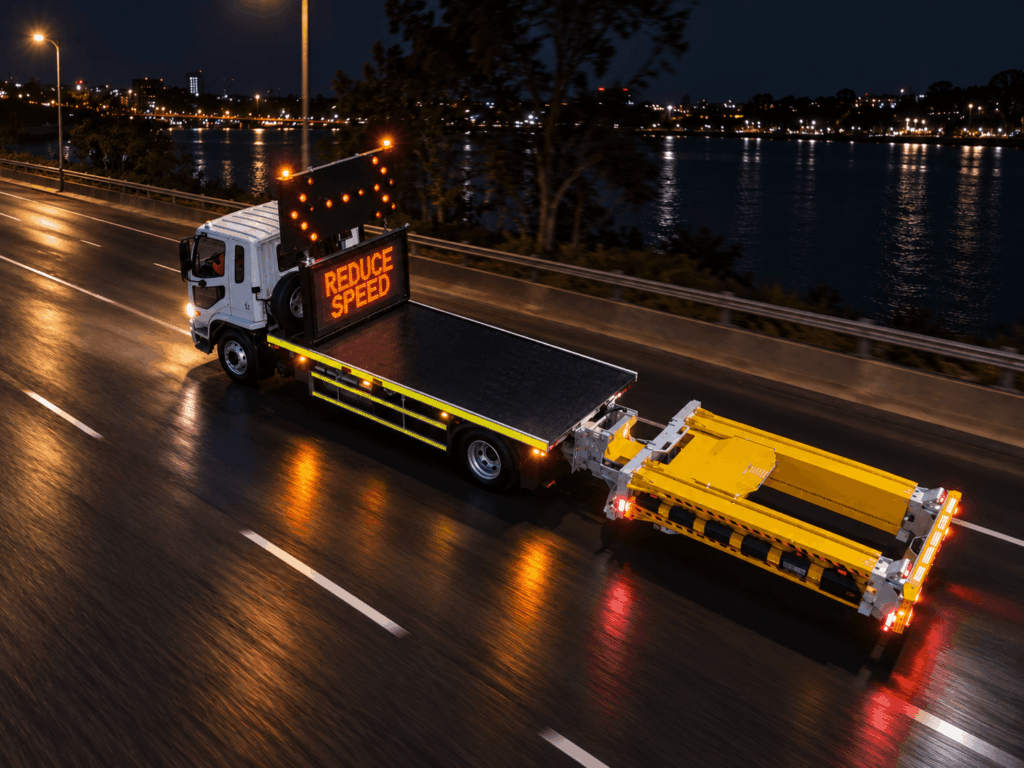
An impact protection vehicle (IPV) is a vehicle positioned at the rear of a work zone to absorb errant vehicle impacts before they reach road workers. It acts as a moving or stationary buffer between live traffic and the crew operating in or near an active lane. This article answers the most common questions about how IPVs work, when they are required, and what equipment they should carry.
What does an impact protection vehicle actually do on the road?
An impact protection vehicle positions itself between oncoming traffic and a road crew to intercept collisions before they reach workers. It absorbs or redirects the energy of an errant vehicle, dramatically reducing the risk of fatalities and serious injuries in active work zones. The vehicle is typically fitted with a truck-mounted attenuator at the rear, which is the primary crash-absorbing device.
In practice, the IPV moves slowly ahead of or behind the work crew depending on the operation type. During mobile operations such as line marking or pothole patching, the vehicle advances with the crew. During stationary operations such as a lane closure, it parks at the taper point and remains in place for the duration of the task.
Beyond physical protection, the IPV also provides a visible warning to approaching drivers. Arrow boards, variable message signs, and flashing lights mounted on the vehicle give drivers advance notice that a work zone is ahead, prompting them to merge or slow down before reaching the crew.
What’s the difference between an impact protection vehicle and a truck-mounted attenuator?
An impact protection vehicle is the complete vehicle setup used to protect a work zone, while a truck-mounted attenuator (TMA) is the crash-absorbing device fitted to the rear of that vehicle. The TMA is the component that physically absorbs the impact. The IPV is the broader system that includes the host vehicle, the attenuator, and any additional warning equipment.
Think of the distinction this way: the truck is the platform, the TMA is the safety device, and together they form the impact protection vehicle. Without a certified truck-mounted attenuator, a vehicle cannot function as a proper IPV. Without the host vehicle, the attenuator has no mobility or operational capacity.
This distinction matters when specifying equipment for a project. Procurement teams need to confirm that the host vehicle meets the minimum weight requirements for the TMA being mounted, and that the combined system has been tested and certified as a unit. A TMA certified under MASH 2016 TL-3, for example, has been tested at 100 km/h (62 mph) and must be matched to a compatible truck within the approved weight range.
When is an impact protection vehicle required in temporary traffic management?
An impact protection vehicle is required whenever road workers are exposed to live traffic in a work zone, particularly where there is a risk of errant vehicles entering the workspace. Most national and regional traffic management standards mandate IPV use during lane closures, mobile operations on high-speed roads, and any task that places workers within or adjacent to a running lane.
The specific trigger points vary by jurisdiction, but common scenarios that require an IPV include:
- Lane closures on motorways and dual carriageways
- Mobile operations such as road marking, sweeping, or pothole repair
- Utility works where crews must work within the carriageway
- Incident management operations where emergency crews are exposed to traffic
- Any task where the work zone taper is positioned in a live traffic lane
On lower-speed urban roads, the requirement may be less prescriptive, but industry best practice still recommends some form of impact protection wherever workers face vehicle exposure. Project managers and safety planners should always consult the applicable traffic management code for the country or region where the work is taking place.
How does an impact protection vehicle protect road workers during a lane closure?
During a lane closure, the impact protection vehicle parks at the rear of the closed lane, positioned at or just behind the taper. Its truck-mounted attenuator faces oncoming traffic and acts as the first point of contact if a driver fails to merge. The attenuator absorbs the crash energy through controlled deformation, slowing the errant vehicle before it can reach the work crew ahead.
The protection works on two levels: physical and psychological. Physically, a certified TMA is engineered to manage impact forces within limits that protect both the errant vehicle occupants and the workers ahead. Psychologically, the visible presence of a large, marked vehicle with flashing lights and an arrow board signals to drivers that a lane is closed, encouraging earlier and more decisive merging behavior.
The positioning of the IPV is important. It must be placed far enough behind the crew to provide a meaningful buffer zone, but close enough to the taper to intercept vehicles before they reach the workspace. During the closure, the IPV operator typically remains in the cab, ready to move if conditions change. Workers ahead of the IPV should never position themselves between the attenuator and live traffic.
What equipment and technology should an impact protection vehicle carry?
A fully equipped impact protection vehicle should carry a certified truck-mounted attenuator, an arrow board or variable message sign, and high-visibility lighting as a minimum. Beyond the baseline, modern IPVs increasingly incorporate GPS tracking, safety alert integration, and remote monitoring tools that improve situational awareness for both the operator and the broader traffic management team.
The core equipment list for a well-specified IPV includes:
- Truck-mounted attenuator: The primary crash protection device, certified to the applicable standard (such as MASH 2016 TL-3)
- Arrow board: Directs approaching traffic to merge away from the closed lane
- Variable message sign (VMS): Communicates specific instructions or warnings to drivers
- High-visibility lighting: LED warning lights increase the vehicle’s conspicuity in all weather and light conditions
- GPS tracking: Allows fleet managers to monitor vehicle location in real time
- Safety alert integration: Systems that push alerts to navigation platforms such as Waze or Google Maps, warning approaching drivers of the work zone
The combination of passive protection (the attenuator) and active warning (lights, signs, and digital alerts) gives the IPV the broadest possible protective effect. Technology-enabled features such as geofencing and safety alert integration are becoming standard expectations on professionally managed projects, not optional extras.
Who is responsible for operating and deploying an impact protection vehicle?
The contractor or organization responsible for the work zone is responsible for deploying and operating the impact protection vehicle. In practice, this means the principal contractor must ensure that a suitably equipped and certified IPV is in place before any workers are exposed to live traffic. The IPV operator, typically a trained driver, is responsible for correct positioning, equipment function, and maintaining the vehicle’s protective role throughout the operation.
Responsibility is shared across several roles:
- Project manager or site supervisor: Plans the traffic management scheme and specifies the IPV requirement
- Traffic management designer: Produces the layout that defines where the IPV must be positioned
- IPV operator: Drives and positions the vehicle, operates the arrow board and attenuator, and monitors conditions from the cab
- Fleet or equipment manager: Ensures the TMA and all associated equipment are certified, maintained, and fit for use
In many countries, IPV operators must hold specific training qualifications before they can operate in this role. The operator must understand the limitations of the attenuator, the correct deployment procedure, and what to do if an impact occurs. An untrained operator in an otherwise well-equipped vehicle still represents a risk to the crew.
How Verdegro Supports Impact Protection Vehicle Operations
We design and manufacture truck-mounted attenuators and supporting equipment specifically built for the demands of temporary traffic management. Our product range gives you the tools to equip an IPV that meets current certification standards and performs reliably in real working conditions.
Our TMA options for IPV applications include:
- Armadillo TMA: Our latest truck attenuator, introduced in 2026, fully tested and approved under MASH 2016 TL-3 at 100 km/h. The Armadillo is lighter, more compact, and mechanically simpler than previous generations, with single-stage deployment in under 20 seconds. It operates without sensors or electronic feedback systems, reducing maintenance demands in demanding environments.
- VanGuard TMA: The world’s first TMA for closed vans, available in rear-mounted, top-mounted, and swing-mounted variants. The VanGuard withstands impacts up to 80 km/h and is fully customizable with arrow boards, VMS signs, and RAL colour matching to suit your fleet.
Both systems are compatible with our Mobitrack GPS tracking module, which integrates directly with safety alert platforms including Waze, Google Maps, and Flitsmeister to push real-time warnings to approaching drivers. You can also monitor your IPV fleet through our Mobilityplanner portal, which gives you live location data, equipment status, and operational statistics from a single dashboard.
You can explore our full range of crash and attenuator systems to find the right TMA for your vehicle type and project requirements. If you want to discuss your specific IPV setup or get technical advice on which system suits your application, contact our team directly.