
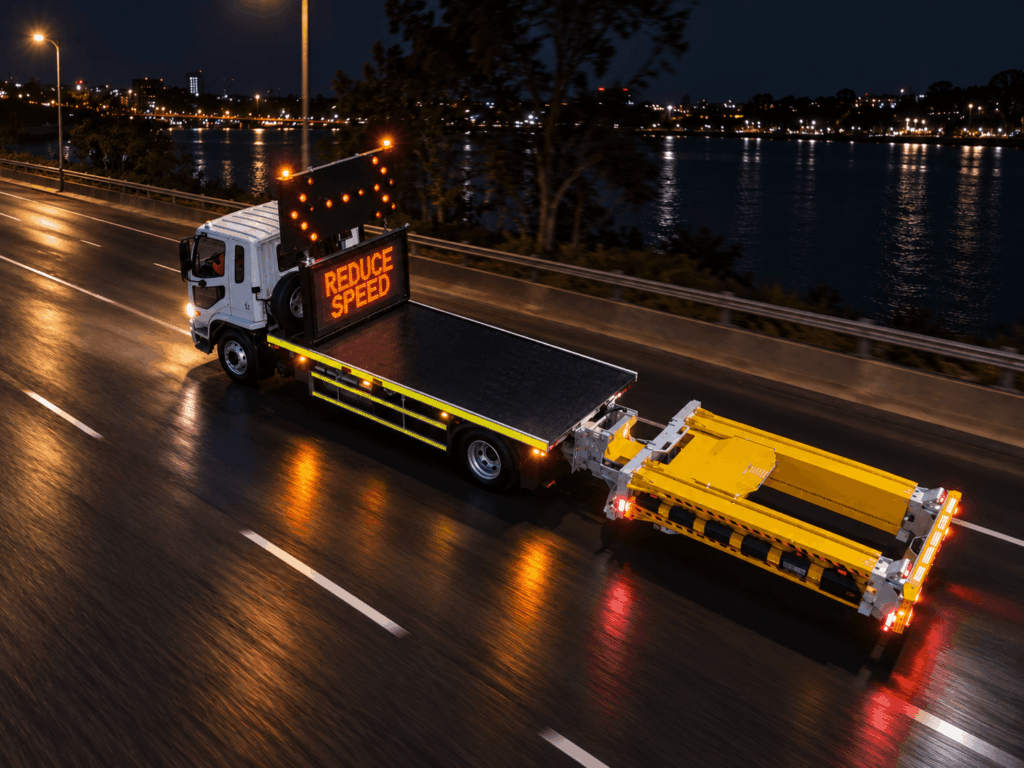
Vehicle type directly affects which crash attenuator you should use, because attenuators are engineered to work within specific weight ranges and mounting configurations. A system designed for a heavy-duty truck will not perform correctly on a light van, and vice versa. Below, we answer the most common questions about matching attenuators to vehicles so you can make the right choice for your work zone.
What factors beyond vehicle type influence attenuator selection?
Beyond vehicle type, the most important factors are the posted speed limit of the road where you deploy the attenuator, the crash test standard required in your country or region, the width of the work zone, and the mounting method available on your vehicle. Each of these factors can narrow or expand your range of suitable options significantly.
Speed limit is particularly decisive. Attenuators are rated to absorb impacts at specific speeds, so a system approved for 80 km/h (50 mph) is not automatically suitable for a motorway where traffic travels at 130 km/h. Regulatory compliance also plays a major role: in the United States, crash attenuator systems must meet MASH 2016 standards, while UK roads require compliance with TD49/07 and its optional 110K test. European markets follow their own national and EN standards.
Work zone geometry matters too. Narrow lanes demand compact attenuator widths to avoid creating secondary hazards. Deployment frequency is another practical consideration: if your crew repositions the shadow vehicle many times per shift, a mechanically simpler system that deploys in under 20 seconds reduces downtime and operator error.
How does vehicle weight determine crash attenuator performance ratings?
Vehicle weight determines crash attenuator performance ratings because the support truck must provide enough mass to absorb and redirect the kinetic energy of an impacting vehicle without being pushed into the work zone. If the truck is too light, the attenuator cannot perform as tested, and the system may fail to protect workers adequately.
Crash test standards specify minimum and maximum support vehicle weights for every approved attenuator. These limits exist because the attenuator and the truck function as a single energy-absorbing system during a crash event. A truck that falls outside the approved weight range invalidates the tested performance, even if the attenuator itself is undamaged.
For example, a heavy-duty truck-mounted attenuator designed for vehicles between roughly 7,200 kg and 12,500 kg will behave very differently if mounted on a vehicle outside that range. Lighter vehicles lack the inertia to hold position under impact; heavier vehicles can transmit forces that exceed the attenuator’s design limits. Always verify that your support vehicle’s gross vehicle weight falls within the attenuator manufacturer’s specified range before deployment.
What is the difference between a TMA and a crash cushion?
A Truck Mounted Attenuator (TMA) is a crash cushion that is permanently or semi-permanently attached to a moving support vehicle, allowing it to travel with and protect a work zone as it progresses along the road. A standalone crash cushion, by contrast, is a fixed or temporary barrier placed in front of a stationary hazard such as a concrete barrier end or a gore point.
The key operational difference is mobility. A TMA moves with the shadow vehicle, keeping the cushion positioned between traffic and the work crew at all times. Standalone crash cushions protect a fixed location and must be repositioned manually if the hazard moves. TMAs are the standard choice for moving operations such as lane restriping, pothole patching, and mobile maintenance crews.
Both types are designed to absorb impact energy and reduce the severity of crashes, but their deployment contexts are distinct. TMAs must also meet vehicle-specific mounting and weight requirements, while standalone cushions are evaluated based on the fixed structure they protect. When your operation moves along the road, a truck attenuator is the appropriate system. When you need to protect a permanent or long-term fixed hazard, a standalone crash cushion is the right tool.
Can the same crash attenuator be used on different vehicle types?
In most cases, the same crash attenuator cannot be freely transferred between different vehicle types without verifying that the new vehicle falls within the attenuator’s approved weight range and that the mounting system is compatible. Using an attenuator on a vehicle outside its tested parameters means the system is no longer operating under certified conditions.
Some attenuator systems are designed with multi-truck brackets that allow installation on a range of vehicles within a defined weight class. These brackets are themselves crash-tested and approved as part of the overall system, so compatibility is built into the design rather than assumed. If you need to move an attenuator between vehicles, check whether the manufacturer offers an approved multi-truck bracket and confirm that every candidate vehicle meets the minimum and maximum weight requirements.
Mounting geometry also varies between vehicle types. A system designed for a flatbed truck uses different attachment points than one designed for a closed van. Attempting to adapt a mounting system not tested for a specific vehicle configuration introduces risk that no amount of field modification can resolve.
Which vehicle types are most commonly paired with TMAs in road work zones?
The most common vehicle types paired with truck-mounted attenuators in road work zones are medium- to heavy-duty flatbed trucks, shadow vehicles in the 7,000 to 15,000 kg range. These vehicles provide the mass and structural rigidity needed to anchor the attenuator system during an impact and carry the hydraulic and electrical systems the attenuator requires.
Closed vans are also used, particularly in urban environments and on lower-speed roads where a smaller footprint is an advantage. Van-based TMA systems are designed specifically for this vehicle class and are tested accordingly, with mounting configurations that account for the van’s body structure and lower weight.
Pickup trucks and light commercial vehicles are generally not suitable for standard TMA systems because they fall below the minimum support vehicle weight required by most crash test standards. Some markets have developed lighter-duty attenuator solutions for these vehicles, but these systems operate within narrower speed and impact parameters and are not interchangeable with heavy-duty TMAs.
How do speed limits affect which attenuator system a vehicle should carry?
Speed limits directly determine the Test Level (TL) an attenuator must meet. Higher-speed roads require attenuators certified to absorb impacts at correspondingly higher speeds, and the support vehicle must be heavy enough to remain stable under those greater impact forces. Deploying an attenuator rated for lower speeds on a high-speed road is a compliance failure and a safety risk.
Under MASH 2016, Test Level 3 (TL-3) covers impact speeds up to 100 km/h (62 mph) and is the standard required for most motorway and highway work zones. Lower test levels apply to roads with reduced speed limits. When you plan a deployment, match the attenuator’s certified test level to the posted speed limit of the road, not the temporary reduced speed that may be in place during the work operation.
It is also worth noting that some attenuator systems carry optional test certifications for higher impact speeds, such as the UK’s 110K test, which validates performance at 110 km/h. If your operation regularly covers high-speed roads in multiple regulatory environments, selecting a system with broader certification coverage reduces the need to swap equipment between jobs.
How Verdegro Supports Your Attenuator Selection
We design and manufacture truck-mounted attenuators for a range of vehicle types and operational environments, so you can match the right system to your specific support vehicle and road conditions. Our current product range includes:
- Armadillo TMA – our newest truck-mounted attenuator, introduced in 2026, fully tested and approved under MASH 2016 TL-3 at 100 km/h. It is designed for support vehicles between 7,228 kg and 12,475 kg, deploys in under 20 seconds, and operates without sensors or electronic components, relying solely on a hydraulic power pack for maximum reliability.
- VanGuard TMA – the world’s first TMA designed specifically for closed vans, available in rear-mounted, top-mounted, and swing-mounted configurations. It handles impacts up to 80 km/h and keeps the van’s rear doors and tow hitch accessible in all variants.
Both systems carry official crash test certifications and CE marking. Optional accessories such as multi-truck brackets and Mobitrack GPS integration allow you to adapt the system to your fleet and connect it to safety alert platforms including Waze, Google, and national traffic control systems.
If you are unsure which attenuator fits your vehicle type, speed environment, or regulatory requirements, contact our team and we will help you identify the right solution for your work zone.