
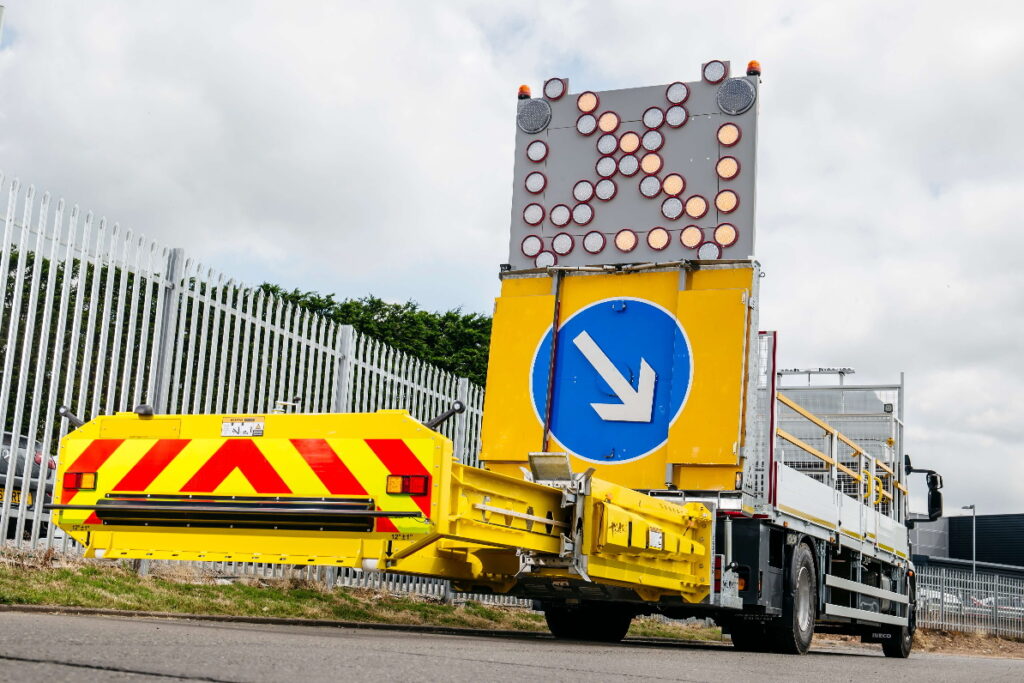
A trailer truck mounted attenuator is not inherently safer than a truck mounted attenuator – both can meet the same crash test standards when properly certified. The real difference lies in how each system is deployed, and which one suits your specific work zone setup. Understanding those differences helps you make the right choice for your crew and the road users you protect.
What are the key structural differences between a TMA and a trailer TMA?
A truck mounted attenuator (TMA) bolts directly to the rear of a host vehicle, typically a work truck or shadow vehicle, and absorbs impact energy through a built-in crash cushion. A trailer TMA (TTMA) is a standalone unit towed behind a separate vehicle. Both carry a crash cushion at the rear, but the TTMA adds an axle, a tow hitch connection, and its own frame structure between the host vehicle and the point of impact.
This structural difference has practical consequences. A TMA transfers some crash forces directly to the host truck, which must meet minimum weight requirements to function correctly as part of the system. A trailer TMA places the crash cushion further from the tow vehicle, which can reduce the forces transmitted to the cab and driver in a rear-end collision. However, the trailer’s own mass and hitch geometry introduce different dynamic behaviors during impact that engineers must account for in the design and testing process.
Both system types can be equipped with accessories such as LED arrow boards, variable message signs, and hydraulic lift masts, making them flexible platforms for active traffic management in addition to crash protection.
How does each attenuator type perform in a crash?
In a rear-end crash, both a TMA and a trailer TMA are designed to absorb the kinetic energy of an errant vehicle, decelerate it in a controlled way, and redirect it away from workers and equipment. The core performance goal is identical: protect the occupants of the striking vehicle and the workers ahead. The difference in performance comes down to the forces experienced by the host vehicle’s driver.
Because a TMA is rigidly attached to the host truck, a high-speed impact can push the host vehicle forward significantly. Ballast weight requirements exist specifically to manage this. A trailer TMA, by contrast, introduces the trailer’s own mass and the hitch as an intermediary, which can absorb or redirect some of those forward forces before they reach the tow vehicle cab. In practice, this can mean less occupant risk for the driver of the tow vehicle during a severe impact.
That said, performance is only meaningful when the system is tested and certified to a recognized crash standard. A certified TMA and a certified TTMA tested under the same conditions provide comparable protection levels for the striking vehicle’s occupants. Certification is what gives you confidence in the numbers.
What does MASH 16 compliance mean for trailer and truck mounted attenuators?
MASH 16 refers to the Manual for Assessing Safety Hardware, 2016 edition, which is the current crash test standard used in the United States for roadside safety hardware, including truck mounted attenuators. MASH 16 compliance means a system has been tested and accepted under the most up-to-date criteria for vehicle impact performance, occupant risk, and structural integrity. Both TMAs and TTMAs can achieve MASH 16 acceptance.
MASH 16 replaced the older NCHRP-350 standard and introduced updated test vehicle weights and impact conditions that more accurately reflect today’s vehicle fleet. For work zone operators purchasing or specifying equipment, MASH 16 acceptance is the benchmark that confirms a system performs to current federal requirements. Many state DOTs and highway agencies now require MASH 16-compliant systems on federally funded projects.
When evaluating any attenuator system, always check whether the manufacturer holds FHWA acceptance letters under MASH 16 for the specific model you are considering. An acceptance letter from the Federal Highway Administration confirms the system passed independent crash testing and meets the current standard, not just a previous one.
When should a work zone use a trailer TMA instead of a truck mounted attenuator?
A trailer TMA is the better choice when your host vehicle is too light to meet the ballast requirements for a conventional TMA, or when you want to reduce the crash forces transmitted to the driver of the shadow vehicle. It also suits operations where the same tow vehicle needs to be repositioned frequently without dismounting the attenuator, since unhitching a trailer is faster than removing a bolted-on unit.
A standard TMA is often the more practical option when your fleet already includes heavy trucks that meet weight requirements, when maneuverability in tight work zones is a priority, or when your project specifications require a directly mounted system. Consider the following factors when making your decision:
- Host vehicle weight: TTMAs are useful when your available vehicles fall below the minimum weight threshold for a direct-mount TMA
- Driver safety priority: If reducing forces on the shadow vehicle driver is a primary concern, a TTMA’s geometry can offer an advantage
- Operational flexibility: A TTMA can be quickly swapped between compatible tow vehicles on the same site
- Space constraints: A TTMA adds overall length to your convoy, which may be a limitation in confined work zones or on urban roads
- Project specification: Some contracts specify one type over the other, so always verify requirements before purchasing
Are there any safety trade-offs when choosing a trailer TMA?
Yes, there are trade-offs to consider. A trailer TMA adds length and a tow connection to your shadow vehicle setup, which can reduce maneuverability and increase the complexity of positioning the system accurately in a work zone. The hitch connection also introduces a mechanical link that requires regular inspection and maintenance. If the hitch fails or is improperly connected, the attenuator cannot perform as designed.
A direct-mount TMA, while it transfers more force to the host vehicle in a severe impact, is a simpler mechanical system with fewer connection points to inspect. For operations that involve frequent repositioning or work on narrow roads, this simplicity can be an advantage.
Neither system is universally superior. The right choice depends on your vehicles, your work zone geometry, your project specifications, and how you balance driver protection against operational practicality. What matters most is that whichever system you choose carries current crash test certification and is deployed and maintained correctly on site.
How Verdegro Supports Your TMA Decision
We manufacture a range of truck mounted attenuators covering both direct-mount and trailer configurations, all tested to current crash safety standards. Our product line includes:
- TMA-US 100K – a direct-mount attenuator tested and accepted under MASH 2016, suited to heavier host vehicles
- TTMA-US 100K – our trailer configuration, designed for operators who need to reduce forces on the tow vehicle driver or work with lighter host trucks
- LTMA-US 70K – a lighter-duty option for operations where a full 100K system is more than the project requires
- BLADE TMA – a compact, versatile system for work zones where space and weight are tightly managed
We hold multiple FHWA acceptance letters under MASH 16, so you can specify our systems on federally funded projects with confidence. All our attenuators are available with optional LED arrow boards, full-color VMS displays, and hydraulic lift masts, giving you a complete work zone protection and signaling platform on a single vehicle.
If you are unsure which system fits your fleet and project requirements, contact us directly and we will help you match the right attenuator to your specific situation.
Related Articles
- What makes one truck mounted attenuator model better suited to your project?
- What accessories improve truck mounted attenuator visibility at night?
- What is the difference between a truck mounted attenuator and a crash cushion?
- What are the advantages of a trailer-mounted attenuator?
- What is the biggest market for truck mounted attenuators?