
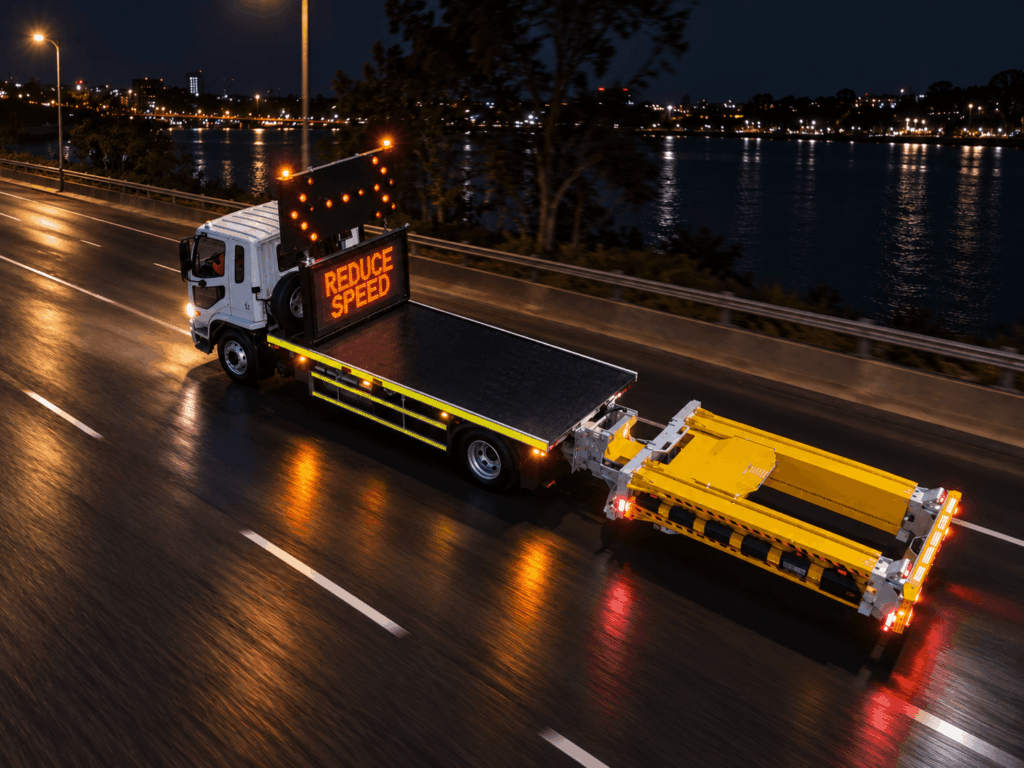
On high-speed roads, the primary crash protection methods are Truck Mounted Attenuators (TMAs), portable crash cushions, and concrete or water-filled barrier systems. TMAs are the most widely used solution for moving work zones and shadow vehicle operations because they actively absorb impact energy and protect both workers and road users. The right choice depends on whether the work zone is stationary or mobile, the posted speed limit, and the applicable safety standard in your region. Below, we answer the most common questions professionals ask when planning crash protection for high-speed road environments.
What types of barriers are used to protect workers on high-speed roads?
Workers on high-speed roads are protected by a combination of truck mounted attenuators, portable crash cushions, concrete barriers, water-filled barriers, and temporary steel guardrails. Each system serves a different function depending on whether the work zone is moving or stationary, and how much lateral space is available. TMAs are the dominant choice for mobile operations, while rigid barriers are typically used to separate traffic lanes from long-term construction zones.
Here is a breakdown of the most common barrier types and their typical applications:
- Truck Mounted Attenuators (TMAs): Mounted to the rear of a shadow vehicle, TMAs absorb the energy of an errant vehicle before it reaches workers. They are the standard choice for moving work zones and slow-moving convoy operations on motorways and high-speed arterials.
- Portable crash cushions: Freestanding energy-absorbing units placed in front of fixed hazards such as lane dividers, bridge piers, or equipment. They protect against head-on impacts into stationary objects.
- Concrete safety barriers (Jersey barriers): Rigid longitudinal barriers that redirect vehicles away from the work area. Used in longer-term projects where a physical separation between traffic and workers is needed.
- Water-filled plastic barriers: A lighter, more flexible alternative to concrete. Easier to deploy and relocate, though they offer less containment at very high speeds.
- Temporary steel guardrails: Used at the edges of roads or elevated structures where vehicle containment and redirection are required over extended project durations.
In practice, most high-speed work zones use a combination of these systems. A typical motorway maintenance operation might deploy TMAs on shadow vehicles at the rear of the convoy while using concrete barriers or water-filled units to define the protected work corridor.
How does a truck mounted attenuator work?
A truck mounted attenuator works by absorbing the kinetic energy of an impacting vehicle through a deformable crash cushion mounted to the rear of a host vehicle. When a vehicle strikes the TMA at speed, the cushion collapses in a controlled manner, slowing the impacting vehicle progressively and reducing the force transferred to its occupants. The host vehicle, known as the shadow vehicle or impact protection vehicle, is designed to move forward on impact, further dissipating energy.
The process involves two key energy-management mechanisms working together:
- Cushion deformation: The attenuator’s aluminium or composite structure crumples on impact, converting kinetic energy into deformation work rather than transmitting it as a sudden shock.
- Roll-ahead of the host vehicle: The shadow vehicle is allowed to move forward a controlled distance during the impact event, extending the deceleration time and reducing peak force on the striking vehicle’s occupants.
Modern TMAs like Verdegro’s Armadillo are hydraulically operated and deploy in less than 20 seconds while the vehicle is moving at up to 80 km/h (50 mph). The system raises and lowers using two hydraulic rams, with no sensors or electronic feedback components involved. This mechanical simplicity reduces the number of potential failure points and makes field maintenance straightforward. The Armadillo TMA deploys as a single cushion element in one continuous motion, eliminating the multi-stage extension mechanisms found in older designs.
After a crash event, the attenuator is assessed and, depending on the severity of the impact, either serviced or replaced. Many modern systems are designed so that the cushion element can be swapped out quickly, minimising downtime for the work zone operation.
What is the difference between a TMA and a portable crash cushion?
The key difference is mobility. A Truck Mounted Attenuator is vehicle-mounted and moves with the work zone, while a portable crash cushion is a freestanding, stationary device placed in front of a fixed hazard. TMAs protect workers in moving operations; portable crash cushions protect against impacts into immovable objects such as concrete barriers, bridge piers, or parked equipment.
The table below summarises the main differences between the two systems:
| Feature | Truck Mounted Attenuator (TMA) | Portable Crash Cushion |
|---|---|---|
| Mobility | Mobile, moves with the host vehicle | Stationary, fixed at a specific location |
| Primary use | Moving work zones and convoy protection | Protection of fixed hazards in stationary zones |
| Deployment | Hydraulically raised/lowered on the vehicle | Positioned and anchored manually or by machine |
| After impact | Vehicle rolls ahead; cushion absorbs energy | Cushion absorbs energy; unit stays in place |
| Reset after impact | Cushion inspected and replaced if needed | Unit inspected and replaced or reset if needed |
| Typical speed rating | Up to 100 km/h (TL-3 under MASH 2016) | Varies by product and test standard |
Both systems are tested and certified under recognised crash standards, but they are not interchangeable. If your operation involves workers moving along the road, for example, line marking, pothole patching, or vegetation cutting, a TMA on a shadow vehicle is the appropriate choice. If you need to protect a fixed object that traffic could strike, a portable crash cushion is the right tool.
What safety standards apply to crash protection on high-speed roads?
The two most widely applied standards for crash protection equipment on high-speed roads are MASH 2016 (Manual for Assessing Safety Hardware) in the United States and internationally, and EN 1317 in Europe. Both standards define test levels based on vehicle type, impact speed, and impact angle, and require that equipment meet specific performance thresholds for occupant risk and structural integrity.
For TMAs, the relevant test level on high-speed roads is typically TL-3, which covers impacts at 100 km/h (62 mph). Under MASH 2016, TL-3 testing includes multiple crash scenarios, head-on impacts from passenger cars and pickup trucks at specified angles and speeds. Equipment that passes all required tests receives official crash test certifications and, in the US, an FHWA acceptance letter.
Key standards and certifications to look for include:
- MASH 2016 TL-3: The current US standard for high-speed road safety hardware. Replaces the older NCHRP 350 standard. Required for federally funded projects in the United States.
- EN 1317: The European standard for road restraint systems, covering barriers, terminals, and crash cushions. Defines performance classes based on containment level and working width.
- TD49/07 (UK): The UK’s supplementary test standard, including an optional 110K test for higher-speed scenarios on UK motorways.
- CE marking: Required for products sold within the European market, confirming conformity with applicable EU directives, including EMC compliance.
When procuring crash protection equipment for government contracts or publicly funded road projects, always verify that the product holds current certifications under the standard applicable in your jurisdiction. Older certifications under superseded standards such as NCHRP 350 may not satisfy current procurement requirements.
When should a shadow vehicle with a TMA be used instead of static barriers?
A shadow vehicle with a truck attenuator should be used whenever workers are operating in or adjacent to live traffic lanes in a moving or short-duration work zone where static barriers cannot be deployed quickly enough or would obstruct the work itself. Static barriers are effective for long-term, fixed work zones, but they cannot protect a crew that is continuously moving along the road.
Use a TMA-equipped shadow vehicle in the following situations:
- Moving maintenance operations: Line marking, pothole repair, road surface inspection, or vegetation management where the crew advances along the road over time.
- Short-duration work zones: Utility inspections, drainage work, or sign maintenance that takes place at a location for less than an hour before moving on.
- High-speed roads where static setup is impractical: On motorways and dual carriageways, deploying and retrieving concrete or water-filled barriers for every short stop is operationally impractical and introduces its own risk during setup.
- Convoy operations: When equipment or vehicles are moving slowly along a live carriageway, a TMA at the rear of the convoy provides continuous protection against rear-end impacts.
Static barriers remain the better choice for long-term projects where the work zone is fixed for days or weeks, where high containment of errant vehicles is required, or where the road geometry demands a physical separation between traffic and workers. In many large-scale projects, both approaches are used together: static barriers define the protected corridor, and a TMA shadow vehicle operates within or ahead of it to protect the active work crew.
How Verdegro Supports Your Crash Protection on High-Speed Roads
We design and manufacture crash protection systems built specifically for the demands of high-speed road environments. Our product range covers the full spectrum of TMA applications, from lightweight van-mounted systems to heavy-duty truck attenuators tested and certified to the most current standards.
- Armadillo TMA: Our newest truck mounted attenuator, fully tested and approved to MASH 2016 TL-3 at 100 km/h. The Armadillo is lighter and more compact than previous generations, deploys in under 20 seconds, and operates with no sensors or electronic components, only a hydraulic power pack. It holds international patents in Europe, the United States, China, and Hong Kong.
- VanGuard TMA: The world’s first TMA designed for closed vans, available in rear-mounted, top-mounted, and swing-mounted variants. The VanGuard withstands impacts at up to 80 km/h and keeps the van’s rear doors and tow hitch fully accessible. It is ideal for lighter-duty operations where a full truck is not required.
- Mobitrack integration: Both systems can be fitted with our Mobitrack module, providing real-time GPS tracking, location history, and integration with safety alert platforms including Waze, Google, and national traffic control systems.
- Full certifications: All our TMAs are delivered with official crash test certifications and CE marking, and we hold multiple FHWA acceptance letters under MASH 2016.
Whether you are equipping a single shadow vehicle or managing a fleet of attenuators across multiple active projects, we can help you find the right solution. Explore our crash protection systems or contact us directly to discuss your specific requirements.
Related Articles
- When is a lighter impact protection vehicle sufficient?
- What should fleet managers look for in a roadwork safety vehicle?
- Should you use a van or truck for roadwork protection?
- Why do truck mounted attenuator standards differ between the US and Europe?
- What happens if a vehicle crashes into a truck mounted attenuator?