
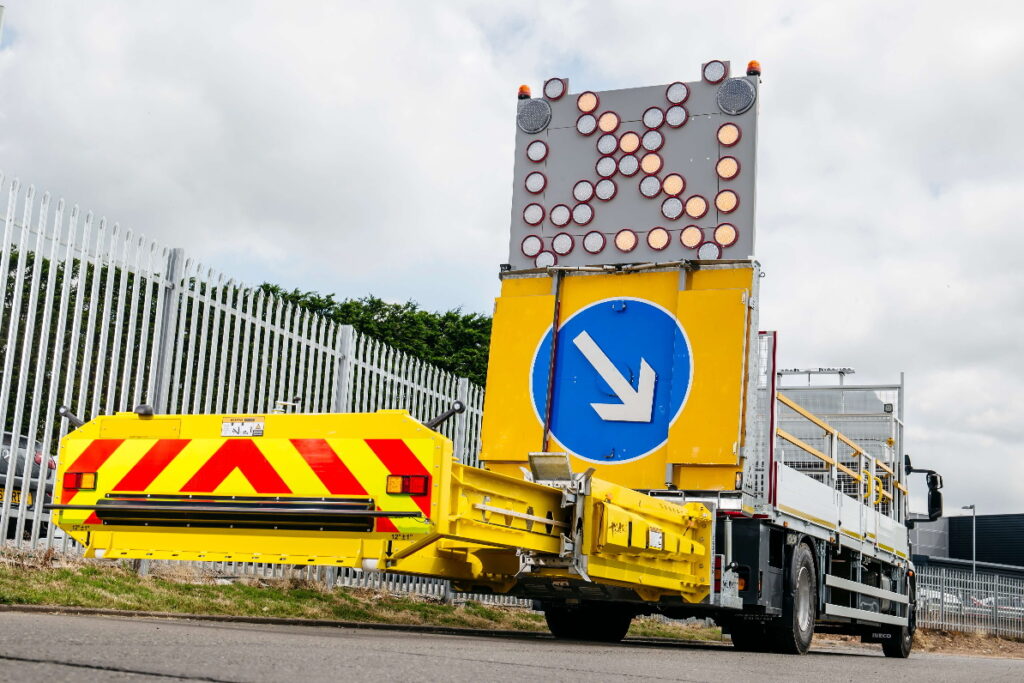
The weight class of a truck mounted attenuator refers to the minimum mass of the host vehicle required to make the crash cushion system perform as tested and certified. Weight class determines how much energy the system can absorb during an impact, which directly affects which crash test standard the TMA meets and where it can legally be deployed. The sections below walk through each related question in detail.
How are truck mounted attenuator weight classes determined?
Truck mounted attenuator weight classes are determined by the crash testing protocol used to certify the system. During testing, a TMA is mounted to a host vehicle of a specific minimum weight and struck by an impacting vehicle at a defined speed and angle. The host vehicle mass is part of the test conditions, so it becomes a fixed requirement for the certified system.
Standards like MASH 2016 (Manual for Assessing Safety Hardware) and NCHRP 350 specify exactly how these tests must be conducted, including the mass of the host vehicle, the speed of the impacting vehicle, and the angle of impact. When a manufacturer submits a TMA for certification, the test results are only valid when the host vehicle meets or exceeds the weight used during testing. If you deploy the same TMA on a lighter truck, the system will not absorb energy the way it was certified to, and the safety performance cannot be guaranteed.
What are the different TMA weight classes under MASH?
Under MASH 2016, truck mounted attenuators are classified primarily by the minimum weight of the host vehicle. The two most common categories are 70,000 lb (approximately 31,750 kg) and 100,000 lb (approximately 45,360 kg) host vehicle classes. These figures represent the minimum operational weight of the truck carrying the attenuator at the time of a potential impact.
The distinction matters because a heavier host vehicle provides more resistance during a rear-end collision. A 100K-class TMA is designed to remain more stable under high-energy impacts, reducing the likelihood of the host vehicle being pushed forward into the work zone. A 70K-class TMA offers a certified alternative for operations where a lighter truck is the only practical option, but it is tested under less demanding impact energy conditions.
Does weight class affect which roads a TMA can be used on?
Yes, weight class can affect where a TMA is permitted for use. Many road authorities and project specifications require TMAs to meet specific crash test standards and host vehicle weight thresholds based on the speed limit and traffic volume of the road being worked on. High-speed highways typically demand higher-class systems, while lower-speed urban roads may allow lighter configurations.
In the United States, the FHWA (Federal Highway Administration) issues acceptance letters for TMAs that have passed MASH testing. These letters confirm that the system is eligible for use on federally funded projects, but individual state departments of transportation may impose additional requirements. Always verify the applicable standard for your specific project before selecting a TMA weight class.
What’s the difference between a light-duty and heavy-duty TMA?
The key distinction between a light-duty and heavy-duty TMA is the minimum host vehicle weight and the corresponding impact energy the system is certified to handle. A light-duty TMA is designed for host vehicles in the 70,000 lb range and is typically used in lower-speed or lower-risk environments. A heavy-duty TMA requires a host vehicle of at least 100,000 lb and is built to absorb significantly higher impact forces.
Beyond weight thresholds, heavy-duty systems often feature more robust structural components, including reinforced frames and larger energy-absorbing cartridges or foam elements. Light-duty systems are generally more compact and easier to mount on smaller trucks, making them practical for municipal maintenance work or urban road operations. The choice between the two should be driven by the road environment, posted speed limit, and the specifications required by the project owner or road authority.
Can any truck be used as a host vehicle for a TMA?
No, not any truck can serve as a host vehicle for a TMA. The host vehicle must meet or exceed the minimum operational weight specified in the TMA’s certification. Using a lighter truck than the one used during crash testing invalidates the certified performance of the system and may expose workers and road users to unacceptable risk.
Beyond weight, the host vehicle must also be structurally compatible with the TMA’s mounting system. The attenuator attaches to the truck’s rear frame or hitch receiver, and the mounting points must be able to handle the forces transferred during an impact. Some TMA models are designed specifically for certain truck configurations, such as dump trucks, flatbeds, or dedicated shadow vehicles. Always confirm compatibility between the attenuator model and the intended host vehicle before deployment.
How do you choose the right TMA weight class for your project?
Choosing the right TMA weight class starts with identifying the speed limit and traffic conditions of the road where you will be working. Higher posted speeds require higher-class systems. From there, check the project specifications or contract documents, as these often define the minimum crash test standard and host vehicle weight required by the road authority.
Consider the following factors when making your decision:
- Posted speed limit: Work zones on highways with speeds above 70 km/h typically require a 100K-class TMA or equivalent.
- Project specifications: Government contracts and highway authority requirements often mandate specific MASH or NCHRP 350 acceptance levels.
- Available host vehicles: Match the TMA weight class to trucks already in your fleet to avoid procurement delays.
- Optional equipment: Consider whether you need integrated arrow boards, VMS displays, or hydraulic lift masts, as these affect total system weight and configuration.
- Regulatory acceptance: Confirm that the TMA holds the relevant FHWA acceptance letter or local approval for the jurisdiction where you are working.
How Verdegro Helps You Choose the Right TMA
We manufacture a range of truck mounted attenuators tested and certified to both NCHRP 350 TL-3 and MASH 2016, giving you options across weight classes and deployment scenarios. Our TMA lineup includes:
- TMA-US 100K and TTMA-US 100K for heavy-duty host vehicles requiring maximum impact protection on high-speed roads
- LTMA-US 70K for lighter host vehicles used in lower-speed or urban work zones
- BLADE TMA for operations requiring a compact, certified solution with a smaller footprint
All our systems are available with optional accessories including LED arrow boards, full-color VMS displays, and hydraulic LED lift masts, so you can configure a complete shadow vehicle in one step. We hold multiple FHWA acceptance letters under MASH 2016, which means our products are eligible for use on federally funded projects in the United States and meet the most current compliance standard.
If you are unsure which weight class fits your fleet and project requirements, contact our team and we will help you identify the right system for your specific situation.
Related Articles
- Should you use a van or truck for roadwork protection?
- Is it cheaper to repair or replace a damaged truck mounted attenuator?
- What should you look for when getting a truck mounted attenuator quote?
- What makes one truck mounted attenuator model better suited to your project?
- How does a truck mounted attenuator work?