
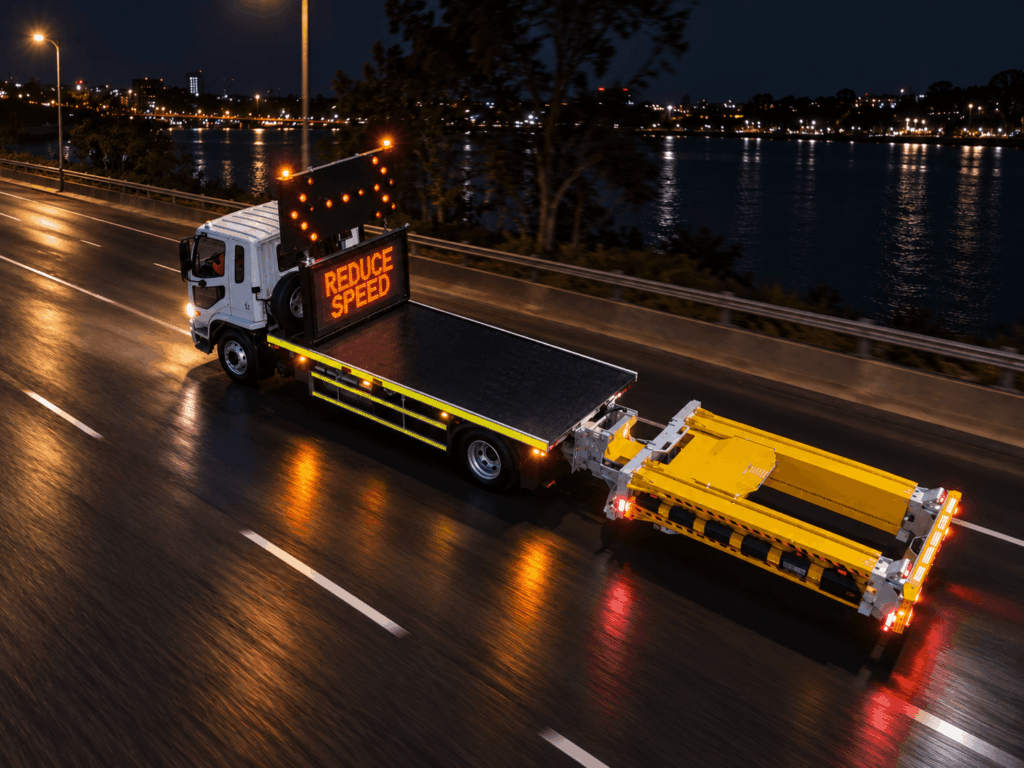
A roadwork vehicle becomes more versatile when it carries a combination of protective, signaling, and operational equipment. The most effective setups include a truck mounted attenuator for crash protection, an arrow board or variable message sign for driver guidance, and a hydraulic lift for elevated access or equipment handling. The right combination depends on the type of work zone and the tasks your crew needs to perform.
Below, we answer the most common questions about roadwork vehicle equipment so you can make informed decisions about what your fleet actually needs.
What types of equipment can be mounted on a roadwork vehicle?
A roadwork vehicle can carry a wide range of safety and operational equipment, including truck mounted attenuators (TMAs), arrow boards, variable message signs (VMS), hydraulic lifts, lighting systems, and rumble mat layers. Each piece of equipment serves a distinct function, and many vehicles are configured to carry multiple systems simultaneously to support different tasks within the same work zone.
The most common mounted equipment falls into three categories:
- Crash protection: Truck mounted attenuators absorb impact energy and protect workers from rear-end collisions.
- Traffic guidance: Arrow boards and variable message signs direct drivers safely through or around work zones.
- Operational tools: Hydraulic lifts, lighting towers, and rumble mat layers support the physical work being carried out on or near the road.
Many modern roadwork vehicles are built to support quick-connect systems, making it easier to swap between configurations depending on the day’s assignment. This modularity is what allows a single vehicle to serve multiple roles across different project types.
How does a truck mounted attenuator improve work zone safety?
A truck mounted attenuator improves work zone safety by absorbing the kinetic energy of an errant vehicle before it reaches workers or equipment. When a driver fails to slow down or drifts into a work zone, the attenuator acts as a buffer, significantly reducing the severity of the impact. This protection is especially important on high-speed roads where rear-end collisions are a leading cause of worker fatalities.
Truck mounted attenuators are fitted to the rear of a shadow vehicle, which positions itself between oncoming traffic and the active work zone. In the event of a crash, the attenuator deforms in a controlled way to slow the striking vehicle while limiting the force transferred to the host truck and its occupants.
Modern TMAs are designed with rapid deployment in mind. For example, single-stage systems can reach operational position in under 20 seconds while the vehicle is still moving at highway speeds. This allows crews to set up protection quickly without interrupting traffic flow unnecessarily.
TMAs are tested and certified under recognized crash standards, such as MASH 2016 TL-3, which defines performance requirements at impact speeds up to 100 km/h (62 mph). Selecting a certified attenuator ensures the system performs as expected under real crash conditions, not just controlled test scenarios.
What is an arrow board and when is it required?
An arrow board is a mounted display panel fitted with LED lights arranged in arrow or chevron patterns that direct drivers to merge, shift lanes, or slow down as they approach a work zone. Arrow boards are required whenever a lane closure, taper, or significant traffic shift is in place on a public road, particularly on highways and arterial roads where advance warning is needed at higher approach speeds.
The specific requirement to use an arrow board depends on national or regional traffic management regulations, as well as the type of road and the nature of the work. In general, arrow boards are required when:
- One or more lanes are closed to traffic.
- Traffic must merge or shift laterally.
- Work takes place on or adjacent to a live traffic lane.
- Visibility conditions reduce the effectiveness of static signs alone.
Arrow boards are typically mounted to the rear of a shadow vehicle or directly to a trailer. They can operate in several display modes, including flashing arrow, sequential chevron, and caution mode, depending on the situation. Many modern arrow boards also integrate with tracking and remote control systems, allowing operators to adjust display settings without leaving the cab.
How does a variable message sign differ from an arrow board?
A variable message sign (VMS) differs from an arrow board in the type of information it communicates. An arrow board uses a fixed LED pattern to show directional guidance, while a variable message sign displays programmable text and symbols that can be changed in real time to convey specific instructions, warnings, or road conditions to drivers.
Arrow boards are optimized for one task: telling drivers which direction to move. They are simple, fast to read, and effective at high approach speeds. A VMS, by contrast, can display messages such as “ROAD CLOSED 500M,” “SLOW DOWN WORKERS AHEAD,” or speed limit reductions. This flexibility makes VMS systems better suited to situations where drivers need context, not just directional cues.
In practice, many work zones use both systems together. The VMS provides advance warning and context further upstream, while the arrow board delivers clear directional instruction at the point of the lane shift or closure. Using both in combination gives drivers more time to react and reduces the risk of sudden lane changes at speed.
VMS signs can also be updated remotely, which is particularly useful for long-duration projects where conditions change frequently, such as multi-phase road construction or incident management operations.
What role do hydraulic lifts play on a roadwork vehicle?
Hydraulic lifts on a roadwork vehicle provide elevated access for workers or allow heavy equipment to be raised, lowered, or repositioned without manual handling. They are commonly used for tasks such as installing overhead signage, maintaining lighting structures, inspecting bridges or tunnels, and handling mounted equipment like attenuators or arrow boards during setup and removal.
On vehicles that carry multiple systems, hydraulic lifts can also serve a functional role in the deployment of those systems. For example, raising or lowering a crash cushion, repositioning an arrow board, or adjusting the angle of a lighting tower all benefit from hydraulic control rather than manual adjustment. This reduces setup time and minimizes the physical risk to workers who would otherwise need to climb or lift equipment by hand.
Hydraulic systems also contribute to operational consistency. Because the lift operates through controlled pressure rather than human effort, the positioning is more precise and repeatable, which matters when equipment must meet specific height or angle requirements to comply with road safety standards.
Which combination of equipment makes a roadwork vehicle most versatile?
The most versatile roadwork vehicle combines a truck mounted attenuator for rear-end crash protection, an arrow board for directional guidance, and a variable message sign for programmable driver communication. Adding a hydraulic lift and integrated tracking capability further extends what a single vehicle can do across different work zone types and project phases.
The right combination depends on the work environment:
- High-speed highway work: TMA plus arrow board, with optional VMS for advance warning.
- Urban or low-speed roads: Arrow board or VMS may be sufficient, with a lighter-duty attenuator such as a van-mounted TMA.
- Multi-phase construction: VMS with remote update capability, TMA for ongoing protection, and hydraulic lift for equipment handling.
- Incident management: TMA, VMS, and mobile lighting for rapid deployment at unpredictable locations.
Quick-connect systems allow crews to swap components between jobs without specialized tools, which means one vehicle can serve as a shadow vehicle in the morning and a signage platform in the afternoon. This flexibility reduces the number of vehicles a fleet needs to maintain and lowers overall operating costs.
How Verdegro Helps You Equip Your Roadwork Vehicle
We design and manufacture the full range of equipment that makes a roadwork vehicle genuinely versatile. Our product line covers everything from truck mounted attenuators and arrow boards to variable message signs, hydraulic lifts, and integrated tracking systems, so you can configure your vehicle for the exact demands of your work zone.
Here is what we offer to help you build a more capable roadwork vehicle:
- Armadillo TMA: Our newest truck mounted attenuator, fully tested and approved under MASH 2016 TL-3 at 100 km/h. It deploys in under 20 seconds while driving, uses a single-stage cushion with no sensors or electronic components, and maintains a compact width of 2300 mm to fit narrow lanes without overhang.
- VanGuard TMA: The world’s first TMA designed for closed vans, available in rear-mounted, top-mounted, and swing-mounted variants. The top and swing versions keep rear doors fully accessible, and all versions leave the tow hitch usable.
- Arrow boards and VMS signs: Available as standalone systems or as integrated accessories on our TMAs, with options for remote control and programmable display modes.
- Mobitrack: Our GPS tracking and safety alert integration system, compatible with Google, Waze, Flitsmeister, Monotch, and national traffic control systems. It provides real-time location data, location history, and the ability to monitor equipment status remotely.
- Mobilityplanner: Our web platform gives you a live overview of your fleet, including GPS positions, product statuses, and remote control capabilities from any device.
All our systems are engineered for real-world reliability, with minimal maintenance requirements and straightforward operation for road crews working in demanding conditions. If you want to discuss which configuration suits your fleet, contact our team and we will help you find the right setup.