
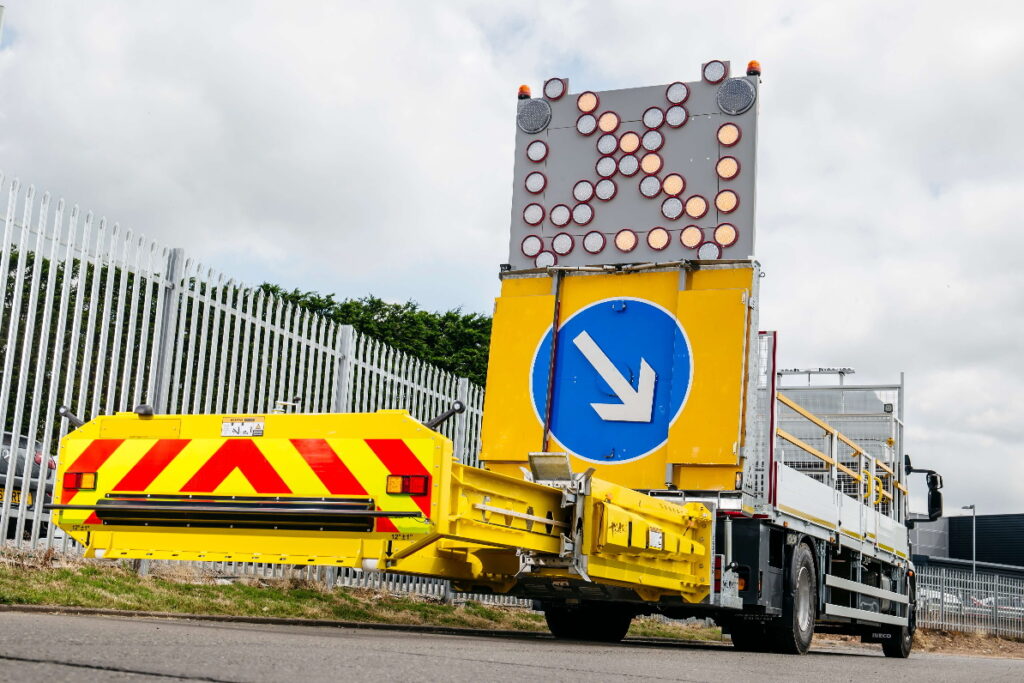
Using a non-certified truck mounted attenuator puts workers, drivers, and your entire operation at serious legal and financial risk. A TMA that has not been tested and approved to recognized crash safety standards may fail to absorb impact energy correctly in a real collision, turning a survivable crash into a fatal one. The sections below walk through the legal, technical, and liability consequences you need to understand before deploying any TMA in a live work zone.
What are the legal consequences of using an uncertified TMA?
Deploying an uncertified truck mounted attenuator in a public road or highway work zone can result in regulatory fines, contract termination, and criminal liability. Most jurisdictions require work zone safety equipment to meet specific standards, and using non-compliant hardware is a direct violation of those requirements regardless of whether an incident occurs.
In the United States, the Federal Highway Administration (FHWA) requires that crash cushions and impact attenuators used on federally funded projects hold a valid acceptance letter under an approved test standard such as MASH 2016 or NCHRP 350. If your TMA lacks that documentation, your project may be shut down immediately upon inspection. Contracts with state DOTs and municipal authorities typically include compliance clauses that allow the contracting authority to terminate the agreement and recover costs if non-compliant equipment is discovered on site.
Beyond contract penalties, using uncertified equipment can expose your company to regulatory enforcement action. Occupational safety regulators in many countries treat the deliberate use of untested protective equipment as a serious violation, which can lead to significant fines and, in the event of a fatality, prosecution of responsible individuals. The legal exposure does not disappear simply because no crash occurred during the project.
How does a non-certified TMA perform differently in a crash?
A non-certified truck mounted attenuator has not been validated through controlled crash testing, so its ability to absorb and redirect impact energy in a real collision is unknown. Certified TMAs are engineered to deform in a predictable, controlled way that slows an errant vehicle gradually and keeps occupants safe. An uncertified unit may collapse incorrectly, transfer excessive force to the host truck, or fail to redirect the impacting vehicle away from workers.
Certification testing under standards like MASH 2016 subjects the attenuator to multiple crash scenarios at defined speeds and angles, measuring occupant risk values, vehicle trajectory, and structural behavior. These tests generate objective data that confirms the device performs within safe limits. Without that testing, you have no reliable evidence that the unit will behave as intended when a vehicle strikes it at highway speed.
In practical terms, a crash into a non-certified TMA is more likely to result in the impacting vehicle vaulting over the attenuator, penetrating the work zone, or causing the host truck to be pushed forward into workers. Each of these outcomes is precisely what certified designs are engineered to prevent.
Who is liable when an uncertified TMA fails in a work zone?
Liability for an uncertified TMA failure typically falls on the contractor who deployed the equipment, the equipment owner or rental company, and potentially the project manager who approved the setup. If the attenuator was knowingly non-compliant, courts and insurers treat that as negligence, which significantly increases financial exposure for all parties involved.
The contractor deploying the TMA carries primary responsibility for ensuring that all safety equipment on site meets applicable standards. Claiming ignorance of the certification status is rarely an effective defense, particularly when procurement records show the equipment was sourced without requesting compliance documentation.
Equipment rental companies and manufacturers can also face liability if they supplied a unit they represented as compliant but which lacked valid certification. In multi-party construction contracts, liability may be shared across the general contractor, subcontractor, and safety officer depending on who signed off on the work zone traffic management plan. Insurance providers frequently deny claims when investigations reveal that non-certified equipment contributed to the incident, leaving all parties to cover costs out of pocket.
What certifications should a truck mounted attenuator have?
A truck mounted attenuator should hold certification under MASH 2016 (Manual for Assessing Safety Hardware) for projects in the United States, or the equivalent standard required in your country. MASH 2016 is the most current test standard and has replaced the older NCHRP 350 standard for new projects on federally funded roads. An FHWA acceptance letter is the formal document that confirms a TMA has passed the required tests.
For projects outside the United States, the relevant standard varies by region. European work zones commonly reference EN standards or national equivalents, while other markets may follow ISO guidelines or local transport authority requirements. Always verify which standard applies to the specific project location before procuring equipment.
Key certification documents to request from any TMA supplier include:
- FHWA acceptance letter (for US projects) confirming the specific model passed MASH 2016 testing
- Test report from an accredited crash test facility detailing the test conditions and results
- Product-specific certification confirming the unit you are receiving matches the tested configuration exactly
- Compliance documentation for any country-specific or project-specific standard required by the contracting authority
How can you verify whether a TMA is genuinely certified?
You can verify a TMA’s certification by requesting the FHWA acceptance letter directly from the manufacturer and cross-referencing it against the FHWA’s publicly available list of accepted devices. The acceptance letter will specify the exact model name, test standard, and any conditions attached to the approval. If the model you are evaluating does not appear on that list or the letter cannot be produced, treat the unit as unverified.
Beyond the FHWA list, ask the supplier for the original crash test report from the accredited testing facility. A legitimate report will include the test date, vehicle specifications, impact speed, and measured outcomes. Be cautious of documentation that references a similar model rather than the exact unit you are purchasing, as certification does not automatically transfer between product variants.
When evaluating a TMA for a specific project, also confirm that the host vehicle weight class matches the certified configuration. Many TMAs are approved for a defined vehicle weight range, and operating outside that range voids the certification even if the attenuator itself is compliant.
How Verdegro Supports Certified TMA Compliance
We manufacture a range of truck mounted attenuator systems that are tested and approved to recognized international crash safety standards, including NCHRP 350 TL-3 and MASH 2016. Our TMA lineup includes the TMA-US 100K, TTMA-US 100K, LTMA-US 70K, and BLADE TMA, each developed to meet the compliance requirements that government agencies and contractors face on federally funded and internationally regulated road projects.
When you source a TMA from us, you receive full certification documentation, including FHWA acceptance letters where applicable, so you can demonstrate compliance to project owners and inspectors without uncertainty. Our systems are also available with optional accessories such as LED arrow boards, full-color VMS displays, and hydraulic LED-lift masts, giving you a complete, certified work zone protection setup from a single supplier.
Here is a quick overview of what our TMA range offers:
- MASH 2016 and NCHRP 350 TL-3 compliance across multiple models
- Full certification documentation provided with every unit
- Optional LED arrow boards and VMS displays for integrated work zone signaling
- Designed for road construction contractors and traffic management operators working in demanding environments
- Backed by over two decades of traffic safety manufacturing experience
If you want to confirm which TMA model fits your project requirements or need help reviewing certification documentation, contact our team and we will help you find the right solution.