
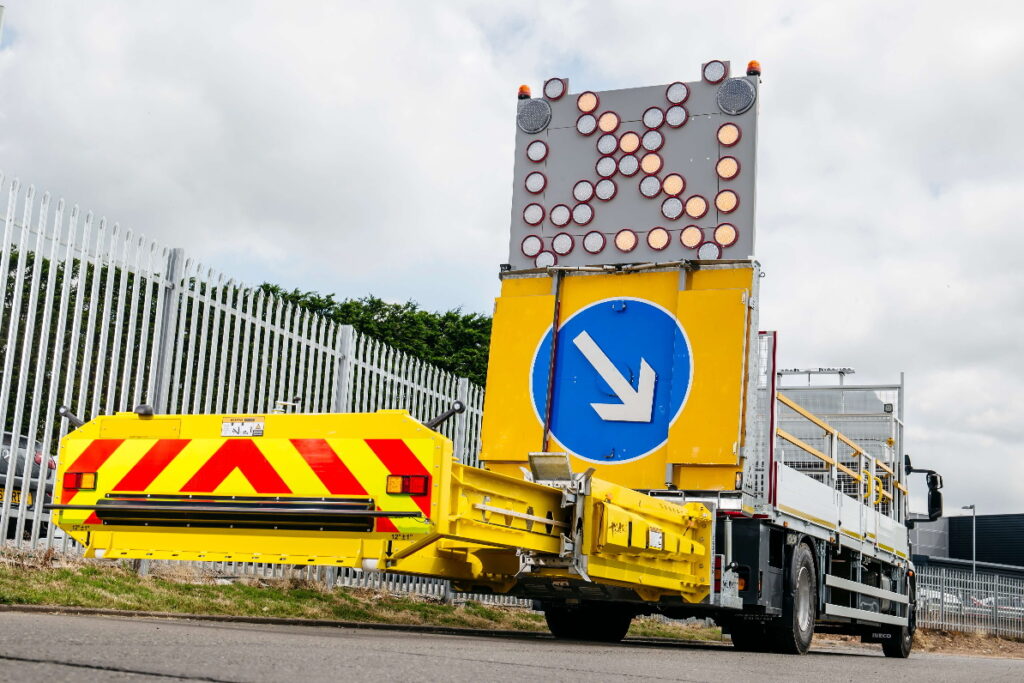
A crash cushion trailer is a towed safety device equipped with an energy-absorbing crash attenuator at the rear, designed to protect road workers and motorists when a vehicle collides with the back of a work zone setup. It acts as a buffer between errant traffic and the workers and equipment ahead. The sections below answer the most common questions about how these systems work, how they compare to truck-mounted attenuators, and what to look for when selecting one.
How does a crash cushion trailer protect workers in a work zone?
A crash cushion trailer protects workers by absorbing and redirecting the energy of an errant vehicle before it reaches the work zone. The attenuator unit at the rear of the trailer deforms on impact, slowing the striking vehicle progressively rather than stopping it abruptly. This dramatically reduces the force transferred to both the vehicle occupants and the workers ahead.
The trailer is positioned at the upstream end of the work zone, creating a physical buffer zone between live traffic and the crew. When a vehicle strikes the attenuator, the controlled deformation of the crash cushion dissipates kinetic energy over a longer distance and time. This mechanism is what separates a crash cushion trailer from a simple barrier: it is engineered to manage impact, not just block it.
Most modern crash cushion trailers are also fitted with high-visibility lighting, arrow boards, or variable message signs to alert approaching drivers well before they reach the work zone. These warning systems give drivers time to react, reducing the likelihood of an impact in the first place. The combination of active warning and passive crash protection makes the trailer one of the most effective safety tools available for mobile and semi-static work zones.
What is the difference between a crash cushion trailer and a truck-mounted attenuator?
The primary difference is mobility and deployment method. A crash cushion trailer is a standalone towed unit that can be unhitched and left in position, while a truck-mounted attenuator (TMA) is permanently or semi-permanently attached to the rear of a work truck, meaning the truck must remain on-site for the attenuator to stay in place.
This distinction has practical consequences for how each system is used:
- Crash cushion trailers are well suited to semi-static work zones where the protection point stays fixed for extended periods. The tow vehicle can be released and used elsewhere once the trailer is deployed.
- Truck-mounted attenuators are better suited to moving or rolling work zones, where the protection moves with the truck as the crew progresses along a road section.
- TMAs are also commonly used on shadow vehicles that follow a work crew, providing continuous protection during active operations.
Both systems serve the same fundamental purpose, absorbing vehicle impact energy to protect workers, but the right choice depends on whether your work zone is stationary or moving, and how long you need the protection in place.
What safety standards do crash cushion trailers need to meet?
Crash cushion trailers must meet recognized crash-testing standards that verify their ability to absorb impact at defined speeds and vehicle weights. In the United States, the two primary standards are NCHRP-350 and the more current MASH 2016 (Manual for Assessing Safety Hardware). MASH 2016 is now the accepted standard for new projects under Federal Highway Administration (FHWA) requirements.
MASH testing evaluates how a device performs when struck by vehicles of specific sizes at defined angles and speeds. Products that pass receive FHWA acceptance letters, which confirm compliance and are often required for use on federally funded road projects. Specifying equipment with current MASH 2016 acceptance provides confidence that the system has been tested under the most up-to-date protocols.
In European markets, comparable requirements exist under EN standards and national road authority specifications. When procuring crash cushion trailers or TMA systems for international projects, always verify which standard applies in the relevant jurisdiction and confirm the product holds the appropriate acceptance documentation.
Where are crash cushion trailers typically deployed?
Crash cushion trailers are deployed wherever a fixed work zone needs upstream impact protection on roads with live traffic. Common deployment locations include highway lane closures, bridge maintenance zones, utility work on arterial roads, and any situation where workers are exposed to the rear of a stationary work area for an extended period.
They are particularly valuable in the following scenarios:
- Long-duration work zones on motorways or expressways where the tow vehicle needs to be freed for other tasks
- Night-time operations where reduced visibility increases the risk of driver inattention
- High-speed roads where the consequences of an errant vehicle impact are most severe
- Urban roadworks near intersections or pedestrian areas where space is limited but protection is still required
Government road authorities, highway construction contractors, and municipal maintenance departments are the most frequent users. The ability to deploy a trailer independently of a dedicated shadow vehicle makes it a flexible option for organizations managing multiple simultaneous work sites.
What features should you look for in a crash cushion trailer?
When selecting a crash cushion trailer, prioritize certified crash performance, visibility equipment, and operational flexibility. The attenuator must hold a valid acceptance letter under the applicable standard (MASH 2016 for US projects), and the trailer should integrate warning systems that actively reduce the chance of an impact occurring.
Key features worth evaluating include:
- Crash standard certification: Confirm MASH 2016 or NCHRP-350 TL-3 acceptance depending on your project requirements
- Integrated arrow board: An LED arrow board mounted on the trailer improves lane guidance for approaching drivers
- Variable message sign (VMS): A full-color VMS display lets you communicate speed limits, warnings, or instructions directly from the trailer
- Hydraulic LED lift mast: Raises lighting or signage to the optimal height for visibility, particularly useful at night
- Remote monitoring and GPS: Real-time tracking and status updates allow you to manage equipment across multiple sites without physical inspections
- Ease of reset: After an impact, the attenuator should be resettable or replaceable in the field with minimal downtime
- Compatibility with your tow vehicle: Check weight ratings and coupling specifications before purchase
The more integrated the warning systems, the more effective the overall setup. A trailer that combines passive crash protection with active driver warnings gives you two layers of safety rather than one.
How Verdegro Helps with Crash Cushion Trailers and TMAs
We manufacture a range of truck-mounted attenuator systems tested and approved to both NCHRP-350 TL-3 and MASH 2016 standards. Our product line includes the TMA-US 100K, TTMA-US 100K, LTMA-US 70K, and BLADE TMA, each designed to absorb vehicle impact energy and protect road workers in active work zones.
Our systems are available with a range of integrated options that directly address the features outlined above:
- LED arrow boards for clear lane guidance
- Full-color VMS displays for dynamic driver messaging
- Hydraulic LED lift masts for elevated, high-visibility lighting
- MobilityPlanner integration for real-time GPS tracking, remote control, and status monitoring across your fleet
We work with road construction contractors, traffic management operators, and government agencies worldwide who need certified, durable crash protection they can rely on. If you want to discuss which system fits your specific project requirements, contact our team and we will help you find the right solution.
Related Articles
- How can impact protection be integrated into an existing maintenance fleet?
- Which countries require CEN/TS 16786-certified truck mounted attenuators?
- When is a light truck mounted attenuator sufficient instead of a full truck mounted attenuator?
- Why do trucks have truck mounted attenuators attached?
- How does a truck mounted attenuator work?