
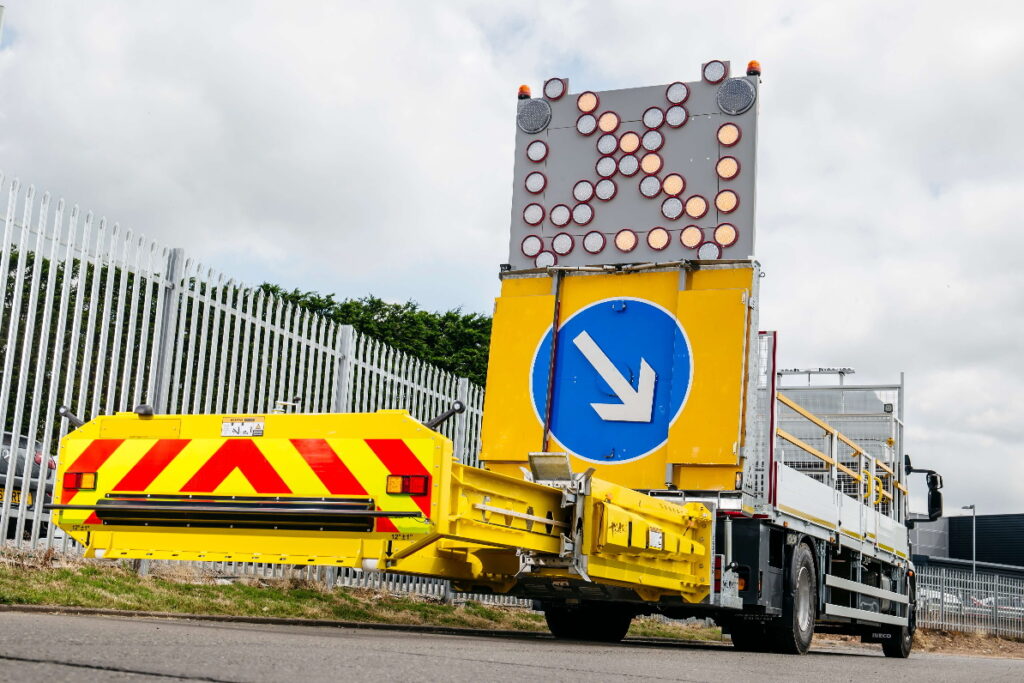
A light truck mounted attenuator (LTMA) is a crash cushion system designed to be mounted on the rear of lighter host vehicles, typically trucks in the 70,000-pound gross vehicle weight range, to absorb the energy of an errant vehicle impact and protect road workers in active work zones. Unlike heavier TMA configurations that require larger trucks, an LTMA offers the same core crash protection on a smaller, more maneuverable platform. Below, we answer the most common questions about how these systems work, where they are used, and what standards they must meet.
How does a light truck mounted attenuator differ from a standard TMA?
A light truck mounted attenuator differs from a standard TMA primarily in the weight class of the host vehicle it is designed for. A standard TMA is typically rated for host vehicles at or above 100,000 pounds gross vehicle weight, while an LTMA is engineered for lighter trucks, often in the 70,000-pound range, making the system physically smaller and lighter without sacrificing its fundamental crash-cushioning function.
The practical difference matters in the field. A standard TMA absorbs impact energy partly through the mass of a heavier host vehicle, whereas an LTMA must achieve comparable energy dissipation through the design of the attenuator itself, since the host truck contributes less inertia. This places greater engineering demands on the crash cushion structure.
From an operational standpoint, an LTMA gives contractors more flexibility. Lighter host vehicles are easier to maneuver in tight work zones, less expensive to operate, and more widely available in typical fleet inventories. Where a full-size TMA would be impractical or excessive, an LTMA provides a right-sized alternative that still meets certified safety requirements.
What types of vehicles can carry a light truck mounted attenuator?
A light truck mounted attenuator is designed to be carried by medium-duty trucks that fall within the host vehicle weight specification defined by the attenuator’s crash test certification. In practice, this typically means trucks in the 70,000-pound gross vehicle weight class, such as tandem-axle dump trucks, utility trucks, or similar medium-duty work vehicles commonly found on road construction and maintenance projects.
The host vehicle compatibility is not just a logistical consideration. It is a safety requirement. An LTMA is tested and certified with a specific host vehicle weight range in mind. Operating the system on a vehicle that falls significantly outside that range could compromise the attenuator’s performance in an actual impact. Always verify that your host truck meets the weight specifications stated in the system’s certification documentation before deployment.
What safety standards apply to light truck mounted attenuators?
Light truck mounted attenuators must meet internationally recognized crash testing standards that govern how roadside safety hardware performs under impact. In the United States, the two primary standards are NCHRP 350 TL-3 and the more current MASH 2016 (Manual for Assessing Safety Hardware), which is administered by the Federal Highway Administration (FHWA). MASH 2016 is the most up-to-date standard and is now required for new projects on federal-aid highways.
Under these standards, an attenuator undergoes a series of controlled crash tests that simulate real-world impact scenarios at defined speeds and angles. The system must demonstrate that it redirects the impacting vehicle safely, limits deceleration forces on vehicle occupants, and protects the work zone crew behind the host truck. A system that passes these tests receives an FHWA acceptance letter, which serves as official documentation of compliance.
When selecting an LTMA for a project, confirming that the system holds a current FHWA acceptance letter under MASH 2016 is important, particularly for any work on federally funded roads. Older systems certified only under NCHRP 350 may no longer meet procurement requirements on certain projects in 2026.
Where are light truck mounted attenuators typically deployed?
Light truck mounted attenuators are typically deployed in active highway and road work zones where a moving or stationary host vehicle needs to provide a protective buffer between traffic and road workers. Common deployment scenarios include lane closures on motorways, maintenance operations on urban arterials, utility work requiring short-duration traffic control, and resurfacing or line-marking projects where the work crew moves progressively along the road.
The LTMA’s suitability for lighter host vehicles makes it particularly useful in situations where a full-size truck would be difficult to maneuver or unnecessary. Urban road maintenance, bridge deck work, and shoulder operations are all environments where the LTMA’s smaller footprint offers a practical advantage. The system travels with the work crew, acting as a moving shield that absorbs any vehicle that drifts into the work zone from behind.
How is a light truck mounted attenuator installed and operated?
A light truck mounted attenuator is installed by mounting the crash cushion assembly to the rear frame or hitch receiver of the host truck using the manufacturer’s specified mounting hardware and connection points. The installation process typically involves securing the attenuator’s mounting bracket to the truck’s rear structure, connecting any hydraulic or mechanical deployment components, and verifying that the system sits at the correct height and alignment relative to the road surface.
Once installed, operation is straightforward. The attenuator travels at the rear of the host vehicle as it moves through the work zone. Many modern LTMA systems include additional features that improve visibility and communication with approaching drivers:
- LED arrow boards mounted on or above the attenuator to direct traffic away from the work area
- Variable message signs (VMS) that display warnings or instructions to approaching drivers
- Hydraulic LED-lift masts that raise lighting and signage to a height visible from a greater distance
After an impact event, the attenuator must be inspected before returning to service. Depending on the severity of the collision, structural components may need replacement. Most manufacturers provide clear guidance on post-impact inspection procedures and replacement parts to restore the system to its certified condition.
How Verdegro Supports Your Work Zone with Truck Mounted Attenuators
We manufacture a range of truck mounted attenuator systems built for road construction contractors and traffic management operators who need certified, durable crash protection. Our TMA lineup includes systems designed for different host vehicle weight classes and operational requirements:
- TMA-US 100K and TTMA-US 100K for heavier host vehicles
- LTMA-US 70K for lighter medium-duty trucks where maneuverability matters
- BLADE TMA for projects requiring a compact, high-performance solution
All our systems are tested and approved to NCHRP 350 TL-3 and MASH 2016, and we hold multiple FHWA acceptance letters under the most current standard. You can configure your system with optional LED arrow boards, full-color VMS displays, and hydraulic LED-lift masts to meet the specific visibility and signaling requirements of your project.
If you want to find the right attenuator for your fleet and project type, get in touch with us and we will help you identify the system that fits your host vehicle, your compliance requirements, and your operational conditions.
Related Articles
- What should you look for when getting a truck mounted attenuator quote?
- What makes one truck mounted attenuator model better suited to your project?
- Is a trailer truck mounted attenuator safer than a truck mounted attenuator?
- What is TL-3 in truck mounted attenuator crash testing?
- What is the most popular truck mounted attenuator model for highway work?