
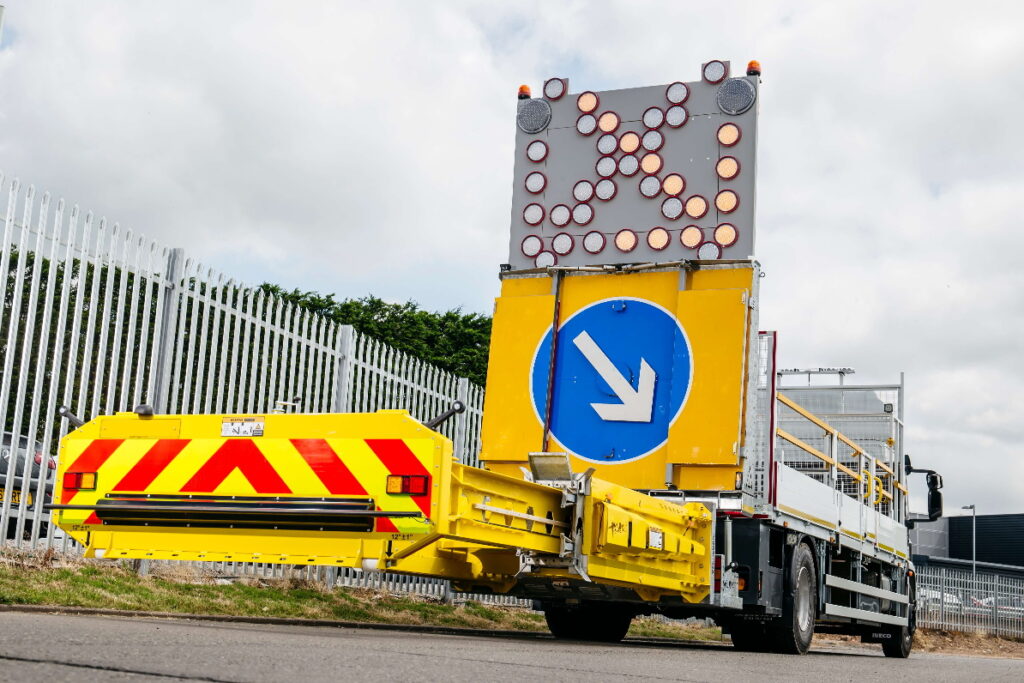
An arrow board add-on for a truck-mounted attenuator is a directional warning display mounted directly onto the TMA frame, giving the attenuator truck the ability to guide traffic away from a work zone without requiring a separate vehicle. It combines crash protection and active traffic direction into a single unit. The sections below answer the most common questions about how these add-ons work, what they do, and when to use them.
How does an arrow board add-on attach to a truck-mounted attenuator?
An arrow board add-on attaches to the rear or upper frame of the TMA using a dedicated mounting bracket system. The board connects to the attenuator’s structural frame rather than the truck body itself, keeping the installation stable under both normal road vibration and impact loads. Power runs from the truck’s electrical system through a hardwired connection or a dedicated power management unit.
Most mounting systems use a folding or tilting mechanism so the board can be lowered flat during transport and raised into the working position when the truck deploys at a work zone. This keeps the overall vehicle height within legal road limits while in transit. The bracket design varies by TMA model, but the principle stays the same: the board becomes a fixed extension of the attenuator unit rather than a loose accessory bolted on as an afterthought.
Wiring runs through protected conduit along the TMA frame to prevent damage during an impact event. On modern systems, the arrow board connects to the same control interface as other onboard equipment, letting the operator manage lighting patterns from the cab.
What functions does an arrow board add-on perform in a work zone?
An arrow board add-on displays directional arrow patterns, chevron sequences, and flashing warning signals to guide drivers away from a lane closure or work zone hazard. It gives approaching traffic a clear, real-time visual instruction to merge left or right before they reach the work zone taper. This active guidance reduces the risk of late lane changes and rear-end collisions.
Beyond basic arrow patterns, most add-on boards offer multiple display modes:
- Sequential arrow: Lights activate in sequence to indicate the direction of the required merge
- Flashing arrow: A static arrow that flashes to attract attention at higher-speed approaches
- Chevron pattern: A series of angled lines reinforcing directional movement
- Caution mode: A flashing diamond or dot pattern used when no specific lane closure is active but a hazard is present
LED technology makes these boards visible in daylight, rain, and low-light conditions without drawing excessive power from the truck’s electrical system. The combination of high brightness and low power draw is particularly useful during extended deployments where the truck engine may not run continuously.
What’s the difference between a standalone arrow board trailer and an arrow board add-on?
A standalone arrow board trailer is an independent unit towed to a location and left in place, while an arrow board add-on is integrated directly onto a TMA-equipped truck and moves with it. The key distinction is mobility and resource use: the add-on eliminates the need for a second vehicle and a second deployment, combining traffic warning and crash protection in one unit.
Each approach suits different operational needs:
- Standalone trailer: Best for fixed, long-duration lane closures where the board stays in one position for hours or days. It can be positioned ahead of the work zone without occupying a truck.
- Arrow board add-on: Best for moving operations, shadow vehicles, or sites where the attenuator truck itself needs to display directional warnings while providing crash protection at the rear of a work convoy.
A standalone trailer also offers a larger display area in some configurations, which can be an advantage on wide multi-lane highways. An add-on, however, keeps your equipment count lower, reduces setup time, and means one fewer vehicle for your crew to manage on site.
Does an arrow board add-on affect the TMA’s crash performance?
A properly engineered arrow board add-on does not degrade the TMA’s crash performance when it is designed and tested as part of the attenuator system. The mounting bracket and board assembly must account for the forces generated during an impact event, including how the board behaves when the TMA absorbs a collision. Boards that are not crash-tested as part of the TMA system can introduce unpredictable behavior during an impact.
This is why crash-testing standards matter. Crash-tested attenuator systems approved under standards such as MASH 2016 or NCHRP-350 TL-3 verify the complete system, including any accessories that form part of the standard configuration. If an arrow board add-on is included in the tested configuration, its presence is accounted for in the certification. If it is added after certification without engineering review, the system’s tested performance may no longer apply.
Always confirm that the arrow board add-on you select has been evaluated as part of the TMA’s certified configuration. This protects both your crew and your compliance standing on regulated projects.
Which work zone scenarios benefit most from a TMA with an arrow board add-on?
Work zones that involve moving operations, limited equipment resources, or high-speed road environments benefit most from a TMA with an integrated arrow board add-on. In these situations, having a single truck that both absorbs impacts and directs traffic is more practical than coordinating two separate units.
The scenarios where this combination delivers the most value include:
- Moving work operations: Road striping, pothole patching, and line painting convoys where the shadow truck advances continuously and needs to warn traffic at all times
- Short-duration closures: Maintenance tasks lasting less than a full shift where setting up a separate trailer adds setup time without meaningful benefit
- High-speed highways: Locations where approaching drivers need early, high-visibility directional guidance before they reach the closure point
- Remote or rural roads: Sites where bringing additional equipment is logistically difficult and a combined unit reduces the number of vehicles needed
- Urban lane closures: Tight environments where space for a separate trailer is limited and the attenuator truck already occupies the best warning position
In each of these cases, the add-on lets one truck do the work of two, which reduces operational complexity and keeps your crew focused on the task rather than managing multiple pieces of equipment.
How Verdegro Helps with Arrow Board Add-Ons for Truck-Mounted Attenuators
We manufacture a range of truck-mounted attenuators designed to accept integrated arrow board add-ons as part of a certified, tested system. Our TMA lineup includes the TMA-US 100K, TTMA-US 100K, LTMA-US 70K, and BLADE TMA, all tested to MASH 2016 and NCHRP-350 TL-3 standards. Each system is built with optional LED arrow boards that are engineered alongside the attenuator, not added as uncertified afterthoughts.
Here is what you get when you choose a Verdegro TMA with an arrow board add-on:
- Certified crash performance: The arrow board configuration is part of the tested system, so your compliance documentation stays intact
- LED visibility: High-brightness LED displays perform in all weather and lighting conditions
- Integrated control: Manage the arrow board alongside other onboard systems from a single operator interface
- Durable mounting: Bracket systems designed to handle both transport vibration and the forces of a real impact event
- International availability: Systems designed for road construction contractors and traffic management operators in multiple markets
If you are specifying equipment for a project that requires both crash protection and active traffic direction, we can help you find the right configuration. Contact us to discuss your work zone requirements and get detailed specifications for the TMA models that best fit your operation.
Related Articles
- How do you choose impact protection for mobile roadworks?
- What is a wings add-on used for on a truck mounted attenuator?
- How do you request a quote for a truck mounted attenuator?
- Do truck mounted attenuator prices vary by weight class or standard?
- Is NCHRP-350 still valid or has it been replaced by MASH for truck mounted attenuators?