
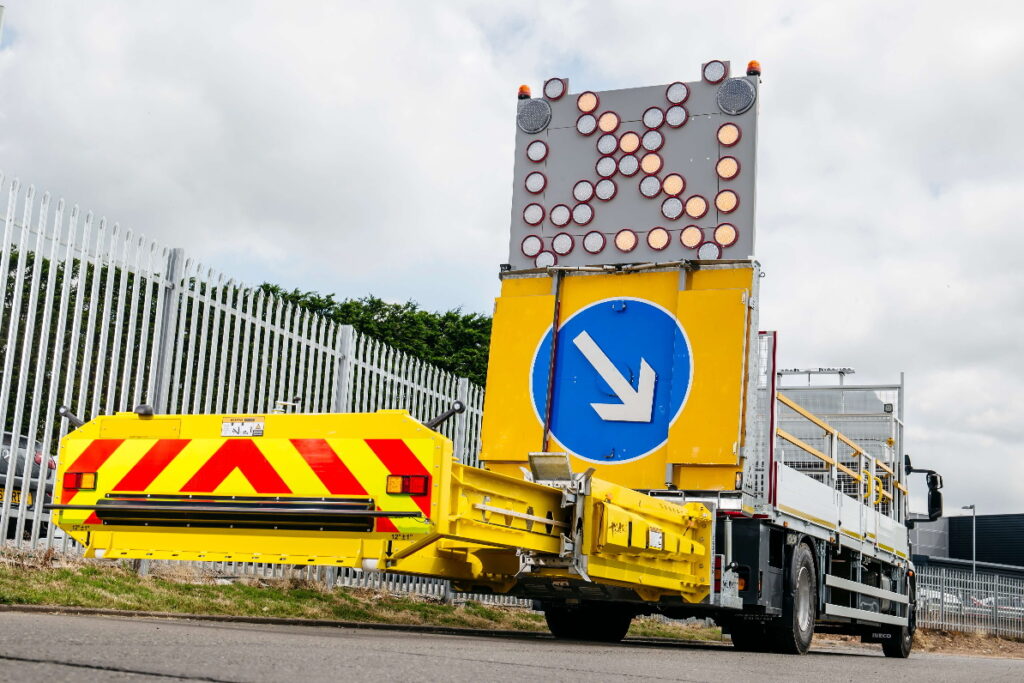
A truck mounted attenuator (TMA) attaches directly to the rear hitch or frame of a host truck, while a trailer truck mounted attenuator (TTMA) is a self-contained unit towed behind a separate vehicle on its own axle and wheels. The core difference comes down to how each system connects to the host vehicle and what that means for your deployment setup, compliance requirements, and operational flexibility. The sections below answer the most common questions contractors and traffic managers ask when choosing between the two.
How does a truck mounted attenuator attach to a host vehicle?
A truck mounted attenuator bolts or pins directly onto the rear of a host truck, typically through a receiver hitch or a dedicated mounting bracket integrated into the truck’s frame. The attenuator becomes a fixed extension of the vehicle itself, with no separate axle or wheels of its own. The host truck carries the full weight of the system and provides all the structural support during an impact.
Because the TMA is rigidly connected to the host truck, the two function as a single unit in the work zone. When a rear-end collision occurs, the attenuator absorbs and redirects impact energy before it reaches the truck cab and the workers ahead. The host truck’s mass plays a direct role in how the system performs during a crash event, which is why minimum truck weight requirements are specified for every certified TMA model.
Most TMA systems also include integrated accessories mounted to the same rear frame, such as LED arrow boards or variable message signs, keeping all active warning equipment in one compact package at the back of the truck.
How does a trailer truck mounted attenuator differ in setup?
A trailer truck mounted attenuator (TTMA) is towed behind a host vehicle using a standard fifth-wheel or pintle hitch connection. Unlike a conventional TMA, the TTMA rides on its own axle and wheels, making it a separate, mobile unit rather than a fixed attachment. The towing vehicle does not carry the attenuator’s weight directly on its frame.
This setup means the TTMA can be uncoupled from the tow vehicle and left in position while the truck moves away for other tasks. In practice, this gives work zone supervisors more options for how they position protective equipment relative to the active work area. The tow vehicle itself typically requires less structural modification than a dedicated TMA host truck, since the attenuator’s load is distributed through the trailer’s own running gear.
The trade-off is that a TTMA adds length to the overall vehicle combination, which can be a consideration on tighter urban road sections or where maneuvering space is limited.
Which attenuator type offers more deployment flexibility?
The TTMA offers more deployment flexibility in most scenarios because it can be detached and left stationary in the work zone while the host vehicle performs other duties. A standard TMA, by contrast, stays with the truck at all times, meaning the truck is committed to its shadow vehicle role for the entire duration of the deployment.
That said, a TMA mounted directly to a truck is often faster to put into service. There is no trailer to couple, no additional lighting circuit to connect, and no need to manage a separate unit in traffic. For operations where the shadow vehicle stays in position throughout the shift, a TMA is a straightforward and efficient choice.
The right answer depends on how your crew operates. If your trucks rotate between tasks during a single shift, a TTMA gives you the flexibility to leave protection in place without tying up a vehicle. If your shadow truck stays stationary for the full deployment, a direct-mount TMA keeps the setup simpler and faster.
What are the MASH compliance differences between TMAs and TTMAs?
Both TMAs and TTMAs can be tested and certified under MASH 2016 (Manual for Assessing Safety Hardware), the current standard in the United States. However, the test conditions differ because the two systems behave differently during a crash. TTMA testing accounts for the trailer’s articulation during impact, while TMA testing treats the attenuator and host truck as a rigid combined mass.
FHWA acceptance letters are issued separately for each specific model and configuration. A TMA certified at a given test level is not automatically equivalent to a TTMA certified at the same level, because the impact dynamics, redirect angles, and occupant risk values are evaluated independently for each system type.
When specifying equipment for a project, always verify that the attenuator model you are considering holds a current FHWA acceptance letter for the test level required by your contract. MASH TL-3 is the most commonly required level for highway work zones in 2026, covering impacts at higher speeds and angles than the older NCHRP 350 standard it replaced.
When should a contractor choose a TMA over a TTMA?
Choose a TMA when your shadow vehicle will remain in position throughout the deployment, when you need a compact rear-end profile, or when your project specifications require a direct-mount configuration. A TMA is also the better choice when the host truck is already equipped and dedicated to shadow vehicle duties, since the integrated setup reduces daily setup time and eliminates the need to manage a separate trailer unit.
A TTMA makes more sense when your fleet needs multi-role flexibility, when the host vehicle must move frequently during a shift, or when you want to position the crash cushion independently of the tow truck. TTMAs are also useful when the towing vehicle is not purpose-built as a shadow truck, since the structural demands on the hitch connection are lower than those of a rigid-mount system.
In both cases, the decision should factor in:
- The speed environment and required MASH test level for your project
- Whether your host vehicles meet the minimum weight requirements for the specific model
- How frequently your shadow vehicle needs to reposition during a shift
- The available maneuvering space on site
- Any contract or agency specifications that mandate one configuration over the other
How Verdegro Supports Your Attenuator Selection
We manufacture a range of certified truck mounted attenuator systems covering both direct-mount and trailer configurations, including the TMA-US 100K, TTMA-US 100K, LTMA-US 70K, and BLADE TMA. Each system is tested and approved to NCHRP 350 TL-3 and MASH 2016, and we hold FHWA acceptance letters under MASH 16 for our certified models.
Here is what our attenuator systems offer:
- Direct-mount and trailer options so you can match the system to your fleet and operational workflow
- Optional LED arrow boards, full-color VMS displays, and hydraulic LED-lift masts integrated into the rear frame for a complete shadow vehicle setup
- Certified compliance with current MASH 2016 standards, backed by FHWA acceptance documentation
- GPS tracking and remote monitoring through our Mobilityplanner platform, giving you real-time visibility of your deployed equipment
- Support for international projects, with systems designed to meet compliance requirements across multiple markets
If you are comparing TMA and TTMA options for an upcoming project or need help matching a system to your host vehicle specifications, contact our team and we will help you find the right configuration.
Related Articles
- When do you need a full-size impact protection vehicle?
- Why is Verdegro's truck mounted attenuator called Armadillo?
- What should fleet managers look for in a roadwork safety vehicle?
- What are the latest developments in mobile impact protection?
- Is it cheaper to repair or replace a damaged truck mounted attenuator?