
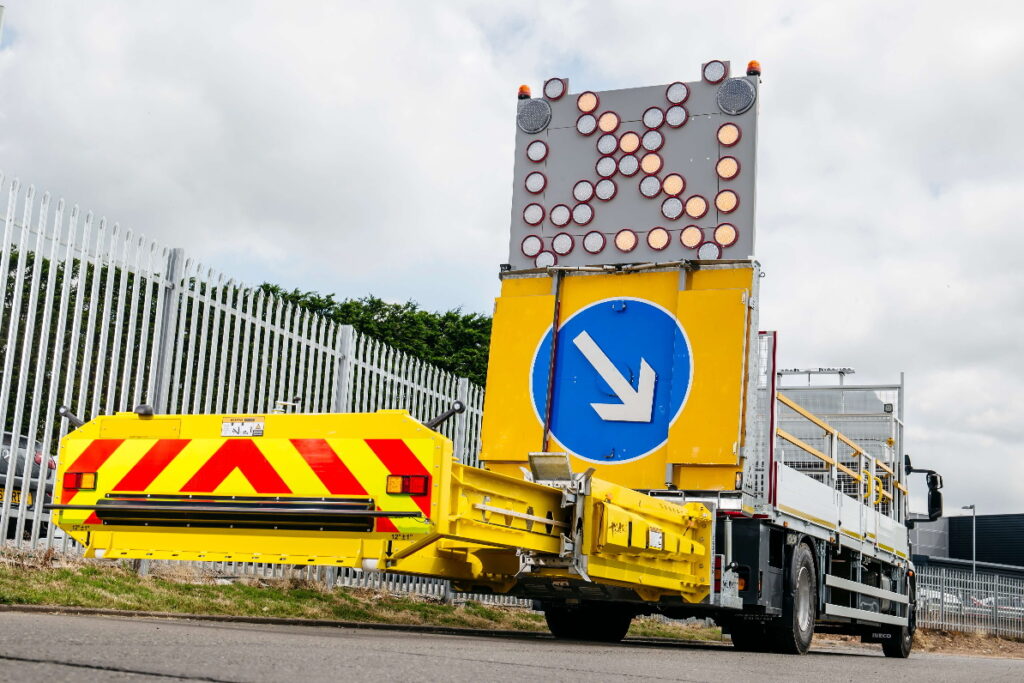
When getting a truck mounted attenuator quote, focus on four things: MASH compliance certification, full technical specifications, total cost of ownership, and supplier support. A quote that covers only the base unit price without addressing certification level, crash test standard, and available accessories gives you an incomplete picture that can lead to costly surprises later. The sections below walk through each factor in detail so you can evaluate any TMA quote with confidence.
What factors affect the price of a truck mounted attenuator?
The price of a truck mounted attenuator is affected by its crash test rating, construction materials, mounting system, included accessories, and the certification standard it meets. Units tested to MASH 2016 typically carry a higher price than older NCHRP-350 units because the testing requirements are more demanding. Optional equipment such as LED arrow boards, VMS displays, and hydraulic lift masts also add to the total cost.
Beyond the unit itself, consider these cost drivers when reviewing any quote:
- Impact head design: Reusable or replaceable cartridge systems reduce post-impact repair costs compared to fully welded designs
- Mounting compatibility: A TMA designed for a specific truck class may require additional brackets or adapters if your fleet uses different vehicles
- Accessories bundled vs. separate: Some suppliers quote the base attenuator only; others include arrow boards or lighting as standard
- Shipping and import duties: For international orders, logistics costs can represent a meaningful portion of the total
- Warranty and service terms: A lower unit price with no after-sales support may cost more over the equipment’s lifespan
Comparing quotes on base price alone is misleading. A higher upfront cost for a well-certified, accessory-equipped unit with strong support terms often represents better value than a stripped-down alternative.
What MASH compliance requirements should a TMA quote include?
A TMA quote should clearly state which crash test standard the unit has been tested to, the test level achieved, and whether the supplier holds an FHWA acceptance letter for that standard. For work in the United States and on federally funded projects, MASH 2016 (MASH TL-3) is the current standard, and any quote for compliant equipment should reference acceptance documentation from the Federal Highway Administration.
MASH 2016 replaced NCHRP-350 as the governing standard for new installations on federal-aid projects. This means that equipment tested only to NCHRP-350 may no longer satisfy project requirements on many public contracts. When reviewing a quote, ask the supplier to confirm:
- The specific crash test standard the unit was tested to (MASH 2016 or NCHRP-350)
- The test level achieved (TL-2 or TL-3, with TL-3 being the higher standard for highway speeds)
- Whether an FHWA acceptance letter is available and current
- Whether the tested configuration matches the unit being quoted, including any accessories that were part of the test
Compliance documentation is not a formality. If a unit is deployed on a project that requires MASH certification and the equipment does not meet that standard, you face liability exposure and potential contract noncompliance. Always request the acceptance letter, not just a supplier’s verbal confirmation.
What specifications should be listed in a TMA quote?
A complete TMA quote should list the unit’s weight capacity, truck class compatibility, crash test standard, energy absorption rating, mounting system type, overall dimensions, and any included or available accessories. Without these specifications in writing, you cannot verify that the quoted unit matches your operational requirements or project compliance obligations.
Key technical specifications to look for include:
- Truck weight class: TMAs are rated for specific gross vehicle weight ranges (for example, 70,000 lb or 100,000 lb); confirm the unit matches your host vehicle
- Impact speed rating: The maximum speed the unit is certified to absorb impact at, linked directly to the test level
- Unit dimensions and travel height: Important for road clearance, storage, and transport compliance
- Mounting system: Pin-and-latch, hydraulic, or fixed mount systems each have different deployment and recovery implications
- Accessory compatibility: Whether the unit supports LED arrow boards, VMS panels, or hydraulic lift masts, and whether these were part of the crash test configuration
- Materials and finish: Galvanized steel, powder coating, or other corrosion-resistant treatments affect durability in field conditions
If a quote omits any of these specifications, request them before proceeding. Vague specifications in a quote often signal that the supplier is less experienced with compliance-driven procurement or that the unit has not been fully tested in the configuration being offered.
How do you compare TMA quotes from different suppliers?
To compare TMA quotes from different suppliers, align them on the same set of criteria: crash test standard, truck class compatibility, included accessories, warranty terms, and total delivered cost. Comparing base prices without normalizing for these variables produces a misleading picture, since a lower-priced unit may require additional accessories, adapters, or certifications to meet your project requirements.
A structured comparison helps you evaluate quotes on equal terms. Use a framework like this:
- Compliance level: Does each quote meet the same crash test standard (MASH 2016 TL-3)? If not, the comparison is not apples-to-apples
- Included vs. optional accessories: List what each quote includes as standard and what is priced separately
- Total delivered cost: Add shipping, import duties, installation support, and any required adapters to the unit price
- Post-impact repair costs: Ask each supplier for typical repair costs after a TL-3 impact event; this affects long-term operating cost significantly
- Lead time and availability: For active projects, delivery timeline may matter as much as price
- Supplier track record: Government tenders, reference projects, and years of manufacturing experience are useful signals of reliability
When two quotes appear similar in price, the differentiator is often the depth of technical support, availability of spare parts, and the supplier’s familiarity with your local regulatory environment.
What questions should you ask a TMA supplier before accepting a quote?
Before accepting a TMA quote, ask the supplier to confirm their FHWA acceptance status, provide the crash test report for the specific configuration quoted, clarify what happens to the unit after an impact event, and explain their warranty and repair support process. These questions separate suppliers with genuine compliance experience from those offering equipment that may not hold up under regulatory scrutiny or real-world use.
Here are the most important questions to put to any supplier:
- Do you hold a current FHWA acceptance letter for this unit under MASH 2016? If yes, ask for a copy.
- Was the unit tested with the accessories included in this quote? Accessories added after testing may affect the unit’s certified performance.
- What is the repair process after an impact? Can the unit be returned to service quickly, and what does that cost?
- What truck models and weight classes is this unit certified for? Confirm compatibility with your specific host vehicles.
- What warranty terms apply? Understand what is covered, for how long, and what the claims process involves.
- Can you provide references from similar projects or clients? Government contractors and highway agencies are particularly relevant references.
- What is the lead time from order to delivery? For active projects, this can affect your scheduling and contract compliance.
A supplier who can answer these questions clearly and provide supporting documentation is demonstrating the kind of transparency that matters when you are making a safety-critical procurement decision.
How Verdegro Helps with Your TMA Quote
We manufacture a range of truck mounted attenuators tested and approved to both NCHRP-350 TL-3 and MASH 2016, including the TMA-US 100K, TTMA-US 100K, LTMA-US 70K, and BLADE TMA. Each unit comes with full documentation, including FHWA acceptance letters under the most current standard, so you can verify compliance before signing any contract.
When you request a quote from us, here is what you can expect:
- Full technical specifications for every unit, including truck class compatibility, crash test configuration, and accessory options
- Compliance documentation provided upfront, not after you ask for it
- Accessory integration including LED arrow boards, full-color VMS displays, and hydraulic LED lift masts, all tested as part of the certified configuration where applicable
- Clear pricing that distinguishes between standard inclusions and optional add-ons
- After-sales support from a manufacturer with direct knowledge of the product, not a reseller
We work with highway construction companies, road maintenance contractors, and municipal transportation departments across international markets. If you are ready to request a quote or want to ask us any of the questions listed above, contact our team and we will provide a clear, documented response.
Related Articles
- What is a trailer light truck mounted attenuator and when is it used?
- Which countries require CEN/TS 16786-certified truck mounted attenuators?
- What accessories improve truck mounted attenuator visibility at night?
- Should you choose a truck-mounted or trailer-mounted attenuator?
- What speed can you safely crash into a truck mounted attenuator at?