
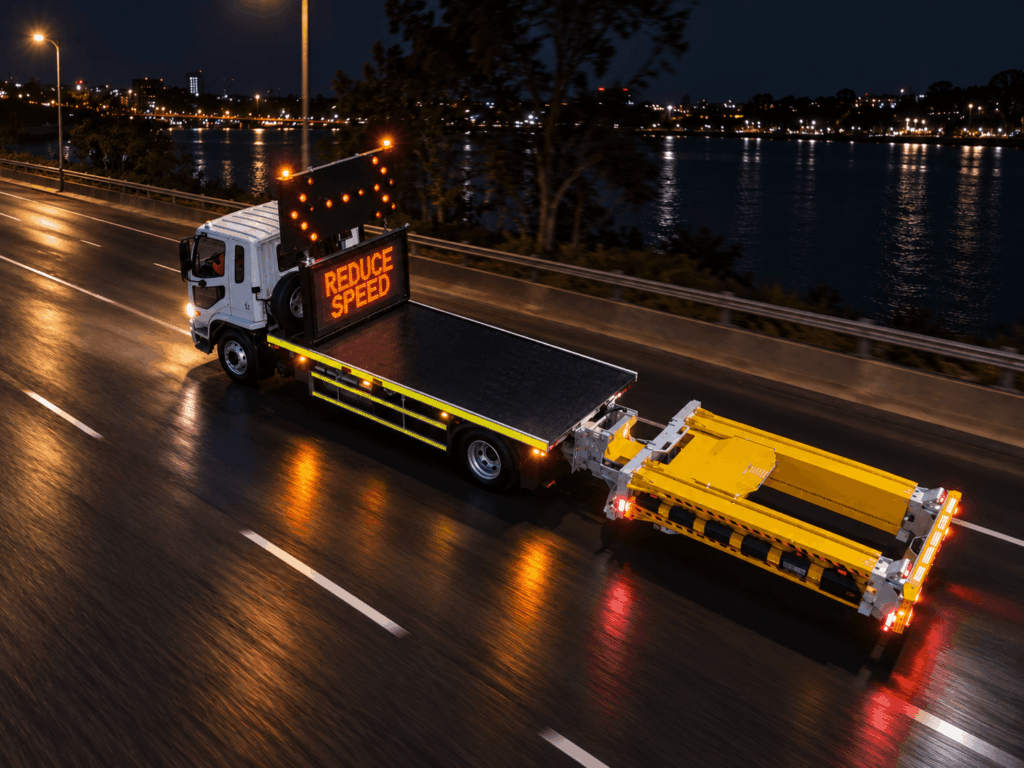
A lighter impact protection vehicle is sufficient when work zone speeds are lower, traffic volumes are manageable, and the risk profile of the operation does not require the full energy absorption of a heavy-duty truck-mounted attenuator. The right choice depends primarily on posted speed limits, the type of road, and the applicable crash test standard for your region. This article walks through the key questions that determine when a lighter IPV is the right tool for the job.
What Makes an Impact Protection Vehicle ‘Lighter’ in Traffic Safety?
A lighter impact protection vehicle is a crash-attenuating system mounted on a smaller host vehicle, typically a van or light truck, rather than a full-size heavy vehicle. These systems absorb and redirect impact energy in a rear-end collision, protecting workers in a work zone. The distinction from a full TMA is primarily about host vehicle weight class, cushion size, and the speed range the system is certified to handle.
In practical terms, a lighter IPV uses a compact crash cushion mounted on a van or medium-duty vehicle. The cushion deforms on impact to reduce the deceleration forces on an errant vehicle and its occupants, while also shielding the work crew ahead. Because the host vehicle is lighter, the overall system has less mass to resist a high-energy impact, which is why speed and road type play such an important role in deciding whether a lighter IPV is appropriate.
Key characteristics that define a lighter IPV include:
- Host vehicle type: Typically a closed van or light truck rather than a heavy goods vehicle
- Cushion dimensions: Smaller and more compact than a full TMA, suited to narrower lanes
- Operational speed range: Generally certified for impacts up to 80 km/h (50 mph)
- Deployment simplicity: Fewer mechanical stages, often controlled by a remote or simple in-cab controller
What Crash Test Ratings Apply to Lighter Impact Protection Vehicles?
Lighter impact protection vehicles are typically certified to Test Level 3 (TL-3) under MASH 2016 (Manual for Assessing Safety Hardware) in the United States, which covers impacts up to 100 km/h (62 mph). In the United Kingdom, the relevant standard is TD 49/07, with an optional 110K test for higher-speed environments. These ratings confirm that the system performs within defined occupant risk limits during a controlled rear-end impact.
Understanding what these ratings mean in practice helps you select the right system for your environment:
- MASH 2016 TL-3: The current US standard, replacing the older NCHRP 350. TL-3 certification covers a 100 km/h (62 mph) impact and is required for federally funded projects in the United States.
- TD 49/07 (UK): The British standard governing TMA performance, with the optional 110K test extending certification to higher impact speeds.
- CE marking and EMC compliance: In Europe, systems must carry CE marking to confirm they meet relevant EU directives on safety and electromagnetic compatibility.
A lighter IPV certified to TL-3 under MASH 2016 meets the same top-level crash standard as a full-size TMA. The difference is not the rating tier but the host vehicle weight class and the specific test configurations used. Always verify that the system you select holds the certifications required by the authority responsible for your project.
What Types of Work Zones Are Suited to a Lighter IPV?
Lighter impact protection vehicles are best suited to short-duration or mobile work zones on roads where posted speeds are 80 km/h (50 mph) or below, lane widths are constrained, and operations require frequent repositioning. They are a practical choice for utility maintenance, line marking, pothole repair, and inspection work where a full heavy TMA would be operationally impractical.
The following work zone scenarios are typically well matched to a lighter IPV:
- Mobile operations: Work that moves progressively along a road, such as line painting or sweeping, where the vehicle travels slowly and the crew moves with it
- Urban and suburban roads: Environments with lower speed limits, tighter lanes, and frequent stops where a compact system is easier to maneuver
- Short-duration stationary work: Tasks completed in minutes or a few hours, such as sign installation or drain inspection, where deploying a full TMA setup is disproportionate
- Narrow lane environments: Roads where a full-width TMA would create excessive overhang or restrict traffic flow
Lighter IPVs are generally not appropriate for long-duration stationary work zones on high-speed roads, where the sustained exposure to fast-moving traffic demands the higher energy absorption of a full truck-mounted attenuator.
How Does Posted Speed Limit Affect Which IPV You Need?
Posted speed limit is one of the most direct factors in IPV selection. As a general rule, roads with speed limits up to 80 km/h (50 mph) are suitable for lighter IPVs, while roads with limits above 80 km/h typically require a full-size TMA certified to the relevant higher-speed test configuration. Higher speeds mean greater kinetic energy in a rear-end impact, which demands a more robust system.
The relationship between speed and impact energy is not linear. Doubling the speed of an impacting vehicle quadruples the kinetic energy the attenuator must absorb. This is why the gap in protection between a lighter IPV and a full TMA becomes significant at motorway speeds.
Speed thresholds and typical system requirements
Below 60 km/h (37 mph), a lighter van-mounted system is often sufficient for most short-duration operations. Between 60 and 80 km/h (37 to 50 mph), a TL-3-certified lighter IPV remains appropriate provided the host vehicle meets the minimum weight requirements and the system holds the correct certification. Above 80 km/h (50 mph), most regulatory frameworks require a full TMA on a heavier host vehicle, because the energy levels involved exceed what a van-mounted system is designed to manage safely.
Speed limit versus operating speed
One important distinction is that posted speed limit and actual operating speed are not always the same. In work zones, temporary speed reductions are common. If your traffic management plan includes a legally enforced reduced speed limit through the work zone, that reduced figure may be the relevant threshold for IPV selection, provided your local regulations recognize this approach. Always confirm this with the responsible highway authority before making a selection based on a reduced speed.
What Regulations Govern IPV Selection in Europe and the US?
In the United States, IPV selection on federally funded projects is governed by FHWA (Federal Highway Administration) guidelines, which require systems to hold FHWA acceptance letters under MASH 2016. In Europe, requirements vary by country but generally reference EN standards, national road authority guidelines, and CE marking requirements. The UK follows TD 49/07. There is no single pan-European standard that applies uniformly to all member states.
In the US, the transition from NCHRP 350 to MASH 2016 is now complete for new projects. Systems that only hold NCHRP 350 acceptance may no longer qualify for use on federally funded work. Contractors and agencies should verify that any TMA or lighter IPV they deploy holds a current FHWA acceptance letter under MASH 2016.
In Europe, the relevant requirements typically include:
- CE marking: Confirms compliance with applicable EU directives
- National road authority specifications: Each country’s highway authority may specify additional requirements for work zone protection vehicles
- TD 49/07 (UK): The British standard for TMA performance, with specific test levels tied to road speed categories
- EMC compliance: Required for systems with electronic components operating near traffic infrastructure
Always consult the specific requirements of the authority overseeing your project. Regulatory frameworks are updated periodically, and the responsible authority’s current specification takes precedence over general guidance.
When Should You Upgrade from a Lighter IPV to a Full TMA?
You should upgrade from a lighter IPV to a full truck-mounted attenuator when any of the following conditions apply: the posted or operating speed exceeds 80 km/h (50 mph), the work zone is stationary for an extended duration on a high-volume road, the project specification requires a specific MASH 2016 test level that a van-mounted system cannot meet, or the host vehicle weight class of a lighter system is insufficient for the road environment.
Beyond speed, consider these upgrade triggers:
- Duration and exposure: The longer workers are stationary in a live traffic environment, the higher the cumulative risk. Full TMAs provide greater protection for extended operations.
- Traffic volume and road type: High-volume motorways and dual carriageways carry a higher probability of a rear-end incident, which shifts the risk calculation toward a more robust system.
- Regulatory mandate: Some project specifications or national standards explicitly require a full TMA regardless of speed, particularly on motorways or primary roads.
- Contractor or agency liability: Where a lighter system is technically permissible but a full TMA is available, project managers often choose the more protective option to reduce liability exposure.
A useful way to frame the decision is to ask whether the lighter IPV is certified for the worst-case impact scenario your work zone is realistically exposed to. If the answer is no, a full TMA is the appropriate choice.
How We Can Help You Choose the Right Impact Protection Vehicle
Selecting the right level of impact protection is a decision that affects both worker safety and regulatory compliance. We design and manufacture a range of crash-tested attenuator systems to cover the full spectrum of work zone needs, from lighter van-mounted solutions to full-size truck-mounted attenuators.
Here is how we support you through the selection process:
- Van-mounted protection: Our VanGuard TMA is the world’s first TMA designed specifically for closed vans. It is available in rear-mounted, top-mounted, and swing-mounted variants, giving you flexibility for different operational requirements. It withstands impacts up to 80 km/h (50 mph) and is fully customizable in terms of arrow boards, VMS signs, and RAL color.
- Full TMA for higher-speed environments: Our Armadillo TMA, introduced in 2026, is fully tested and approved under MASH 2016 TL-3 at 100 km/h (62 mph). It is lighter, more compact, and mechanically simpler than previous generations, with single-stage deployment in under 20 seconds while driving at 80 km/h.
- FHWA acceptance under MASH 2016: We hold multiple FHWA acceptance letters under MASH 2016, the current standard, so our systems qualify for federally funded projects in the United States.
- Mobitrack integration: All our systems can be fitted with Mobitrack for real-time GPS tracking, location history, and integration with safety alert platforms including Waze, Google, and Flitsmeister, so you maintain full visibility of your fleet.
If you are unsure which system fits your specific work zone conditions, speed environment, or regulatory requirements, contact our team and we will help you identify the right solution.
Related Articles
- Why is Verdegro's truck mounted attenuator called Armadillo?
- What are the latest developments in mobile impact protection?
- How does vehicle type affect the choice of crash attenuator?
- When is a light truck mounted attenuator sufficient instead of a full truck mounted attenuator?
- What accessories improve truck mounted attenuator visibility at night?