
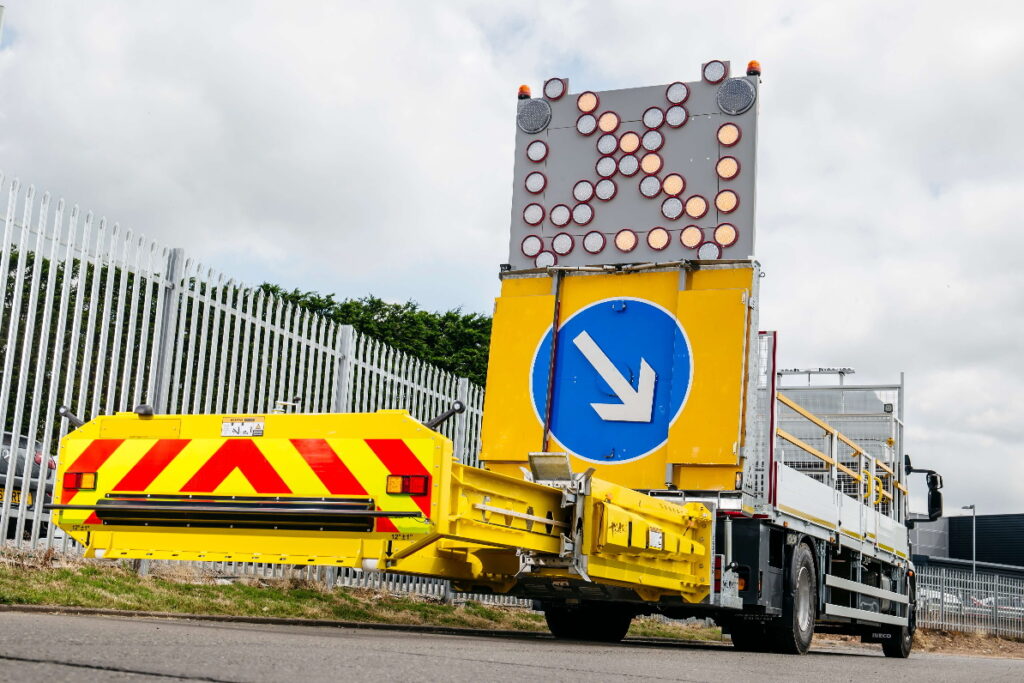
Use a truck mounted attenuator (TMA) when your work zone requires high mobility, frequent repositioning, or shadow vehicle protection in live traffic. A trailer-mounted attenuator is better suited to fixed or semi-permanent setups where the unit stays in place for extended periods. The right choice depends on your operational tempo, site layout, and compliance requirements, all of which this article breaks down question by question.
What’s the difference between a truck mounted attenuator and a trailer-mounted one?
A truck mounted attenuator is a crash cushion system bolted directly to the rear of a work truck, making the truck itself the host vehicle. A trailer-mounted attenuator is a standalone unit towed behind a separate vehicle and unhitched at the work zone. The core difference is mobility: a TMA moves with the truck, while a trailer-mounted unit is deployed and left in position.
Both types serve the same fundamental purpose: absorbing impact energy from errant vehicles to protect road workers and the equipment ahead of them. However, they achieve this in different operational contexts.
- Truck mounted attenuators travel with the host vehicle throughout the shift. The truck acts as both the transport and the protective barrier simultaneously.
- Trailer-mounted attenuators are towed to a site, positioned at the taper or work zone entrance, and then disconnected. The tow vehicle drives away and the attenuator stays put.
- TMAs are typically used in moving operations such as rolling road closures, lane striping, or pothole patching. Trailer-mounted units suit stationary setups like bridge repairs or utility work with a defined perimeter.
Weight capacity and mounting configuration also differ. TMAs must be matched to the host truck’s gross vehicle weight rating, which is why models like the TMA-US 100K and LTMA-US 70K are rated to specific truck weight classes.
When is a truck mounted attenuator the better choice?
A truck mounted attenuator is the better choice when your crew is performing moving or short-duration work zone operations where the protection needs to travel with the work. Any task that involves a shadow vehicle, a truck that follows workers down the road, calls for a TMA rather than a towed unit.
Specific situations where a TMA outperforms a trailer-mounted alternative include:
- Rolling road closures for line marking, crack sealing, or pothole repair
- Mowing and sweeping operations where the host vehicle moves continuously
- Short-duration maintenance where setting up a full static taper is impractical
- Urban arterial work where space is tight and a towed trailer adds logistical complexity
- Any situation where the work zone advances along the road rather than staying at a fixed point
The operational advantage is speed. A TMA-equipped shadow truck can be on-site and protecting workers within minutes of arrival, with no setup, unhitching, or secondary vehicle coordination required. This makes it particularly valuable for highway maintenance contractors managing multiple short stops across a single shift.
When does a trailer-mounted attenuator make more sense?
A trailer-mounted attenuator makes more sense when the work zone is stationary and the protection needs to remain in place while the tow vehicle is used elsewhere. If your crew will be working at a fixed location for several hours or days, a trailer-mounted unit lets you deploy the attenuator and free up the tow vehicle for other tasks.
This approach works well in scenarios such as:
- Bridge deck repairs and overhead structure maintenance
- Long-duration utility work within a fixed lane closure
- Situations where the contractor has a limited number of dedicated shadow trucks
- Multi-day closures where the attenuator stays in position overnight
The trade-off is flexibility. Once the trailer is unhitched and the tow vehicle leaves, repositioning the attenuator requires returning with that vehicle. If your work zone boundaries shift frequently, this becomes a logistical burden rather than an advantage.
Do truck mounted attenuators meet MASH compliance requirements?
Yes, truck mounted attenuators can fully meet MASH 2016 compliance requirements, the most current crash testing standard used in the United States and increasingly referenced internationally. MASH (Manual for Assessing Safety Hardware) replaced NCHRP-350 as the benchmark for evaluating how roadside safety hardware performs under impact. TMAs tested to MASH TL-3 are approved for use on highways with speeds up to 100 km/h (62 mph).
FHWA acceptance letters are the formal documentation confirming that a TMA has passed MASH testing. When selecting a system, verifying that it holds a current FHWA acceptance letter under MASH 2016 is important. Older systems tested only to NCHRP-350 may not meet current procurement requirements on federally funded projects.
It is also worth noting that MASH compliance applies to the attenuator system as a whole, including how it is mounted to the host vehicle. A TMA approved for one truck class may not carry the same approval when mounted to a significantly lighter or heavier vehicle. Always verify the rated truck weight range for any TMA you are considering.
What operational factors should influence the attenuator decision?
The decision between a truck mounted attenuator and a trailer-mounted unit should come down to five core operational factors: work zone mobility, available vehicles, project duration, speed environment, and compliance requirements. No single factor overrides the others, the right answer emerges from evaluating all five together.
- Mobility: Moving operations require a TMA. Stationary setups can use either, but trailer-mounted units offer more flexibility in how you allocate your vehicle fleet.
- Vehicle availability: A TMA ties up the host truck for the duration of the work. If that truck is needed for other tasks, a trailer-mounted unit may free up resources.
- Project duration: Short-duration or multi-stop work favors a TMA. Long-duration fixed closures often favor a trailer-mounted unit.
- Speed environment: Both types can be rated for high-speed highways, but confirm the specific test level (TL-2 or TL-3) matches your road classification.
- Compliance requirements: Government and federally funded projects often specify MASH 2016 compliance. Confirm the standard required before selecting a system.
Crew size and site access also matter. A TMA with integrated arrow board and VMS display reduces the number of separate units your crew needs to manage, which simplifies logistics on tight or high-traffic sites.
How Verdegro Supports Your Attenuator Decision
We manufacture a range of truck mounted attenuator systems tested and approved to both NCHRP-350 TL-3 and MASH 2016, giving you certified options that meet current compliance requirements across international markets. Our TMA lineup includes:
- TMA-US 100K — for heavy host trucks, full MASH 2016 approval
- TTMA-US 100K — a towable TMA variant combining flexibility with certified crash protection
- LTMA-US 70K — designed for lighter host vehicles where a full 100K system is not required
- BLADE TMA — a compact, aerodynamic option suited to space-constrained applications
All systems are available with optional accessories including LED arrow boards, full-color VMS displays, and hydraulic LED-lift masts, so you can configure a single shadow truck that handles signage, messaging, and crash protection in one unit. We also hold multiple FHWA acceptance letters under MASH 16, so you can procure with confidence on federally funded projects.
If you are evaluating which system fits your fleet and project requirements, contact us directly and we will help you match the right TMA to your host vehicle weight, speed environment, and compliance obligations.