
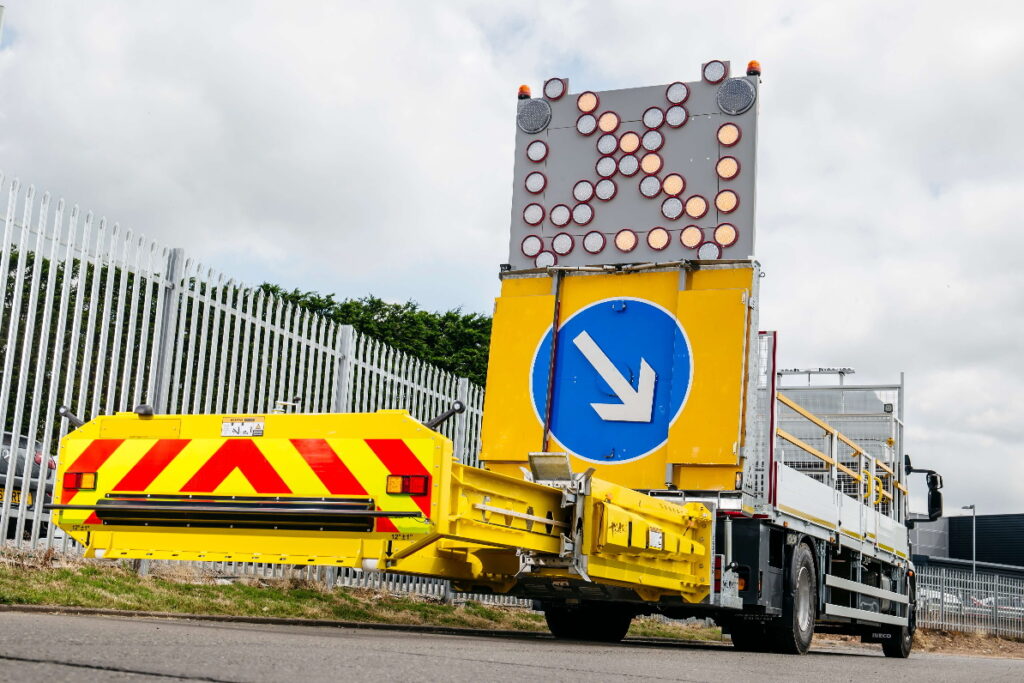
Yes, you can survive a crash into a truck-mounted attenuator. These systems are purpose-built to absorb impact energy and reduce the forces transferred to a striking vehicle, giving drivers a significantly better chance of walking away from a collision. Survival depends on factors like impact speed, angle, and whether the driver is wearing a seatbelt. The sections below break down exactly how these systems work, what they can withstand, and when they belong in a work zone.
How does a truck-mounted attenuator absorb crash energy?
A truck-mounted attenuator absorbs crash energy through a controlled collapse of its rear-mounted cushion structure. When a vehicle strikes the TMA, the attenuator’s energy-absorbing cartridges or honeycomb panels crush progressively, converting the kinetic energy of the impact into deformation work. This slows the striking vehicle down over a longer distance and time, reducing the peak deceleration force on the occupants.
The host truck itself is designed to move forward on impact rather than act as a rigid wall. This ride-down effect is a deliberate part of the system’s design. By allowing the truck to travel forward, the attenuator extends the stopping distance of the striking vehicle, which directly lowers the g-forces experienced by the driver inside it.
Most modern truck-mounted attenuators use replaceable cartridge systems, so after an impact the damaged components can be swapped out and the unit returned to service. This makes them practical for high-frequency work zone deployments where the attenuator may be struck more than once over its operational life.
What crash speeds can a truck-mounted attenuator withstand?
Truck-mounted attenuators are tested and rated to handle impacts at specific speeds defined by crash testing standards. Under MASH 2016 (the current standard in the United States), TL-2 systems are rated for impacts up to 70 km/h (approximately 44 mph), while TL-3 systems are rated for impacts up to 100 km/h (approximately 62 mph). These ratings reflect the speed at which the attenuator can protect occupants within defined injury thresholds.
It is important to understand that these ratings are based on standardized test conditions, including specific vehicle weights and impact angles. A real-world collision at the rated speed does not guarantee zero injury, but it does mean the system has been independently verified to keep occupant deceleration forces within survivable limits under those conditions.
Impacts significantly above the rated speed, or at unusual angles, can exceed the design parameters of the attenuator. This is why matching the correct TMA test level to the posted speed limit of the work zone is a critical part of work zone planning.
What happens to the driver who hits a TMA?
When a driver strikes a truck-mounted attenuator at or below the system’s rated speed, the attenuator slows the vehicle progressively rather than stopping it abruptly. The driver experiences a controlled deceleration rather than a sudden violent stop. With a seatbelt worn, the occupant restraint system works alongside the attenuator’s ride-down effect to keep the driver within survivable injury limits.
Without a seatbelt, the outcome changes significantly. The attenuator reduces peak g-forces on the vehicle structure, but an unbelted driver continues moving forward inside the vehicle at the original impact speed. Seatbelt use remains one of the most important variables in crash survivability, even when the attenuator performs exactly as designed.
After the impact, the striking vehicle typically comes to rest at or near the attenuator. The host truck moves forward, absorbing some of the momentum. Emergency responders can then access the vehicle from the sides and front. The attenuator’s cartridge structure also reduces the risk of the striking vehicle being deflected into adjacent traffic lanes, which helps contain the collision event within a predictable area.
How does a TMA protect road workers in the work zone?
A truck-mounted attenuator protects road workers by placing a physical barrier between the active work zone and errant vehicles approaching from the rear. The TMA host truck positions itself at the upstream end of the work zone, absorbing any impact before it can reach workers on foot or operating equipment further ahead. This gives workers a buffer that dramatically reduces the risk of a direct vehicle strike.
The protection extends beyond the physical barrier. Because the TMA slows and redirects a striking vehicle, it limits how far that vehicle penetrates into the work zone. Workers operating even a short distance ahead of the host truck gain meaningful protection from vehicles that might otherwise travel deep into the active work area at full speed.
Work zone fatalities and injuries frequently involve rear-end impacts from distracted or impaired drivers. Positioning a TMA at the shadow vehicle location is one of the most direct ways to reduce that risk. Many traffic management contracts and highway construction specifications now require TMA use as a standard condition of work zone setup, reflecting how well established the protective benefit is in practice.
What is the difference between TL-2 and TL-3 truck-mounted attenuators?
The difference between TL-2 and TL-3 truck-mounted attenuators is their rated impact speed. TL-2 attenuators are tested and approved for work zones with posted speeds up to 70 km/h (44 mph), while TL-3 attenuators are tested and approved for work zones with posted speeds up to 100 km/h (62 mph). Choosing the wrong test level for a given road speed creates a gap between the protection the system provides and the energy it may actually need to absorb.
Beyond speed rating, TL-3 systems are generally heavier and more structurally robust than TL-2 systems, because they must manage significantly greater impact forces. This affects the host vehicle requirements, as TL-3 attenuators typically require a heavier host truck to maintain stability during an impact.
For highway work zones on roads with speed limits at or above 100 km/h, TL-3 is the appropriate specification. For lower-speed urban or suburban work zones, TL-2 may be sufficient. Many contractors opt for TL-3 systems across all deployments to avoid mismatches and simplify their equipment fleet. Regulatory guidance in the relevant jurisdiction should always be consulted when selecting the correct test level for a specific project.
When should a work zone use a truck-mounted attenuator?
A work zone should use a truck-mounted attenuator whenever workers are exposed to live traffic and a vehicle intrusion from the rear would pose a direct risk to those workers. This applies to most moving work operations on open roads, including lane closures on highways, maintenance operations on arterial roads, and any scenario where a shadow vehicle is positioned between active traffic and a work crew.
Specific conditions that call for a TMA include:
- Highway lane closures where traffic speeds are 70 km/h or higher
- Moving work operations such as line marking, pothole patching, or sweeping, where the work vehicle travels slowly in a live traffic lane
- Short-duration work where full traffic control setup is not practical but worker exposure is still present
- Shadow vehicle deployments protecting crews working on foot near live lanes
- Incident management operations where emergency responders are working on or near the carriageway
Regulations vary by country and jurisdiction, but the underlying principle is consistent: when workers are exposed to the risk of a rear-end vehicle intrusion, a TMA provides a level of protection that signs, cones, and barriers alone cannot match. Work zone planners should assess traffic speed, worker exposure duration, and proximity to live lanes when deciding whether a TMA is warranted for a specific operation.
How Verdegro Helps with Truck-Mounted Attenuator Protection
We manufacture a range of truck-mounted attenuator systems tested and approved to both NCHRP-350 TL-3 and MASH 2016, the current standard for crash safety compliance. Our lineup includes the following systems:
- TMA-US 100K: A TL-3-rated attenuator for high-speed highway work zones
- TTMA-US 100K: A towable TMA option for flexible deployment configurations
- LTMA-US 70K: A TL-2-rated system suited for lower-speed urban and suburban work zones
- BLADE TMA: A compact, durable option for contractors who need a lower-profile system without compromising on certification
All our systems are available with optional accessories including LED arrow boards, full-color VMS displays, and hydraulic LED-lift masts, so you can configure a complete work zone protection setup around a single host vehicle. Our attenuators are designed for road construction contractors and traffic management operators who need certified, field-proven crash protection.
If you are specifying equipment for an upcoming project or want to understand which system matches your work zone speed requirements, contact us directly and we will help you identify the right solution.