
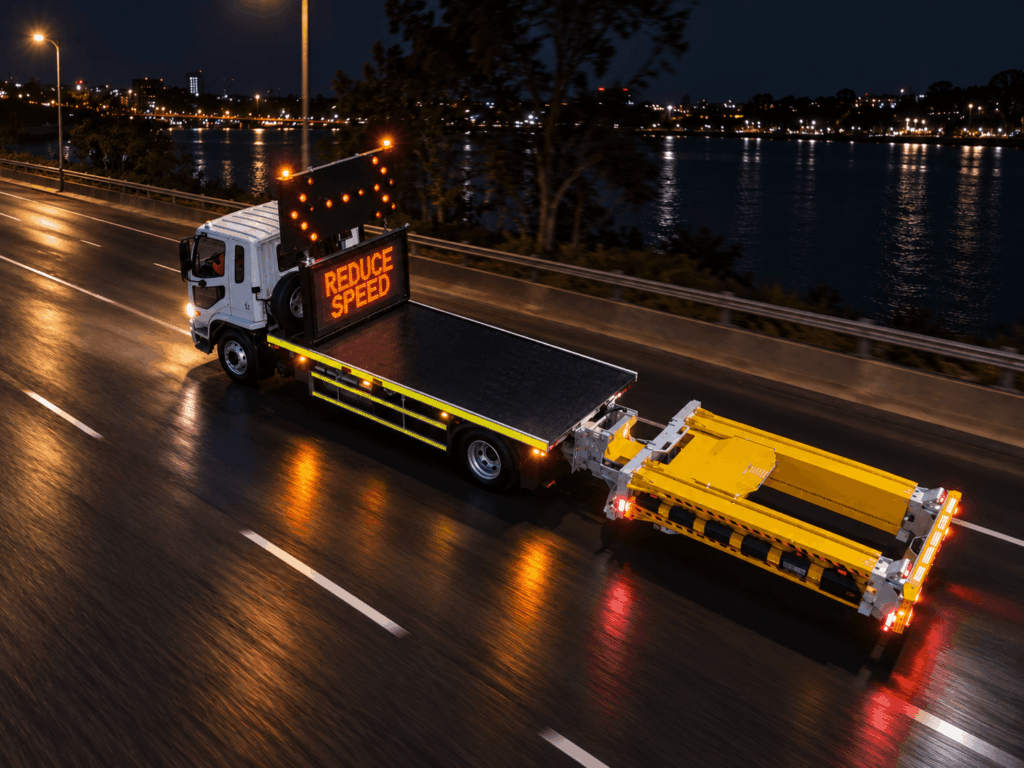
Impact protection can be integrated into an existing maintenance fleet by mounting a Truck Mounted Attenuator (TMA) onto trucks already in service, selecting van-compatible systems for lighter vehicles, and adding tracking and alert technology to existing units. Most modern TMA systems are designed to work with a range of vehicle classes, making retrofit integration practical for fleet managers without requiring a full equipment replacement.
The right approach depends on your vehicle weight class, the type of road work you perform, and the compliance standards that apply in your region. Below, we cover the most relevant questions fleet managers face when adding impact protection to an existing operation.
What types of impact protection vehicles are used in road maintenance?
Road maintenance operations use several types of impact protection vehicles, with the Truck Mounted Attenuator (TMA) being the most widely deployed. A TMA is a crash cushion attached to the rear of a host truck that absorbs the energy of an errant vehicle before it reaches workers in the work zone. Other common types include van-mounted attenuators for lighter vehicles and shadow vehicles fitted with arrow boards or Variable Message Signs.
Each vehicle type serves a specific role depending on the scale of the operation and the road environment:
- Truck Mounted Attenuators (TMAs): Used on medium-to-heavy trucks, these systems offer the highest level of protection and are tested to national crash standards. They are standard equipment on highway maintenance operations.
- Van-mounted attenuators: Designed for closed vans, these systems bring impact protection to lighter vehicles that operate in urban or lower-speed environments. They are available in rear-mounted, top-mounted, and swing-mounted configurations.
- Shadow vehicles with arrow boards or VMS: These direct traffic away from the work zone and are often combined with a TMA or van-mounted attenuator for dual-purpose use.
- Incident management trucks: Larger, multi-function vehicles that combine impact protection with traffic management equipment for use during major road incidents.
The choice between these vehicle types depends on the speed environment, the weight of the host vehicle, and the level of protection required by local regulations.
What are the MASH compliance requirements for fleet impact protection?
MASH, the Manual for Assessing Safety Hardware, is the current standard in the United States for testing and approving roadside safety devices, including truck mounted attenuators. Under MASH 2016, TMAs must pass a series of full-scale crash tests at defined Test Levels. For most highway work zones, Test Level 3 (TL-3) is required, which involves impacts at 100 km/h (62 mph). Equipment must carry official crash test certifications to be used on federally funded roads.
Key compliance points for fleet managers to understand:
- MASH 2016 replaces NCHRP 350: Equipment approved only under the older NCHRP 350 standard is no longer accepted on many federally funded projects in the US. Verify that any TMA you deploy holds a current FHWA acceptance letter under MASH 2016.
- Test Level determines speed rating: TL-3 covers impacts up to 100 km/h. Lower test levels apply to lower-speed environments, but highway work zones typically require TL-3 as a minimum.
- Vehicle weight class matters: Each TMA is approved for a specific range of host vehicle weights. Deploying a system on a truck outside that weight range voids the certification.
- Regional variations exist: In the UK, the TD49/07 standard applies, and some systems are additionally tested to an optional 110K test for higher-speed roads. European markets have their own national requirements, so always confirm the applicable standard for your operating region.
Compliance is not a one-time check. When you add a TMA to an existing truck, confirm that the combination of the attenuator, the host vehicle, and any accessories such as arrow board brackets still falls within the tested and approved configuration.
Can a TMA be retrofitted onto an existing maintenance truck?
Yes, a truck mounted attenuator can be retrofitted onto an existing maintenance truck, provided the vehicle falls within the approved weight range for the chosen system. Most TMA manufacturers design their systems with retrofit in mind, using standardized mounting brackets that attach to the truck’s rear frame. The key requirement is that the host vehicle meets the minimum and maximum weight specifications defined in the crash test certification.
A practical retrofit involves several steps:
- Verify vehicle weight: Confirm the truck’s gross vehicle weight rating (GVWR) falls within the TMA’s approved weight range. For example, a system may require a host vehicle between 7,228 kg and 12,475 kg.
- Check mounting compatibility: The rear frame of the truck must be able to accept the attenuator’s mounting bracket. Some systems use a multi-truck bracket that accommodates different frame configurations.
- Assess electrical supply: TMAs with hydraulic power packs require a stable electrical supply from the vehicle, typically 12 VDC or 24 VDC. Confirm the truck’s electrical system can support this.
- Review cab control requirements: Most systems operate via a wired in-cab controller. Routing the control cable and mounting the controller inside the cab is part of the installation process.
- Confirm certification remains valid: After installation, verify that the specific truck and TMA combination is covered by the system’s crash test certification and any required FHWA acceptance letter.
One practical advantage of simpler TMA designs is that they reduce installation complexity. Systems that rely only on a hydraulic power pack, without sensors or electronic feedback components, are generally easier to install and maintain on existing vehicles.
How does impact protection equipment affect fleet operations and workflow?
Adding a TMA or van-mounted attenuator to a maintenance vehicle changes how that vehicle is used day to day. The most direct effect is that the vehicle takes on a dedicated protective role during active work zones, functioning as a shadow vehicle positioned between traffic and the work crew. This changes crew assignments, deployment sequences, and the overall workflow on site.
Fleet managers should anticipate the following operational effects:
- Flatbed access: Some TMA designs obstruct the truck’s flatbed in transport position, limiting the vehicle’s dual-use potential. Systems with an upright transport configuration preserve full flatbed access, allowing the truck to carry tools and materials even when the attenuator is mounted.
- Deployment time: A system that deploys in under 20 seconds while the vehicle is moving at operational speed keeps workflow moving. Slow or complex deployment sequences add time to site setup and increase exposure during the transition period.
- Lane width constraints: Compact attenuator designs with a width of around 2,300 mm allow operation in narrow lanes without excessive overhang, which is relevant for urban maintenance and lane-restricted motorway work.
- Maintenance scheduling: Mechanically simpler systems with fewer electronic components require less frequent servicing. This reduces downtime and keeps vehicles available across a wider range of shifts.
- Tracking and alert integration: When attenuators are fitted with GPS tracking modules, fleet managers gain real-time visibility of vehicle positions. Integration with navigation and alert platforms means approaching drivers receive warnings automatically, reducing the risk of secondary incidents.
The overall effect on workflow is manageable when the right system is matched to the vehicle and the operation. The larger shift is organizational: teams need clear protocols for when the shadow vehicle is deployed, how it is positioned, and who is responsible for operating the attenuator controls.
What should fleet managers evaluate when selecting impact protection systems?
Fleet managers should evaluate impact protection systems against four main criteria: compliance certification, vehicle compatibility, operational simplicity, and total cost of ownership. A system that meets all four criteria for your specific fleet and operating environment will deliver reliable protection without creating unnecessary administrative or maintenance burdens.
Use the following framework when comparing options:
| Evaluation criterion | What to check |
|---|---|
| Compliance certification | Does the system hold a valid FHWA acceptance letter under MASH 2016? Is it certified to the applicable standard in your country? |
| Vehicle compatibility | Does your truck or van fall within the approved host vehicle weight range? Is the mounting bracket compatible with your vehicle frame? |
| Operational simplicity | How long does deployment take? Does the system require sensors or electronic components that add failure points? Can operators be trained quickly? |
| Flatbed and door access | Does the system allow full use of the truck’s flatbed or van’s rear doors in transport position? |
| Maintenance requirements | What is the expected service interval? Are replacement parts readily available? How complex is post-impact repair? |
| Tracking and connectivity | Can the system integrate with GPS tracking and safety alert platforms? Does this integration require additional hardware or software? |
| Total cost of ownership | What is the purchase price relative to the system’s durability, maintenance costs, and expected service life? |
Beyond these criteria, consider how the system fits into your broader fleet management workflow. A system that provides real-time location data and integrates with navigation platforms adds operational value beyond the physical protection it provides. Equally, a system that is quick to deploy and simple to operate reduces the training burden on crews and lowers the risk of incorrect use in the field.
How Verdegro Helps You Integrate Impact Protection into Your Fleet
We design our impact protection systems specifically to work with existing maintenance fleets, not just new vehicle purchases. Whether you operate medium-duty trucks or closed vans, we offer solutions that can be retrofitted without requiring a complete fleet overhaul.
Our current TMA range includes:
- Armadillo TMA: Our newest truck mounted attenuator, introduced in 2026 and fully tested and approved under MASH 2016 TL-3. The Armadillo is lighter and more compact than previous generations, operates without sensors or electronic feedback components, and deploys in a single stage in under 20 seconds at 80 km/h. Its upright transport position preserves full flatbed access. The system uses a quick-connect mechanism that allows easy swapping of the attenuator and arrow board by forklift, making it practical for fleets that share equipment across vehicles. Learn more about our crash protection systems.
- VanGuard TMA: The world’s first TMA designed for closed vans, available in rear-mounted, top-mounted, and swing-mounted versions. The VanGuard handles impacts up to 80 km/h and keeps rear door access available on the top- and swing-mounted variants. It is fully customizable to match your fleet’s RAL colour scheme and can be fitted with arrow boards or VMS signs.
- Mobitrack: Our GPS tracking and safety alert module integrates with both new and existing products. It connects automatically with platforms including Google, Waze, Flitsmeister, and Monotch, sending real-time alerts to approaching drivers. The advanced version also allows remote status monitoring of your equipment, arrow direction, cushion position, lights, directly from our Mobilityplanner platform.
If you are evaluating how to bring your fleet into compliance or improve worker protection on active road maintenance projects, we are ready to help you find the right configuration. Contact us to discuss your fleet requirements, and we will recommend the most practical solution for your vehicles and operating environment.
Related Articles
- When is a lighter impact protection vehicle sufficient?
- Who typically buys truck mounted attenuators?
- What happens if a vehicle crashes into a truck mounted attenuator?
- How do truck mounted attenuator models differ in crash performance?
- What is the difference between a truck mounted attenuator and an arrow board?