
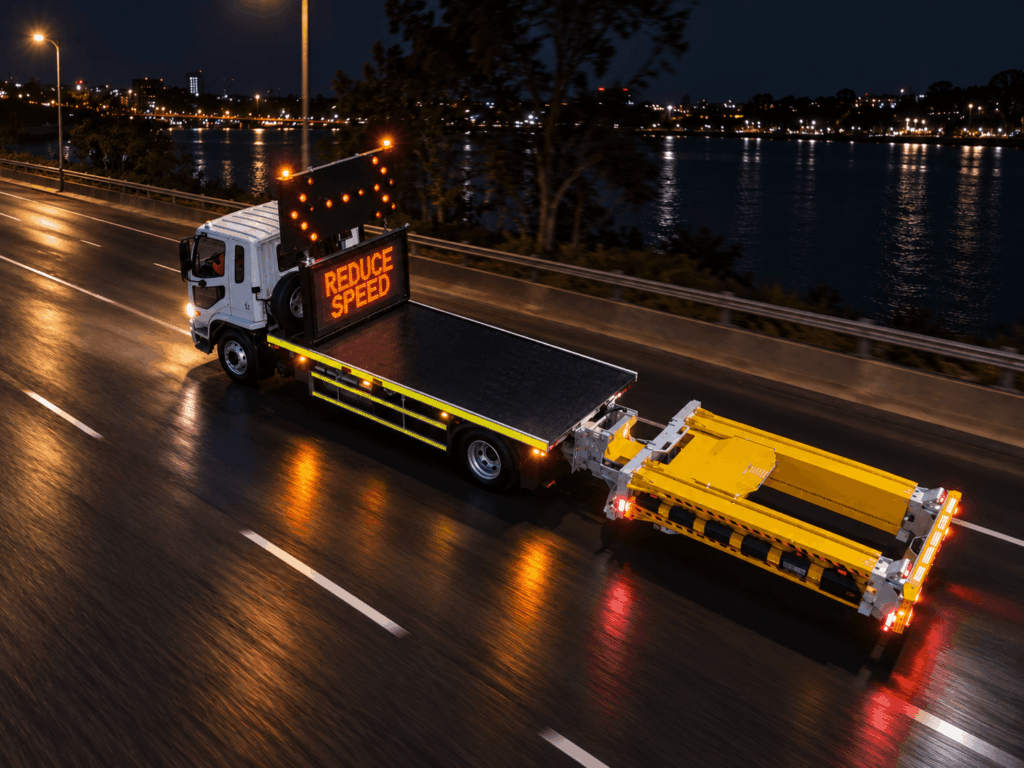
The name VanGuard is a play on words that combines “van” (the vehicle it mounts on) with “guard” (the protection it provides). In short, it means a guard for a van. Verdegro created this name to reflect exactly what the product does: it attaches to a closed van and protects workers and road users from rear-end collisions in active work zones. Below, we unpack the name, the product, and the standards it must meet.
Where does the name VanGuard come from?
The name VanGuard comes directly from what the product is and what it does. “Van” refers to the closed van it mounts on, and “guard” refers to the crash protection it provides. Put the two together and you get VanGuard: a guard for a van. Verdegro chose this name deliberately so that anyone hearing it for the first time immediately understands the product’s purpose.
The naming logic follows the same approach Verdegro uses across its product range. The Armadillo TMA, for example, takes its name from the armadillo, which uses hard scales to deflect danger, just as the crash cushion absorbs and deflects impact energy. With VanGuard, the name is even more literal: the word itself describes the vehicle type and the protective function in a single, memorable term.
It is also worth noting that “vanguard” as a standalone English word means the leading force at the front of something, a group that goes ahead to protect or pioneer. That secondary meaning adds another layer: the VanGuard goes ahead of the work zone, leading the convoy and absorbing risk so that workers behind it are shielded.
What is a VanGuard used for in traffic safety?
The VanGuard is a truck mounted attenuator designed specifically for closed vans. It is used to protect road workers and road users by absorbing the energy of a rear-end collision in a work zone. When a vehicle strikes the back of a shadow vehicle, the crash cushion takes the impact rather than the van, the driver, or the workers ahead.
Truck mounted attenuators like the VanGuard are deployed in situations where a moving or stationary work zone needs a physical buffer between live traffic and the crew. This includes lane closures, road markings, pothole repairs, and any operation where workers are exposed to passing vehicles. The shadow vehicle, the van carrying the VanGuard, trails behind or leads the work convoy, absorbing the risk of errant drivers.
What makes the VanGuard distinctive is that it is the world’s first TMA designed specifically for closed vans. Before its development, truck mounted attenuators were built for larger, heavier support trucks. The VanGuard opened up attenuator protection to a much wider range of vehicles, giving smaller road crews access to certified crash protection without needing a full-sized truck.
The VanGuard is available in three variants to suit different operational needs:
- Rear mounted: The standard version, where the cushion unfolds into a 90-degree operational position from the rear of the van.
- Top mounted: The cushion slides down from the roof to the operational position, keeping the rear doors fully accessible.
- Swing mounted: The cushion rotates sideways via a rotation bracket, also keeping the rear doors accessible, a new design in our crash cushion range.
Across all three variants, the tow hitch remains usable, and the LED display stays visible even when the cushion is folded or in transport position.
How does the VanGuard name reflect what the device does?
The VanGuard name directly mirrors the device’s function. “Van” identifies the host vehicle, a closed van, and “guard” describes the protective role the crash cushion plays. The name tells you the vehicle type and the action in two syllables. That alignment between name and function is intentional: the product does exactly what its name says.
This is not just a branding choice. The name communicates the product’s core value proposition to the people who need it most: road safety managers, work zone supervisors, and fleet operators who need to quickly understand what a piece of equipment does and whether it fits their operation. A name like VanGuard removes ambiguity immediately.
The device lives up to the name in practical terms too. It can withstand impacts at speeds up to 80 km/h (50 mph), it is double-patented (covering the cushion, tow hitch, and top mounting), and it is fully customizable in RAL colour, arrow board configuration, and VMS sign options. The “guard” in VanGuard is not just a label, it is a performance specification backed by engineering and testing.
Is VanGuard a brand name or a generic term for TMAs?
VanGuard is a brand name owned by Verdegro, not a generic term for truck mounted attenuators. It refers specifically to Verdegro’s range of crash cushions designed for closed vans. While the broader product category is called a Truck Mounted Attenuator (TMA), VanGuard is the trademarked product name for this specific design, protected by two patents covering distinct parts of the system.
The distinction matters when specifying equipment for a project. When a procurement document calls for a “truck mounted attenuator,” it is referencing the product category. When it specifies a “VanGuard,” it is referencing Verdegro’s patented van-specific design. The two are not interchangeable in a legal or technical sense.
Generic TMAs are built for larger support trucks and have been on the market for decades. The VanGuard occupies a specific niche within that category: it is engineered for closed vans (based on L3H2 van models), operates on 12V or 24V DC electrical systems, and is controlled via remote control or an optional touch panel. These are design choices specific to the VanGuard, not characteristics of TMAs as a general product class.
What standards must a VanGuard meet to be road-legal?
To be road-legal, a VanGuard must meet the crash testing and certification requirements that apply in the country or region where it is deployed. In the United States, this means compliance with MASH (Manual for Assessing Safety Hardware) standards, specifically MASH 2016, which is the most current standard. In European markets, national road authority requirements and CE marking apply. The VanGuard holds the relevant certifications needed for deployment in its target markets.
Crash testing for a TMA like the VanGuard evaluates how the system performs under controlled impact conditions at defined speeds and vehicle weights. The testing verifies that the attenuator absorbs energy within acceptable limits, that the host vehicle does not become a secondary hazard, and that occupant risk values remain within the standard’s thresholds. Passing these tests is what earns the product its acceptance letters and certifications.
Beyond crash testing, road-legal deployment typically requires:
- Correct vehicle weight class: The host van must fall within the minimum and maximum weight specifications for the TMA model used.
- Visible warning systems: The LED arrow board or VMS sign must be operational and meet visibility requirements for the work zone type.
- Proper deployment: The cushion must be in the correct operational position before the vehicle enters live traffic as a shadow vehicle.
- Country-specific markings: Reflective foil chevrons and other markings must conform to national specifications.
Operators should always verify that the specific VanGuard variant they are using carries the correct certification for their jurisdiction before deploying it in a work zone.
How Verdegro Supports VanGuard Users in the Field
We developed the VanGuard to solve a real gap in the market: road crews operating with closed vans had no certified TMA option built for their vehicle type. The VanGuard fills that gap with a double-patented, fully tested crash cushion that fits the vehicles already in use across road maintenance fleets.
Here is what we provide alongside the VanGuard hardware:
- Three mounting variants (rear, top, and swing) so you can match the system to your operational workflow and van model.
- Optional Mobitrack integration for real-time GPS tracking, location history, and safety alert integration with platforms including Waze, Flitsmeister, and national traffic control systems.
- Full customization in RAL colour, arrow board type, and VMS sign configuration to meet your project and regulatory requirements.
- Remote control operation as standard, with an optional touch panel for in-cab control.
- MobilityPlanner access, our online platform where you can monitor product status, track locations, and manage your fleet in real time.
If you want to find out which VanGuard variant fits your vehicles and work zone requirements, contact our team and we will walk you through the options.
Related Articles
- What equipment makes a roadwork vehicle more versatile?
- Can one impact protection vehicle be used for different types of roadwork?
- Why is Verdegro's impact protection system called VanGuard?
- What is a trailer light truck mounted attenuator and when is it used?
- When is a light truck mounted attenuator sufficient instead of a full truck mounted attenuator?