
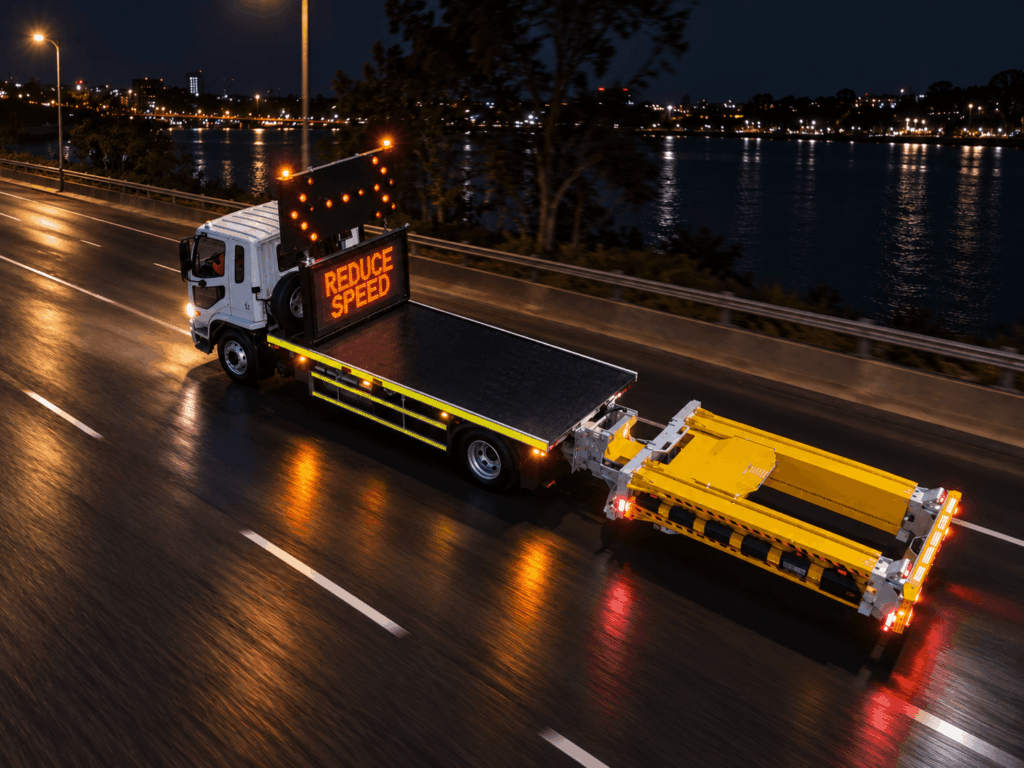
For short-duration road maintenance, a Truck Mounted Attenuator (TMA) is the most practical and widely used form of impact protection. It mounts directly to a shadow vehicle, deploys in seconds, and moves with the work crew as they progress along the road. The right choice depends on the specific operation, applicable safety standards, and the type of vehicle available. Below, we answer the most important questions to help you make an informed decision.
What types of impact protection devices are used in work zones?
Work zone impact protection devices fall into two main categories: fixed systems and mobile systems. Fixed systems such as crash cushions and concrete barriers protect stationary hazards like lane closures or bridge piers. Mobile systems, primarily truck-mounted attenuators, travel with the work crew and absorb rear-end impacts from errant vehicles in moving or short-duration operations.
The most common types of impact protection devices used in work zones include:
- Truck Mounted Attenuators (TMAs): Crash cushions mounted to the rear of a shadow vehicle. They absorb impact energy and redirect errant vehicles away from workers.
- Portable crash cushions: Freestanding, reusable attenuators placed in front of fixed obstacles such as barrier ends or bridge supports.
- Water-filled barriers: Plastic barriers filled with water or sand, used to delineate lanes and provide a degree of impact absorption for slower-speed zones.
- Concrete safety barriers: Rigid, high-mass barriers used in long-term or high-speed work zones where permanent separation is needed.
- Van-mounted attenuators: Similar to TMAs but fitted to closed vans rather than trucks, suited for lighter-duty or urban maintenance work.
For mobile operations, truck-mounted attenuators offer a clear advantage: they travel with the crew, require no repositioning by hand, and provide certified protection throughout the duration of the job. For fixed hazards within a work zone, portable crash cushions or barriers remain the standard approach.
What counts as a short-duration road maintenance operation?
A short-duration road maintenance operation is one that occupies a specific location for less than a single work shift, typically under 12 hours, and often as little as 15 to 60 minutes. Examples include pothole patching, guardrail repair, line marking, vegetation cutting, and inspection work. These operations move frequently and do not justify the setup time of full lane closure infrastructure.
Industry guidance generally classifies work zone durations into the following categories:
- Long-term stationary: More than three days in one location
- Short-term stationary: Daytime only, up to three days
- Short-duration: A few hours, within a single work shift
- Mobile: Continuously moving or making frequent stops of only a few minutes
Short-duration and mobile operations share many of the same characteristics. Workers are exposed to live traffic for brief, repeated intervals. The work zone moves before drivers fully register its presence. This makes rapid deployment and reliable protection especially important. A shadow vehicle equipped with a truck-mounted attenuator is the standard response to this risk profile, because it provides an immediate protective buffer without requiring extensive traffic management infrastructure.
What MASH or safety standards apply to short-duration work zones?
In the United States, impact protection devices used in short-duration work zones must meet the Manual for Assessing Safety Hardware (MASH) 2016 standard, specifically Test Level 3 (TL-3), which covers impacts at speeds up to 100 km/h (62 mph). MASH 2016 replaced the earlier NCHRP Report 350 standard and sets more rigorous requirements for both the device and the host vehicle.
MASH TL-3 testing evaluates how a device performs when struck by a passenger car and a pickup truck at defined angles and speeds. For a TMA to receive FHWA acceptance, it must pass a defined set of crash tests and demonstrate that the attenuator redirects vehicles safely while limiting occupant injury risk within prescribed limits.
In the United Kingdom, the relevant standard is TD49/07, which includes an optional 110 km/h impact test for higher-speed roads. European countries each apply their own national requirements, but MASH 2016 acceptance is increasingly recognized internationally as a benchmark for quality and compliance.
For contractors and agencies specifying equipment, verifying that a TMA holds current FHWA acceptance letters under MASH 2016 is the most reliable way to confirm compliance. Devices tested only to the older NCHRP 350 standard may no longer meet procurement requirements on many public projects.
Is a truck-mounted attenuator suitable for short-duration maintenance?
Yes, a truck-mounted attenuator is the most suitable form of impact protection for short-duration road maintenance. It deploys in under a minute, travels with the work crew between locations, and provides MASH-certified crash protection throughout the operation. No other device matches this combination of speed, mobility, and certified safety performance for moving or frequently relocated work.
The suitability of a TMA for short-duration work comes down to three practical factors:
- Deployment speed: A modern TMA deploys in less than 20 seconds while the vehicle is moving. This means protection is active from the moment the crew begins work, not after a lengthy setup process.
- Mobility: As the crew moves along the road, the shadow vehicle and TMA move with them. There is no need to dismantle and reconstruct a protection zone at each new location.
- Certified performance: A MASH 2016 TL-3 approved TMA has been crash-tested and accepted by transport authorities. This gives contractors and agencies documented evidence of compliance for project records and insurance purposes.
For very low-speed urban work or operations on minor roads, a van-mounted attenuator may be a proportionate alternative. However, for any work on roads with speed limits above 50 km/h, a truck attenuator mounted to a suitably rated shadow vehicle remains the standard and most defensible choice.
How do you choose the right impact protection for a specific maintenance job?
Choosing the right impact protection starts with four key factors: road speed, operation duration, crew mobility, and applicable standards. Match the device to these conditions and you will meet both safety and compliance requirements. A high-speed motorway patching job requires a different solution than a slow-moving urban maintenance crew.
Use the following framework to guide your selection:
- Identify the posted speed limit: Higher speeds require higher test level certification. MASH TL-3 covers up to 100 km/h. For lower-speed urban roads, a TL-2 or van-mounted device may be sufficient.
- Determine how long you will be in one location: Short-duration and mobile operations benefit from a TMA. Stationary operations lasting more than a shift may justify additional fixed barriers or crash cushions.
- Assess crew and vehicle mobility: If your crew moves frequently, a truck-mounted system eliminates repeated setup and takedown. If the work is fixed, a portable crash cushion placed in front of the hazard may be more appropriate.
- Check the applicable standard: Confirm which crash test standard your contract or jurisdiction requires. MASH 2016 TL-3 is the current benchmark in the US; TD49/07 applies in the UK.
- Consider the host vehicle: A TMA must be matched to a vehicle within the approved weight range. Using a vehicle that is too light or too heavy invalidates the crash test certification.
The table below summarizes common maintenance scenarios and the most appropriate protection type:
| Maintenance Scenario | Speed Limit | Duration | Recommended Protection |
|---|---|---|---|
| Motorway pothole patching | Above 100 km/h | Short-duration / mobile | TMA (MASH TL-3) |
| Urban road line marking | 50 km/h or below | Mobile | Van-mounted attenuator or TMA |
| Guardrail repair on A-road | 80-100 km/h | Short-term stationary | TMA plus lane closure signage |
| Bridge inspection | Variable | Short-duration | TMA or portable crash cushion |
| Long-term lane closure | Any | Long-term stationary | Concrete barriers plus crash cushion at taper end |
How We Help You Choose and Deploy the Right Impact Protection
At Verdegro, we design and manufacture truck-mounted attenuators built specifically for the demands of real-world road maintenance. Our product range covers a variety of operational profiles, from heavy-duty truck-based systems to van-mounted solutions for lighter work.
Our newest TMA, the Armadillo, is fully tested and approved to MASH 2016 TL-3, including the UK optional 110K test under TD49/07. It deploys in under 20 seconds while driving at 80 km/h, weighs approximately 950 kg, and operates without sensors or electronic components, using only a hydraulic power pack. This mechanical simplicity means less maintenance, fewer failure points, and reliable performance in demanding environments.
For operations requiring a van-based solution, the VanGuard is the world’s first TMA designed for closed vans. It is available in three configurations (rear mounted, top mounted, and swing mounted), keeping rear door access open and the tow hitch usable across all variants.
Here is what we offer to support your impact protection decisions:
- MASH 2016 TL-3 certified systems with official crash test certifications and CE marking
- FHWA acceptance letters to support procurement and project compliance documentation
- Mobitrack integration for real-time GPS tracking, location history, and safety alert system connectivity
- Optional geofencing with visibility in Waze, Flitsmeister, Apple Maps, and national traffic control systems
- Customizable configurations including arrow boards, VMS signs, and RAL color finishes
If you are selecting impact protection for an upcoming maintenance contract or need to verify compliance for a specific project, contact our team and we will help you identify the right system for your operation.
Related Articles
- How is roadwork impact protection changing for lighter vehicles?
- What is the story behind the Armadillo truck mounted attenuator?
- What happens if a vehicle crashes into a truck mounted attenuator?
- What is the difference between a 70K and 100K truck mounted attenuator?
- What is inside a truck mounted attenuator?