
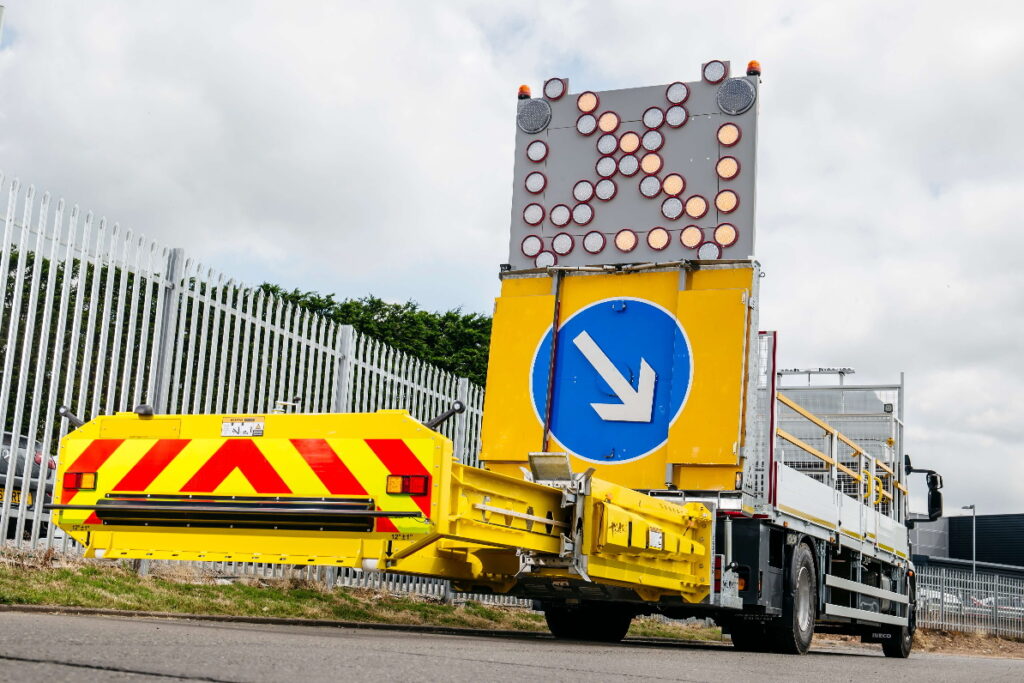
NCHRP-350 is a crash testing standard developed by the National Cooperative Highway Research Program that defines performance criteria for roadside safety hardware, including truck-mounted attenuators. It was the primary accepted standard in the United States for decades before being succeeded by MASH (Manual for Assessing Safety Hardware). Contractors and equipment buyers working across different project types still encounter both standards, so understanding what NCHRP-350 requires and where it still applies directly affects your purchasing and compliance decisions. The sections below answer the most common questions about NCHRP-350 and how it relates to TMA selection today.
How does NCHRP-350 differ from MASH for crash testing?
NCHRP-350 and MASH both set performance criteria for roadside safety devices, but MASH uses heavier test vehicles, stricter impact conditions, and updated evaluation metrics that reflect modern vehicle fleet weights and crash dynamics. MASH replaced NCHRP-350 as the preferred standard in the United States, and the Federal Highway Administration (FHWA) now requires MASH compliance for new devices on federally funded projects.
The most significant difference lies in the test vehicles themselves. NCHRP-350 used a 2,000 kg (4,400 lb) pickup truck for its highest test level, while MASH increased that to a 2,270 kg (5,000 lb) pickup. This change reflects the shift in average vehicle weights across the US fleet and produces more demanding impact scenarios for attenuator systems to absorb.
MASH also introduced updated occupant risk criteria and tightened the evaluation of vehicle trajectory after impact. The result is a standard that demands more from safety hardware and gives engineers higher confidence that a certified device will perform predictably in real-world crash events.
What crash tests does NCHRP-350 require for truck-mounted attenuators?
Under NCHRP-350, truck-mounted attenuators must pass a series of impact tests at Test Level 3 (TL-3), which includes a head-on impact from an 820 kg (1,800 lb) small car and a 2,000 kg (4,400 lb) pickup truck at speeds up to 100 km/h (62 mph). These tests evaluate how well the attenuator absorbs crash energy, limits occupant deceleration forces, and controls the redirected vehicle path after impact.
The testing protocol assesses three core outcomes: whether the device contains and redirects the impacting vehicle safely, whether the host truck remains stable and does not become a secondary hazard, and whether occupant risk values (measured as the Occupant Impact Velocity and Ridedown Acceleration) fall within acceptable limits.
Passing TL-3 under NCHRP-350 means the attenuator has demonstrated it can protect both the vehicle occupants and the work zone crew behind the host truck during a high-speed rear-end collision. This was the benchmark for TMA certification for many years and remains the basis for a large portion of equipment currently deployed in the field.
Are NCHRP-350-certified TMAs still accepted on job sites today?
Yes, NCHRP-350-certified truck-mounted attenuators are still accepted on many job sites, but acceptance depends on the project type, funding source, and state or local agency requirements. On federally funded projects, the FHWA now requires MASH-compliant devices for new purchases. However, NCHRP-350 equipment already in service was generally grandfathered and can continue to be used.
State DOTs vary in how strictly they enforce the transition. Some states have set hard deadlines for phasing out NCHRP-350 equipment on their projects, while others still accept it for non-federal or locally funded work. Before deploying any TMA, you should confirm the specific requirements of the contracting agency and the funding source for that project.
In practice, many contractors continue to operate NCHRP-350-certified TMAs without issue on maintenance and smaller municipal projects. The important thing is to verify acceptance with the relevant authority before mobilizing equipment, rather than assuming either standard is universally accepted or rejected.
What is the difference between an FHWA acceptance letter and NCHRP-350 certification?
An FHWA acceptance letter is an official document from the Federal Highway Administration confirming that a device meets the requirements of a specific crash test standard and is acceptable for use on the National Highway System. NCHRP-350 certification refers to the test standard against which the device was evaluated, not the federal approval itself.
A manufacturer can have a product tested to NCHRP-350 TL-3, but the FHWA acceptance letter is what formally authorizes that product for use on federally funded roads. The letter specifies which standard the device was tested under, the test level achieved, and any conditions or limitations on use.
As MASH has become the current standard, new FHWA acceptance letters are issued under MASH 2016. Devices that hold older letters under NCHRP-350 retain those approvals for grandfathered use, but they do not automatically qualify for projects that require current MASH compliance. When you evaluate a TMA for procurement, always request the current FHWA acceptance letter and confirm which standard it references.
When should contractors choose a MASH-compliant TMA over an NCHRP-350 model?
Contractors should choose a MASH-compliant truck-mounted attenuator whenever the project involves federal funding, when the state DOT specifies MASH compliance, or when the equipment will be used long term and needs to remain deployable across a wide range of future projects. Choosing MASH-certified equipment now reduces the risk of compliance issues as agencies continue phasing out NCHRP-350 acceptance.
For contractors bidding on highway construction, major infrastructure projects, or any work on the National Highway System, MASH compliance is effectively required. Deploying an NCHRP-350 TMA on a project that specifies MASH can result in equipment rejection, project delays, and contract penalties.
For smaller municipal or locally funded projects where the agency still accepts NCHRP-350 equipment, an older certified TMA may remain a practical and cost-effective option in the short term. But if you are making a new purchase or expanding your fleet, investing in a MASH-compliant model gives you broader deployment flexibility and a longer service life before the equipment becomes restricted.
How Verdegro Helps with Truck-Mounted Attenuator Compliance
We manufacture a range of truck-mounted attenuator systems tested and approved to both NCHRP-350 TL-3 and MASH 2016, giving you options that match your project requirements and compliance obligations. Our TMA lineup includes:
- TMA-US 100K and TTMA-US 100K for standard and tandem truck applications
- LTMA-US 70K for lighter host vehicle configurations
- BLADE TMA for compact, high-performance crash protection
All models carry FHWA acceptance letters under the applicable standard, so you can confirm compliance before deployment. We also offer optional accessories including LED arrow boards, full-color VMS displays, and hydraulic LED-lift masts, allowing you to configure a complete work zone protection system from a single supplier.
If you are unsure which standard applies to your project or which TMA model fits your host vehicle and deployment context, we can help you work through those requirements. Contact us to discuss your specific situation and find the right certified solution for your fleet.
Related Articles
- What is a trailer light truck mounted attenuator and when is it used?
- When is a light truck mounted attenuator sufficient instead of a full truck mounted attenuator?
- What is the difference between MASH and CEN/TS 16786 for truck mounted attenuators?
- What should you look for when getting a truck mounted attenuator quote?
- What is the MASH standard for truck mounted attenuators?