
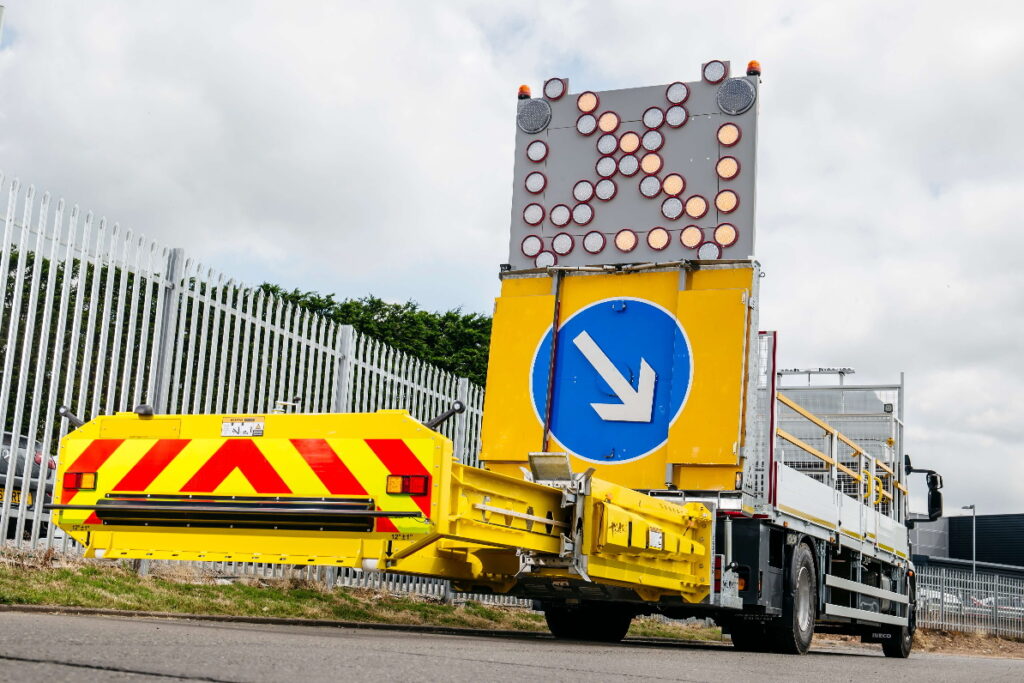
A truck-mounted attenuator (TMA) and a crash cushion are both impact-absorbing safety devices, but they serve different purposes. A TMA mounts to the rear of a moving work truck to protect road workers in active work zones, while a crash cushion is a fixed or portable barrier placed in front of rigid hazards like concrete dividers or bridge piers. The right choice depends on whether your hazard is mobile or stationary.
Both devices absorb kinetic energy during a vehicle collision, but their deployment, design, and regulatory requirements differ significantly. The sections below break down how each works, where each belongs, and when you might need both.
How does each device absorb a vehicle impact?
Both truck-mounted attenuators and crash cushions absorb impact energy through controlled deformation, but the mechanism and scale differ. A TMA uses a collapsible cartridge or honeycomb structure at the rear of a truck that crushes progressively on impact, slowing the errant vehicle over a distance and reducing the force transferred to occupants. A crash cushion achieves the same result through a series of compressible modules or sand-filled barrels arranged in front of a fixed hazard.
The key difference in the absorption process is what happens after impact. A TMA is designed to be replaced or reset after a collision, allowing the host truck to return to service. Crash cushions, depending on their type, may be repairable, resettable, or single-use. Redirective crash cushions also guide an errant vehicle back toward traffic rather than simply stopping it, which matters in narrow work zones where lateral space is limited.
Both device types are tested against standardized crash scenarios at defined speeds and angles, so the energy absorption performance is not guesswork. It is a verified, documented result from controlled crash testing.
What are truck-mounted attenuators designed to protect against?
Truck-mounted attenuators are designed to protect road workers and equipment from rear-end vehicle impacts in active work zones. The TMA acts as a sacrificial buffer between fast-moving traffic and the crew working ahead of the host vehicle. When a distracted or impaired driver strikes the rear of the work truck, the attenuator absorbs and dissipates the collision energy before it reaches the cab or the workers on foot.
TMAs are built for mobile and slow-moving operations such as lane closures, line painting, pothole patching, and highway maintenance. Because the host truck moves with the work crew, the TMA provides continuous protection that a fixed barrier cannot offer. The device also shields the truck itself from severe structural damage, which reduces downtime and repair costs after an incident.
It is worth noting that TMAs are not designed to redirect vehicles laterally. Their purpose is to absorb energy along a linear path. This is why they are paired with arrow boards and traffic control setups that guide drivers away from the work zone before a collision becomes likely.
Where are crash cushions used instead of a TMA?
Crash cushions are used in front of fixed roadside hazards where a TMA cannot be deployed. Common locations include the nose of concrete median barriers, bridge piers, gore areas at highway exits, toll booth islands, and the ends of guardrails. In these situations, there is no moving truck involved. The hazard is stationary, and the crash cushion provides a permanent or semi-permanent protective buffer.
Portable crash cushions are also placed at the upstream end of temporary concrete barriers in work zones where the barrier itself presents a blunt, rigid face to oncoming traffic. In this context, the crash cushion and a TMA may both be present in the same work zone, each protecting against a different type of impact scenario.
A crash cushion is the right choice when:
- The hazard is fixed and cannot be removed from the roadside
- The work zone setup requires protection at a specific point rather than along a moving front
- Lateral redirection of an errant vehicle is needed to prevent secondary collisions
- Long-term installation is required, such as at a permanent highway feature
Can a TMA and a crash cushion be used together?
Yes, a TMA and a crash cushion can and often do work together in the same work zone. They protect against different collision scenarios, so using both simultaneously is a practical and common approach on larger highway projects. The TMA protects the moving shadow vehicle and the crew working ahead of it, while crash cushions protect the fixed ends of temporary concrete barriers or other rigid structures within the same closure.
A typical highway lane closure might include a crash cushion at the upstream nose of the temporary concrete barrier and a TMA on the shadow truck that travels slowly through the active work area. Together, they create a layered protection strategy that addresses both stationary and mobile hazard points within the same zone.
When planning a work zone, think of the two devices as complementary rather than interchangeable. Identifying every fixed hazard and every moving operation separately helps you determine where each device is needed.
Which device is required by traffic safety regulations?
Requirements for truck-mounted attenuators and crash cushions depend on the jurisdiction, the type of road, and the nature of the work. In the United States, the Manual on Uniform Traffic Control Devices (MUTCD) and state-level standards specify when shadow vehicles with TMAs are required, typically on high-speed highways during mobile operations. Crash cushions are required by AASHTO and state DOT standards wherever fixed-object hazards exist within the clear zone of a roadway.
Both device types must meet crash-testing standards to be approved for use on public roads. In the US, the current standard is MASH 2016 (Manual for Assessing Safety Hardware), which replaced the older NCHRP-350 standard. Devices tested and accepted under MASH 2016 carry FHWA acceptance letters, which are required for federally funded projects. Some jurisdictions still accept NCHRP-350-tested equipment on non-federal projects, but MASH 2016 compliance is increasingly the baseline expectation.
Outside the US, equivalent standards apply. European and international projects reference EN 1317 and related national standards. Always verify which standard applies to your specific project and funding source before selecting equipment.
How Verdegro Helps with Truck-Mounted Attenuators and Crash Protection
We manufacture a complete range of truck-mounted attenuator systems tested and approved to both NCHRP-350 TL-3 and MASH 2016, the most current standard in force. Our TMA lineup includes the following models, each suited to different vehicle classes and operational requirements:
- TMA-US 100K and TTMA-US 100K for standard and tandem truck configurations
- LTMA-US 70K for lighter host vehicles
- BLADE TMA for operations where a lower-profile, aerodynamic design is needed
All our systems can be configured with optional accessories including LED arrow boards, full-color VMS displays, and hydraulic LED-lift masts, so you can build a complete shadow vehicle setup from a single supplier. We hold multiple FHWA acceptance letters under MASH 2016, which means our equipment qualifies for federally funded projects in the US without additional documentation hurdles.
Whether you are equipping a single maintenance truck or outfitting a fleet for a major highway contract, we can help you select the right system for your vehicle class, speed environment, and compliance requirements. Contact us to discuss your project and get a recommendation tailored to your specific work zone setup.
Related Articles
- How is roadwork impact protection changing for lighter vehicles?
- How do you choose impact protection for mobile roadworks?
- Can a trailer truck mounted attenuator be towed by any vehicle?
- What is CEN/TS 16786 for truck mounted attenuators?
- Can a damaged truck mounted attenuator be repaired or does it need replacing?