
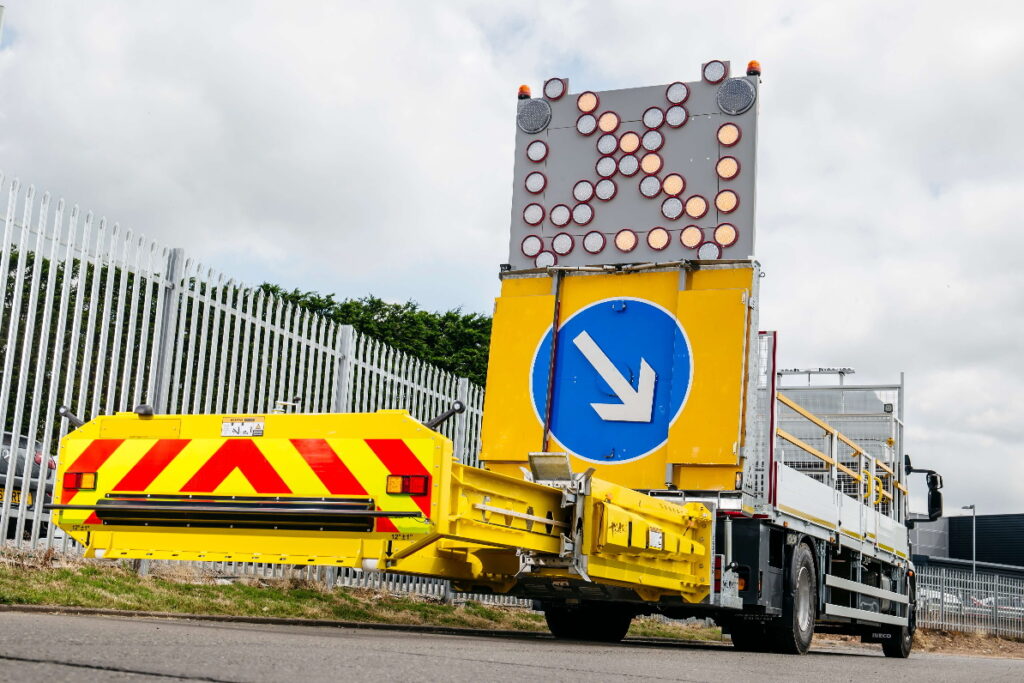
No, a trailer truck mounted attenuator cannot be towed by just any vehicle. The tow vehicle must meet specific weight, hitch, and braking requirements to ensure the TMA functions correctly in a crash scenario and complies with certification standards. The vehicle you choose directly affects both safety performance and legal compliance on the road.
Choosing the wrong tow vehicle is not simply a logistical oversight – it can invalidate the TMA’s crash test certification and expose workers and road users to serious risk. Below, we answer the most important questions about towing compatibility so you can make informed decisions for your work zone operations.
What towing capacity does a trailer TMA require?
A trailer TMA requires a tow vehicle with a Gross Vehicle Weight Rating (GVWR) and towing capacity that meet or exceed the total weight of the loaded trailer system. Most trailer TMAs weigh between 2,000 and 5,000 kg depending on configuration, so the tow vehicle must be rated to handle that load safely, including the tongue weight transferred to the hitch.
Towing capacity is not just about whether the vehicle can physically pull the trailer – it determines whether the combination can stop safely and maintain stability at highway speeds. A vehicle operating near or above its towing limit will have reduced braking performance and increased risk of trailer sway, both of which are dangerous in active work zone environments.
You should always check the tow vehicle’s published towing rating in its manufacturer specifications, not just the engine size or vehicle class. The tongue weight rating is equally important: this is the downward force the trailer places on the hitch, and exceeding it can cause handling problems even when the total towing capacity appears sufficient.
What vehicle types are approved to tow a trailer TMA?
Approved tow vehicles for trailer TMAs are typically heavy-duty pickup trucks, light commercial vehicles, or dedicated work trucks with sufficient GVWR and a factory-rated tow package. The specific vehicle type depends on the TMA model and the crash test certification requirements associated with it.
In practice, the most commonly used tow vehicles include:
- Heavy-duty pickup trucks (such as 3/4-ton or 1-ton class vehicles) with tow packages
- Light commercial trucks rated for the trailer’s gross weight
- Dedicated shadow vehicles configured specifically for work zone protection duties
- Flatbed or utility trucks with appropriate hitch receivers and braking systems
Passenger cars, standard SUVs, and light vans are generally not suitable. Their towing ratings are too low, their hitch systems are not designed for the tongue weights involved, and they typically lack the braking capacity required for safe operation. Using an undersized vehicle also creates a mismatch between the TMA’s certified performance and real-world deployment conditions.
Does the tow vehicle affect the TMA’s crash test certification?
Yes, the tow vehicle directly affects whether the trailer TMA’s crash test certification remains valid in the field. Crash test certifications such as NCHRP-350 TL-3 and MASH 2016 are issued based on tests conducted with a specific vehicle configuration, including defined weight ranges for the tow vehicle. Deploying the TMA with a vehicle outside those parameters can invalidate the certification.
During crash testing, the tow vehicle’s mass plays an active role in absorbing and redirecting impact energy. If the vehicle is too light, it will not behave as it did during the test – it may move further forward on impact, reducing the cushioning effect and increasing the risk of injury to workers ahead of the shadow vehicle.
When you review a TMA’s acceptance documentation, look for the minimum and maximum tow vehicle weight specifications listed in the test report. These are not guidelines – they are part of the certified system. Staying within those ranges is what keeps your deployment compliant with standards like MASH 2016, which is the current benchmark for crash protection systems in modern work zones.
What hitch and connection standards apply to trailer TMAs?
Trailer TMAs require a rated hitch receiver and coupling system that matches the trailer’s tongue weight and gross weight class. In most cases, this means a Class III, Class IV, or Class V hitch receiver mounted to the tow vehicle’s frame, combined with a ball mount or pintle hook rated for the specific load.
Beyond the hitch receiver itself, the connection system typically must include:
- Safety chains or cables rated to the trailer’s gross weight, crossed under the tongue
- Trailer brakes – electric or hydraulic – on trailers above a specified weight threshold (requirements vary by country and state)
- Breakaway brake systems that automatically apply the trailer’s brakes if it becomes disconnected from the tow vehicle
- Electrical connections for trailer lighting, including brake lights, indicators, and any integrated warning systems
The coupling hardware must be inspected before each deployment. Worn ball mounts, corroded safety chains, or faulty electrical connections are not minor maintenance issues – they are failure points that can lead to trailer separation at highway speed. Always follow the TMA manufacturer’s connection checklist as part of your pre-deployment procedure.
Are there legal requirements for the driver towing a trailer TMA?
Yes, in most jurisdictions drivers towing a trailer TMA must hold a valid driving licence that covers the combined vehicle weight of the tow vehicle and trailer. In many countries, a standard car licence (Category B) only permits towing up to a certain combined weight, and heavier configurations require an additional trailer endorsement or a higher licence category.
In the United States, requirements vary by state, but drivers operating a vehicle and trailer combination above 26,000 lbs GVWR typically require a Commercial Driver’s License (CDL). In Europe, a Category B+E licence is required when the trailer exceeds 750 kg and the combined weight surpasses 3,500 kg. You should verify the specific rules in each jurisdiction where you operate.
Beyond the licence itself, drivers may also need to comply with:
- Work zone traffic control training requirements specific to the region or contract
- Hours of service regulations if the vehicle is classified as a commercial vehicle
- Vehicle inspection obligations before entering public roads with a loaded trailer
Ignoring these requirements creates legal liability for both the driver and the operating organization. Before deploying any trailer TMA, confirm that your drivers hold the correct credentials for the combined vehicle configuration in the country and region where the work is taking place.
How Verdegro Supports Your Trailer TMA Deployment
We design and manufacture trailer truck mounted attenuators that are tested and certified to current international standards, including MASH 2016 and NCHRP-350 TL-3. Our systems are built with defined tow vehicle requirements so that you always know exactly what vehicle class and hitch configuration is needed to maintain certification compliance.
When you work with us, you get more than a certified product. We provide practical deployment support that helps you get the system right from the start:
- Detailed tow vehicle specifications for each TMA model, including minimum GVWR and weight range requirements
- Hitch and connection guidance aligned with the crash test documentation
- Product options including the TMA-US 100K, TTMA-US 100K, LTMA-US 70K, and BLADE TMA, each with clear compatibility requirements
- Optional accessories such as LED arrow boards and hydraulic LED-lift masts that integrate with the tow vehicle’s electrical system
If you are unsure which TMA system fits your vehicle fleet or operational requirements, contact our team and we will help you find the right configuration for your work zone setup.
Related Articles
- When does a mobile work zone need a crash protection vehicle?
- What is the safe following distance behind a truck mounted attenuator?
- What is a wings add-on used for on a truck mounted attenuator?
- How is a truck mounted attenuator tested before it's approved?
- What does the weight class of a truck mounted attenuator mean?